APC by Schneider Electric GVSUPS100KB5HS Galaxy VS 100kW Three-Phase Online UPS
Overview
The APC by Schneider Electric GVSUPS100KB5HS is a 100kW (100 kVA) three-phase, double-conversion online UPS built for critical commercial and industrial power protection — data centers, large-scale security infrastructure, industrial control rooms, and enterprise server environments where a momentary power sag cannot be tolerated. Double-conversion online topology means the load runs continuously on conditioned inverter output; incoming utility power is never directly connected to the load, so surges, sags, spikes, and frequency deviations are isolated completely rather than simply clamped. This is the topology you reach for when generator switchover transients, building-wide voltage swings, or sensitive edge-computing loads are in the equation.
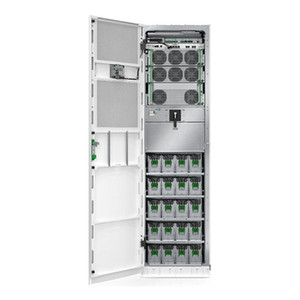
Three internal 9Ah Smart Modular Battery Strings ship standard and are expandable, giving facilities teams a path to extend runtime without replacing the UPS chassis — a meaningful operational advantage in deployments where downtime windows are scarce. If you are evaluating three-phase UPS systems for a critical infrastructure refresh, the GVSUPS100KB5HS sits at the intersection of scalable runtime and high-efficiency power conversion.
Key Features
- Double-Conversion Online Topology: The load never touches raw utility power — the inverter drives output continuously. This eliminates the transfer-time gap found in line-interactive designs and makes the unit appropriate for loads with zero tolerance for micro-interruptions, including high-density server rows and managed network infrastructure.
- 100kW / 100kVA at Unity Power Factor: Output power factor of 1.0 means the 100kW and 100kVA ratings are identical — no derating penalty when driving modern server PSUs or switching-mode loads. Older UPS units rated at 0.8 pF would deliver only 80kW from a 100kVA chassis; this unit does not impose that constraint.
- 0.99 Input Power Factor: Drawing power at 0.99 input PF means the upstream electrical infrastructure sees near-unity demand. Generator sets and utility feeds sized for this load see less reactive overhead, which can reduce upstream infrastructure costs or free capacity for additional loads on shared feeders.
- Wide Input Voltage Window (340–460V): Accepts input across a 120V swing — 340V to 460V — before switching to battery. In facilities with marginal utility quality or long distribution runs, this breadth reduces unnecessary battery cycling and extends battery service life. Paired with a 40–70Hz input frequency acceptance range, the unit handles non-standard or generator-sourced power without complaint.
- Pure Sine Wave Output: Regulated sine wave output with under 3% total harmonic distortion (THD) protects sensitive loads — motor drives, medical equipment controllers, and high-density computing — from waveform distortion that can cause overheating or logic faults in switched-mode power supplies.
- 2.5:1 Crest Factor Handling: A crest factor tolerance of 2.5:1 accommodates the peak-current demands of non-linear loads (server PSUs, VFDs, UPS rectifiers downstream) without output voltage collapse. Many lower-tier UPS designs clip at 1.5:1, causing output distortion under realistic IT loads.
- Three-Phase In / Three-Phase Out: Native three-phase input and output at up to 180A maximum current suits panel-fed distribution in commercial buildings and data halls. No phase-balancing transformers required for standard three-phase PDU integration.
- Output Voltage Range 380–415V: Output regulation holds within the 380–415V window regardless of input conditions, covering standard European and international three-phase distribution standards. Useful for mixed-vendor server environments with differing PSU input tolerances.
- Expandable Smart Modular Battery Strings: The three included 9Ah strings are a starting point, not a ceiling. Modular architecture means runtime can be extended by adding strings — without hot-aisle shutdowns or UPS replacement. For NVR-anchored surveillance infrastructure or edge data centers where runtime requirements evolve with load, this avoids forced forklift upgrades.
- 12,377 BTU/h Heat Dissipation: Plan for roughly 12,400 BTU/h of cooling load in the room or enclosure housing this unit. At 100kW of throughput this is a realistic efficiency figure — verify your CRAC or precision cooling capacity covers this before commissioning.
Integration and Compatibility
The GVSUPS100KB5HS is designed for integration into three-phase 400V distribution environments standard across European and international commercial facilities, as well as purpose-built data center power chains. The unit's wide input voltage window (340–460V) and broad frequency acceptance (40–70Hz input, 50/60Hz output) make it compatible with both utility-fed and generator-backed distribution panels without requiring external voltage regulation. For facilities deploying the Galaxy VS alongside APC power management infrastructure, the Smart Modular Battery architecture supports centralized battery management via compatible APC software platforms.
The 180A maximum input current rating requires appropriate upstream breaker sizing — consult the installation documentation and local electrical code for minimum breaker and conductor specifications at this current level. Three-phase balanced loading is assumed; significantly unbalanced phase loading should be evaluated against the unit's derating curves in the APC engineering documentation.
Frequently Asked Questions
Q: What is the UPS topology of the GVSUPS100KB5HS?
A: The GVSUPS100KB5HS uses double-conversion (online) topology. The load runs continuously on conditioned inverter output — there is no transfer time to battery during a utility outage or disturbance, making it suitable for zero-tolerance critical loads.
Q: What is the output power factor, and why does it matter?
A: The output power factor is 1.0, meaning the 100kVA and 100kW ratings are equivalent with no derating. This matters because older UPS designs at 0.8 power factor deliver only 80kW from a 100kVA chassis — this unit delivers the full 100kW to modern switching-mode loads.
Q: Can the battery runtime be extended after initial installation?
A: Yes. The unit ships with three internal 9Ah Smart Modular Battery Strings and is designed to accept additional strings, allowing runtime extension without replacing the UPS chassis or taking the load offline for a forklift upgrade.
Q: What input voltage range does the GVSUPS100KB5HS accept?
A: The unit accepts input from 340V to 460V (three-phase) with an input frequency range of 40–70Hz. This wide window accommodates generator-sourced power and facilities with marginal utility voltage regulation without unnecessary battery cycling.
Q: What is the output voltage THD specification?
A: Output voltage total harmonic distortion (THD) is specified at under 3%, which protects sensitive downstream loads — including server PSUs, motor drives, and industrial controllers — from waveform distortion that can cause overheating or logic errors.
Q: How much heat does the GVSUPS100KB5HS generate, and does it affect room cooling planning?
A: The unit dissipates up to 12,377 BTU/h at full load. This must be accounted for in the facility's cooling capacity planning — confirm your CRAC or precision air handling can absorb this load before commissioning the unit in an enclosed equipment room.
The GVSUPS100KB5HS is one of the few three-phase UPS units at this power class that ships with a unity output power factor (1.0) — which sounds like a marketing detail until you're sizing a high-density server room and realize a 0.8 pF competitor chassis is handing you 80kW, not 100kW, from the same footprint. That distinction alone often settles the selection conversation for facilities running modern switching-mode PSUs at scale.
Technical Highlights:
- Double-Conversion Online: Continuous inverter-driven output means zero transfer time — the load never sees a utility disturbance. For surveillance NVRs, access control servers, or communication infrastructure that cannot tolerate even a 4ms gap, this topology is non-negotiable.
- 340–460V Input Window: A 120V input swing before battery engagement is unusually broad. In facilities fed by aging utility infrastructure or running generator backup, this window dramatically reduces battery cycling frequency and extends battery string service intervals.
- Under 3% Output THD: At full 100kW load, output waveform distortion stays below 3%. That keeps downstream switching supplies, industrial controllers, and motor drives within their specified input quality envelopes — a spec that matters when your load mix includes VFDs or precision measurement equipment alongside servers.
Deployment Considerations:
- At 180A maximum input current, upstream breaker and conductor sizing is a real engineering task — do not assume standard commercial panel feeds accommodate this without a dedicated circuit study. Coordinate with the facility's electrical engineer before specifying the upstream protective device.
- The 12,377 BTU/h heat dissipation budget at full load is non-trivial. If this unit is going into a sealed equipment room with existing CRAC capacity already committed, verify headroom before commissioning — thermal overload in the UPS room is a common post-installation surprise at this power class.
The GVSUPS100KB5HS is specifically well-suited for large enterprise security operations centers and data hall edge deployments where three-phase 400V distribution is already in place, runtime extensibility is a long-term operational requirement, and load sensitivity rules out line-interactive or standby topologies entirely.