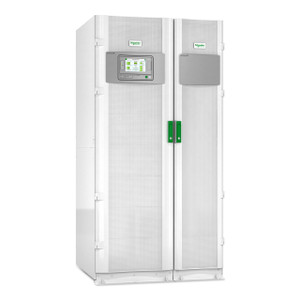
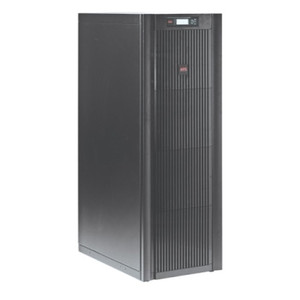
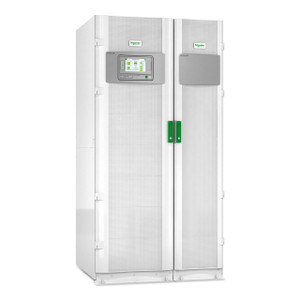
APC by Schneider Electric GVMSB200KHS Galaxy VM 200 kVA Online UPS with Backfeed Protection
The GVMSB200KHS is APC by Schneider Electric's Galaxy VM 200 kVA double-conversion online UPS built for large-scale three-phase power protection in data centers, industrial facilities, and mission-critical infrastructure. At 200 kVA / 180 kW, this unit handles serious load — the kind of capacity you're specifying when a single UPS needs to protect an entire server room, a large network operations center, or a high-density surveillance and access control deployment running continuous 24/7 workloads. The 5x8 startup service inclusion and integrated backfeed protection distinguish this configuration from base Galaxy VM SKUs and make it the right choice when commissioning complexity and downstream electrical safety are part of the project scope.
Key Features
- 200 kVA / 180 kW Double-Conversion Online Topology: True online double-conversion means the load is always running on conditioned inverter output — utility power never touches the connected equipment directly. Any voltage sag, surge, frequency excursion, or complete outage is invisible to the downstream load. At 180,000 W of real output power, this handles server rooms, blade chassis farms, or mixed-infrastructure deployments where a single critical UPS is the right architecture over a distributed fleet of smaller units.
- Wide Input Voltage Window (250–600 V): The 250–600 V input operating range is unusually broad for a 400 V-class UPS. In practice, this means the unit stays on utility power — not battery — through deeper voltage depressions than narrower-input competitors. That directly extends battery service life on sites with historically unstable utility feeds, like industrial campuses or facilities near heavy manufacturing.
- 40–70 Hz Input Frequency Tolerance: Most UPS units demand tight ±2–3 Hz frequency tolerance. The GVMSB200KHS accepts input from 40 to 70 Hz, which matters in regions with generator-fed utility infrastructure or when the UPS will operate downstream of a generator with imprecise governor control during load transitions. You won't lose utility bypass availability just because a generator is hunting frequency at startup.
- Unity Input Power Factor (PF = 1.0): A unity input power factor means the UPS draws current that matches its real power consumption — no reactive power burden on upstream distribution panels or generators. When sizing your feeders and switchgear for this installation, the 200 kVA apparent load equals the 180 kW real load. Simpler calculations, no derating surprises on shared distribution circuits.
- Output THD ≤ 3%: Three-percent total harmonic distortion on the output is clean enough for sensitive computing and communications loads. Servers with switched-mode power supplies, network switches, and storage arrays all operate more reliably and generate less internal heat when fed low-distortion sine wave power. This spec also matters if your load includes audio, broadcast, or precision instrumentation equipment sharing the same UPS bus.
- ECO Mode: ECO mode routes utility power through a static bypass with real-time monitoring, switching to inverter output only when utility quality degrades. The efficiency gain in ECO mode is substantial at this power level — even a 2–3% efficiency improvement on a 180 kW load represents meaningful annual energy cost reduction and lower heat dissipation in the UPS room. Use ECO mode where utility power quality is consistently good; disable it where the load can't tolerate the brief transfer time.
- Emergency Power Off (EPO): Integrated EPO support allows a hardwired emergency shutoff from a remote panel or safety switch — a code requirement in many data center and industrial environments. The EPO circuit lets facilities staff or fire suppression systems cut UPS output instantly without physical access to the unit itself.
- Backfeed Protection: The included backfeed protection prevents voltage from feeding back into the utility feed during a mains outage — a critical safety feature when the facility has generator backup or other parallel power sources. This protects utility workers and prevents equipment damage during switching events. Not all Galaxy VM configurations include this by default; the GVMSB200KHS includes it as part of this SKU.
- 24,570 BTU/h Heat Dissipation: At full load, plan for approximately 24,570 BTU/h of heat output from this unit. That's roughly 7.2 kW of thermal load on your cooling infrastructure. Factor this into your room cooling capacity calculation — it's a meaningful addition to the heat budget of a UPS room or data center floor, and underestimating it leads to thermal management problems after commissioning.
- Output Voltage Range (380–415 V, 3-Phase): The 380–415 V output range covers standard European and international 400 V three-phase distribution. Output frequency is selectable for 50 or 60 Hz, allowing deployment across global sites without hardware changes to the UPS itself.
- 328 A Maximum Output Current: At 200 kVA / 180 kW into a 400 V three-phase load, the 328 A maximum current rating sets your downstream branch circuit and feeder sizing baseline. Coordinate this with your electrical engineer during panel design — breaker sizing, busbar ratings, and cable ampacity all key off this figure.
- 5x8 Startup Service Included: The GVMSB200KHS includes a 5x8 (business hours, five days per week) startup service from APC by Schneider Electric. This is not a trivial inclusion at this power class — a 200 kVA three-phase UPS installation involves significant electrical commissioning work, and having factory-trained startup support reduces the risk of configuration errors during initial energization.
Integration and Compatibility
The GVMSB200KHS operates as a standalone three-phase online UPS and integrates with building management systems and DCIM platforms via standard communication interfaces available in the Galaxy VM platform. The EPO port wires to facility safety systems following NFPA 70E and local electrical code requirements. ECO mode and other operating parameters are configurable through the unit's local display and remote management interfaces. Coordinate input feeder sizing with the 250–600 V input range and unity power factor; output distribution should be engineered for the 380–415 V, 328 A three-phase output specifications. Battery runtime extension requires compatible external battery cabinet additions — confirm compatibility with APC's Galaxy VM battery module lineup for this frame size before specifying extended runtime.
Frequently Asked Questions
Q: What is the real power output (watts) of the GVMSB200KHS, and how does it relate to the 200 kVA rating?
A: The GVMSB200KHS delivers 180,000 W (180 kW) of real output power at its 200 kVA apparent power rating. The power factor is effectively 0.9 (180 kW ÷ 200 kVA). When sizing loads, use the 180 kW real power figure — that's the usable capacity for resistive and switched-mode power supply loads typical in data centers and infrastructure deployments.
Q: Does the GVMSB200KHS include backfeed protection, and why does it matter?
A: Yes. Backfeed protection is included in this specific configuration. It prevents the UPS from feeding voltage back onto a de-energized utility feed during a mains outage — a serious safety hazard for utility workers performing line repairs. It also protects connected equipment during utility switching events. Not every Galaxy VM configuration includes this by default, so confirm it's present in your SKU before substituting.
Q: What input voltage range does the GVMSB200KHS accept, and does it work with generator feeds?
A: The unit accepts input voltages from 250 V to 600 V and input frequencies from 40 to 70 Hz. The wide frequency window is specifically useful with generator-fed supplies, where governor hunting during load transitions can push frequency outside the narrower ±3 Hz tolerance of lesser UPS designs. This keeps the unit on bypass (utility/generator) rather than switching to battery unnecessarily during generator startup.
Q: What is ECO mode on the GVMSB200KHS, and when should I disable it?
A: ECO mode routes power through a high-efficiency static bypass rather than through the full double-conversion path, improving efficiency and reducing heat output. Enable it on sites with consistently clean utility power. Disable it when utility power quality is poor or when the connected load cannot tolerate the brief transfer time to inverter output that occurs when ECO mode detects a power quality event. Mission-critical loads with zero-transfer-time requirements should run in standard double-conversion mode.
Q: What cooling capacity is needed to support the GVMSB200KHS at full load?
A: At full load, the unit dissipates approximately 24,570 BTU/h (roughly 7.2 kW of thermal output). This must be accounted for in the room or enclosure cooling design. Underestimating thermal load is a common commissioning oversight at this power class — confirm with your facilities/HVAC engineer that the UPS room cooling system can absorb this load in addition to all other heat-generating equipment in the space.
Q: What does the 5x8 startup service included with the GVMSB200KHS cover?
A: The 5x8 startup service provides factory-supported commissioning during standard business hours (five days per week). This typically includes on-site verification of installation, initial energization support, and configuration validation by APC by Schneider Electric service personnel. For 24/7 startup coverage or extended service windows, a different service tier would be required. Confirm the exact scope of the included service with APC before scheduling the installation.
The spec that anchors every decision on the GVMSB200KHS is that 250–600 V input operating window combined with the 40–70 Hz frequency tolerance. Most 200 kVA UPS deployments I've seen specified for generator-backed facilities run into bypass availability problems when the generator governor hunts during load acceptance — the UPS detects out-of-range frequency and transfers to battery instead of staying on bypass. That doesn't happen here, and it's one of the reasons this unit is worth the specification conversation for sites where generator reliability is already a concern.
Technical Highlights:
- 180 kW Real Output at Unity Input PF: The unity input power factor (PF = 1.0) means your upstream feeder sizing is straightforward — 200 kVA draws like 200 kW on the input side. No reactive current penalty on shared distribution circuits or generator sets, which simplifies coordination with the electrical engineer on transformer and breaker sizing.
- Output THD ≤ 3%: Three percent THD on a 180 kW three-phase output is tight. For mixed loads that include server hardware, network infrastructure, and precision instrumentation, this keeps downstream power supply ripple within spec and reduces waste heat generated inside connected equipment — meaningful at this scale.
- 24,570 BTU/h Full-Load Heat Output: At 7.2 kW of thermal dissipation, this unit is the equivalent of adding a small server room's worth of heat to your cooling budget. I've seen facilities teams surprised by this number post-installation. Get it in front of the HVAC engineer before the UPS room layout is finalized, not after.
Deployment Considerations:
- The 5x8 startup service is business-hours only — if your commissioning window is a weekend or a maintenance night outside business hours, coordinate early with APC to understand what that means for your startup support coverage. Upgrading service tier before purchase is easier than negotiating it after the equipment is on-site.
- Battery runtime is not specified in the base GVMSB200KHS configuration — runtime depends on external battery cabinet additions. Do not specify this unit for a runtime-sensitive application without separately engineering the battery string capacity and confirming Galaxy VM external battery module compatibility for this frame.
The GVMSB200KHS is the right call for a large data center row, a network operations center, or a campus-level infrastructure consolidation where the project team has already decided on centralized three-phase UPS architecture over distributed rackmount units, and where generator integration, backfeed safety compliance, and factory startup support are non-negotiable scope items.