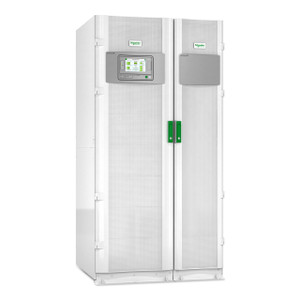
APC by Schneider Electric GVMSB160KHS 160 kVA Three-Phase Online UPS with Backfeed Protection
Overview
The APC by Schneider Electric GVMSB160KHS is a 160 kVA / 144 kW double-conversion online UPS built for large commercial and industrial power protection applications — data centers, manufacturing facilities, critical process environments, and enterprise server rooms where a momentary power disturbance isn't an option. Unlike line-interactive or standby topologies, the Galaxy VM's double-conversion architecture means your load is always running off conditioned inverter output; the raw utility feed never reaches your equipment directly. The result is complete isolation from input voltage swings, frequency excursions, and waveform distortion.
This specific configuration ships with backfeed protection and a 5x8 startup service, making it a ready-to-deploy solution for sites that need protection against dangerous reverse current flow into the utility — a code requirement in many jurisdictions and an absolute safety necessity in any facility where service technicians work on upstream distribution equipment.
Key Features
- 160 kVA / 144 kW Double-Conversion Output: The online double-conversion topology of the GVMSB160KHS means zero transfer time to battery — load current is continuously synthesized by the inverter. For sensitive server, storage, or process-control loads, this eliminates the brief interruption that line-interactive units impose during deep sags or outages.
- Wide Input Voltage Range (250–600 V): An input operating window from 250 V to 600 V means this unit can ride through significant utility voltage instability without switching to battery. That directly extends battery service life in regions or facilities with poor grid quality — fewer deep discharge cycles means longer battery replacement intervals.
- Three-Phase Input and Output: Native 3-phase architecture (3-phase in, 3-phase out) at 380–415 V output matches the power distribution topology of commercial and industrial facilities. This avoids single-phase derating losses and keeps power factor at 1.0 on the input side, reducing reactive power charges and stress on upstream distribution.
- Input Power Factor of 1.0: Unity input power factor means the GVMSB160KHS draws only real (working) power from the utility — no reactive current waste. For facilities billed on apparent power or kVA demand, this directly reduces energy costs and eliminates the need for power factor correction capacitors upstream.
- ECO Mode: When utility power quality is within acceptable bounds, ECO mode bypasses the double-conversion path for high-efficiency operation. For a 144 kW load running 8,760 hours per year, even a 2–3% efficiency improvement translates to thousands of dollars annually in reduced energy spend — worth configuring if your utility feed is stable.
- Output THD ≤ 3% (Sine Wave): Pure sine wave output with total harmonic distortion under 3% protects sensitive electronics from the waveform pollution that can degrade power supplies, trigger nuisance trips, and shorten equipment life. This is the specification that separates a true online UPS from a stepped-approximation design.
- Input Current THD ≤ 3%: Low input current distortion means the GVMSB160KHS won't inject harmonics back into your facility's distribution system — a key consideration in shared electrical infrastructure where variable-frequency drives, lighting ballasts, and other non-linear loads are already present.
- Emergency Power Off (EPO): Integrated EPO capability allows a single hardwired switch to drop the UPS output instantly — a requirement under NFPA 70 (NEC) Article 645 for IT equipment rooms and a standard feature request from facilities management teams and AHJs during permitting.
- Backfeed Protection Included: This configuration includes hardware backfeed protection, preventing inverter current from reaching the upstream distribution panel when utility power is absent. Without backfeed protection, downstream UPS sources pose a real electrocution risk to utility workers; many jurisdictions mandate this protection by code.
- Input Frequency Acceptance 40–70 Hz: The wide frequency tolerance handles both 50 Hz and 60 Hz utility feeds, plus the frequency excursions common near diesel generator sets and in regions with unstable grid frequency. If your backup generator produces 47 Hz at startup, this unit won't transfer to battery prematurely.
- Output Frequency 50/60 Hz Selectable: Configurable output frequency makes the GVMSB160KHS deployable in both North American (60 Hz) and international (50 Hz) infrastructure — useful for multinational enterprises standardizing on a single UPS platform across facilities.
- Maximum Output Current 262 A: At 262 A maximum output, the unit can support significant inrush current during large load startup events — server farm boot sequences, motor starting loads, or UPS output breaker coordination — without nuisance tripping or voltage sag on the output bus.
Integration and Compatibility
The Galaxy VM platform integrates with APC's EcoStruxure IT infrastructure management ecosystem for remote monitoring, predictive maintenance alerting, and capacity planning. The three-phase 400 V output aligns with standard European and international PDU and rack distribution architectures. The EPO interface uses industry-standard dry-contact wiring, compatible with building management systems (BMS) and emergency shutdown panels from any vendor. For facilities running parallel redundancy or distributed UPS topologies, the Galaxy VM family supports N+1 parallel configurations — verify compatibility with your specific paralleling kit and firmware version before commissioning.
Frequently Asked Questions
Q: What is the output power capacity of the GVMSB160KHS?
A: The GVMSB160KHS provides 160 kVA / 144,000 W (144 kW) of three-phase output power at 380–415 V.
Q: Does the GVMSB160KHS support ECO mode for energy savings?
A: Yes. ECO mode is supported, allowing the unit to bypass the double-conversion path during stable utility conditions for higher efficiency. This is configurable and can be disabled if your facility requires continuous double-conversion protection at all times.
Q: What does backfeed protection mean on the GVMSB160KHS?
A: Backfeed protection prevents inverter output current from flowing back into the upstream utility distribution when utility power is lost. This is a safety requirement in many jurisdictions to protect utility workers from energized downstream sources, and it is included as hardware in this GVMSB160KHS configuration.
Q: What is the input voltage range the GVMSB160KHS can accept?
A: The unit accepts input voltages from 250 V to 600 V (three-phase) at 40–70 Hz, providing wide tolerance for utility voltage sags, swells, and frequency variations without switching to battery.
Q: Does the GVMSB160KHS include Emergency Power Off (EPO)?
A: Yes. An integrated EPO function is included, allowing the UPS output to be remotely disconnected via a hardwired dry-contact switch — a common requirement under NEC Article 645 for IT equipment rooms and similar critical facilities.
Q: What startup service is included with the GVMSB160KHS?
A: This configuration includes APC's Start UP 5x8 service, which provides on-site startup assistance during standard business hours (5 days a week, 8 hours a day).
The GVMSB160KHS sits in a sweet spot for mid-to-large enterprise deployments: 144 kW of double-conversion output with a 250–600 V input tolerance wide enough to ride through the worst utility conditions I've seen on the job — including sites with aging transformers and frequent browndowns to 270 V. The built-in backfeed protection isn't a checkbox feature here; for any facility where the AHJ reviews one-line diagrams during permitting, having it integrated in the UPS rather than bolted on externally simplifies the approval process considerably.
Technical Highlights:
- Unity Input Power Factor (1.0): At 160 kVA / 144 kW, a power factor of 1.0 means the apparent and real power draw are equal — no reactive current overhead. Facilities with kVA-based demand billing will see measurable cost reduction versus UPS designs with 0.9 or lower input PF at this scale.
- Output THD ≤ 3%: Sine wave output below 3% THD is tighter than the ≤5% threshold many sensitive process-control and medical-grade loads specify. This matters when the protected loads include active rectifier power supplies, which can amplify upstream waveform distortion into internal DC bus ripple.
- 40–70 Hz Input Frequency Range: Generator compatibility is built in. Most diesel gensets take 10–15 seconds to stabilize frequency after startup; a 40 Hz low-end tolerance means the GVMSB160KHS won't ride battery through that entire stabilization window on every utility event — a real battery-life factor in generator-backed facilities.
Deployment Considerations:
- The 5x8 startup service covers business-hours commissioning. If your facility requires after-hours or weekend startup — common in healthcare and financial data centers where production windows are tight — verify whether an upgraded startup service level is available for this model before ordering.
- ECO mode delivers efficiency gains only when input power quality is consistently within tolerance. Sites with high harmonic injection from variable-frequency drives or frequent voltage events may find ECO mode trips back to double-conversion frequently enough that the efficiency benefit is minimal — audit your utility quality data before committing to ECO-mode operation.
For a 400 V three-phase enterprise data hall or industrial control room in the 100–150 kW load range, the GVMSB160KHS with backfeed protection is a fully code-ready, commissioning-supported solution that covers the power quality, safety, and efficiency requirements in a single SKU.