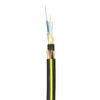
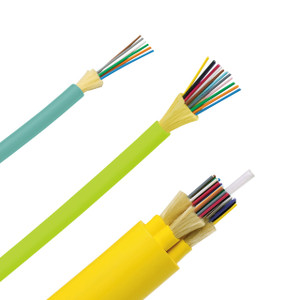
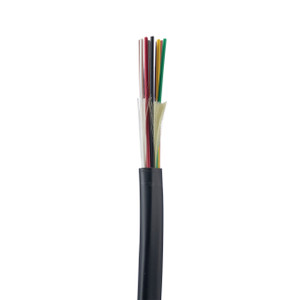
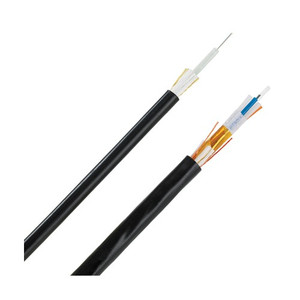
Panduit FSJD948 48-Fiber OS2 Indoor/Outdoor Bulk Fiber Optic Cable
Overview
The Panduit FSJD948 is a 48-fiber OS2 single-mode bulk cable engineered for runs that start indoors and transition to outdoor plant — or vice versa — without a mid-span splice or a separate outdoor-rated pull. Part of Panduit's IndustrialNet™ fiber optic line, the FSJD948 uses a dielectric double-jacketed (DDJ) construction: an inner jacket rated for indoor Riser (OFNR-LS) environments and an outer jacket that handles the outdoor segment, all in a single cable run. That dual-jacket design is the core reason to choose this cable over a single-jacket alternative when your pathway moves through a conduit penetration, into a building, and terminates at a patch panel or splice enclosure.
The 250µm fiber geometry keeps the overall cable diameter compact, which matters in high-density fiber optic cable trays and innerduct where bend radius and fill ratio are constraints. OS2 glass delivers the low-attenuation, long-reach performance that enterprise backbone, campus interconnect, and surveillance backbone runs demand.
Key Features
- 48-Fiber Count: 48 individual OS2 fibers in a single sheath means one pull handles a full core-to-distribution backbone segment. If you're building out a campus surveillance ring or a multi-building IDF interconnect, 48 fibers gives you room to provision active runs, maintain dark spares for future growth, and still have capacity for out-of-band management paths — all without a second cable pull.
- OS2 Single-Mode (9µm Fiber Diameter): OS2 is the right choice when distance is the constraint. Single-mode glass supports multi-kilometer spans at 10G, 40G, and 100G — practical for campus backbones, perimeter surveillance feeds from remote buildings, or inter-facility connections where OM3/OM4 multimode would run out of reach well before the far end.
- Dielectric Double-Jacketed (DDJ) Construction: The DDJ build eliminates the need for a transition splice where indoor and outdoor cable segments would otherwise meet. You pull one cable from the outdoor segment through the building penetration to the termination point. No splice enclosure at the wall, no additional splice loss budget to account for, and no secondary cable pull for the indoor segment — that's real labor savings on a large installation.
- Riser/LSZH Flammability Rating (OFNR-LS): Riser-rated jacket satisfies NEC Article 770 requirements for vertical indoor runs between floors. The LSZH (Low Smoke Zero Halogen) chemistry matters in enclosed spaces — in a fire event, LSZH jacketing doesn't emit the toxic halogen gases that PVC jacketing does. Specify LSZH anywhere occupant safety or equipment-room air quality is a consideration: data centers, transit facilities, healthcare, or any space with limited ventilation.
- All-Dielectric Design: No metallic elements in the cable construction means no bonding or grounding requirements at either end. This is a real-world convenience for mixed AC/DC environments and eliminates a common code-compliance question when running fiber alongside copper power infrastructure.
- Black Cable Color: Black jacket is the standard for outdoor and industrial plant applications — UV-stabilized colorways signal outdoor suitability and simplify identification in mixed-cable trays where indoor-only (typically yellow OS2) and outdoor cables share the same pathway.
- IndustrialNet™ Pedigree: The FSJD948 is part of Panduit's IndustrialNet™ product family, designed for infrastructure environments where cable management, system integrity, and long service life are specified requirements rather than afterthoughts. This matters when the installation is part of a larger Panduit-based fiber optic cabling system with end-to-end documentation and system warranty eligibility.
Integration & Compatibility
The FSJD948 is a bulk cable — it terminates into any standard OS2-compatible connector, splice, or pigtail system. Pair it with Panduit's LC, SC, or MPO/MTP fiber connectors and fiber optic enclosures for a fully documented end-to-end channel. The 9µm/250µm fiber geometry is compatible with standard OS2 field-installable connectors, fusion splice equipment, and pre-terminated pigtail assemblies. OFNR-LS rating qualifies the cable for use in riser pathways per NEC 770; verify local AHJ requirements for mixed indoor/outdoor installations, particularly at building entry points where additional conduit sealing or fire-stop provisions may be required.
For network switch or transceiver connections, match the connector type and polish (typically UPC or APC) to the transceiver specification — APC is standard for GPON and some DWDM applications; UPC is standard for most LAN/SAN and surveillance backbone applications. Confirm polish type before termination since mixing UPC and APC connectors increases return loss significantly.
Frequently Asked Questions
Q: What is the difference between the FSJD948's DDJ construction and a standard single-jacket indoor/outdoor cable?
A: The dielectric double-jacketed (DDJ) design uses two separate jacket layers — an inner jacket meeting indoor Riser/LSZH requirements and an outer jacket for outdoor exposure. This allows the FSJD948 to transition from outdoor plant directly into a building and terminate without a mid-span splice, which a single-jacket cable may require at the building entry point to comply with indoor plenum or riser fire ratings.
Q: Is the FSJD948 suitable for direct burial or outdoor aerial installation?
A: The FSJD948 is rated for indoor/outdoor use. The source evidence describes it as an indoor/outdoor DDJ cable. Direct burial typically requires an armored or gel-filled cable with additional mechanical protection. Verify the specific installation method with the full Panduit product datasheet and your local code authority before specifying for direct burial or aerial without additional conduit or messenger wire support.
Q: What fiber type is the FSJD948, and how does it differ from OM3 or OM4 multimode fiber?
A: The FSJD948 uses OS2 single-mode fiber (9µm core diameter). OS2 single-mode supports much longer distances than OM3 or OM4 multimode — typically several kilometers versus a few hundred meters for multimode at 10G. OS2 is the correct choice for inter-building campus runs, perimeter surveillance backbones, or any link where distance exceeds multimode reach.
Q: How many fibers are included in a single run of the FSJD948?
A: The FSJD948 contains 48 individual OS2 fibers. This high fiber count supports provisioning multiple active links, dedicated dark fiber spares, and out-of-band management paths all within a single cable pull.
Q: What does the LSZH jacket rating mean for my installation?
A: LSZH (Low Smoke Zero Halogen) means the jacket material does not emit toxic halogen gases when exposed to fire. This is a specification requirement in occupied buildings with limited ventilation — including data centers, transit facilities, healthcare environments, and European-standard installations. The FSJD948 is rated Riser/LSZH (OFNR-LS), satisfying both the NEC riser fire rating and LSZH chemistry requirements simultaneously.
Q: Does the FSJD948's all-dielectric construction require grounding at the installation endpoints?
A: No. All-dielectric cable contains no metallic elements, so there are no bonding or grounding requirements at either end of the run. This simplifies installation in environments where fiber runs alongside copper power infrastructure and eliminates a common NEC bonding compliance question.
The FSJD948 is the cable I reach for when a run has to enter a building through a conduit penetration and continue to a termination point without introducing a splice closure at the wall. The Riser/LSZH (OFNR-LS) dual-jacket construction handles both sides of that transition in one pull — and with 48 OS2 fibers, you have capacity to provision today's active links and still leave dark spares for the next three infrastructure refreshes.
Technical Highlights:
- DDJ Dual-Jacket Construction: Eliminates the transition splice at building entry. On a 20-run installation, that's 20 fewer splice enclosures to install, document, and maintain — and 20 fewer splice loss budgets to account for in your optical link budget calculations.
- OS2 Single-Mode, 9µm/250µm: The 250µm fiber geometry keeps the cable OD compact for high-density innerduct fills. OS2 glass means your link budget supports multi-kilometer spans at 10G and above — spec it when multimode would run out of distance before the far-end equipment room.
- LSZH Jacket Chemistry: LSZH is non-negotiable in transit, healthcare, and data center environments where halogen gas emission during a fire event is a life-safety and equipment-protection concern. The FSJD948 delivers this alongside NEC Riser compliance in a single product, rather than requiring a separate plenum- or LSZH-only cable for the indoor segment.
Deployment Considerations:
- Confirm the building entry point fire-stop method with your AHJ before pulling. OFNR-LS satisfies NEC 770 riser requirements, but the conduit penetration itself typically requires intumescent putty or a listed firestop system — that's a separate scope item that the cable rating alone doesn't cover.
- The FSJD948 is all-dielectric, but that doesn't eliminate the need for a grounded innerduct or conduit where lightning protection is required for outdoor aerial or direct-buried adjacent runs. Dielectric = no cable bonding; it does not substitute for surge protection at the equipment endpoints.
This cable is the right specification for campus surveillance backbone pulls entering occupied buildings — particularly in healthcare, transit, or multi-tenant commercial environments where LSZH is required by code or owner specification and the run crosses the building envelope in a single unbroken pull.