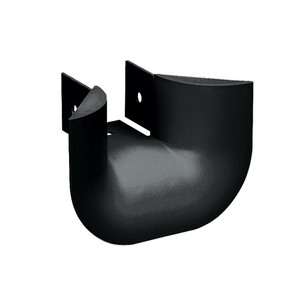
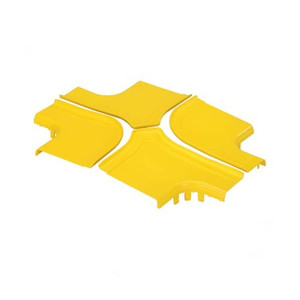
Panduit FTR4X4LYL 3-Sided Vertical Tee Trumpet Splice Router
The Panduit FTR4X4LYL trumpet splice router addresses a critical fiber management challenge in vertical tee transitions: maintaining minimum bend radius at exit points. When fiber cables leave a 4×4 or 6×4 FiberRunner vertical tee, unguided routing risks micro-bending and signal loss. This 3-sided trumpet guide enforces a 2-inch (50.8mm) bend radius—the ANSI/TIA-568 minimum for singlemode and most multimode fibers—ensuring optical performance isn't compromised by installation geometry. Molded from polycarbonate/ABS, the yellow guide provides visual confirmation of proper pathway protection in telecommunications central offices and hyperscale data centers where fiber density and airflow access demand structured, repeatable routing at every transition point.
Key Features
- Enforces 2 in (50.8mm) minimum bend radius at vertical tee exits to prevent signal degradation
- Integrates with FiberRunner 4×4 and 6×4 vertical tee assemblies for seamless pathway transitions
- 3-sided trumpet design guides cables through 90° vertical-to-horizontal turns while allowing open-side cable access
- Polycarbonate/ABS construction balances structural rigidity with impact resistance in equipment room environments
- Yellow color coding provides high-visibility pathway identification in dense multi-system rack installations
- UL 2024 listed for fiber optic cable routing assemblies per NEC Article 770.113
- NEBS Level 3 compliant per Telcordia GR-63-CORE earthquake, thermal, and humidity testing
- RoHS compliant for lead-free telecommunications infrastructure requirements
Fiber optic cable performance degrades rapidly when bend radius falls below manufacturer minimums—typically 1 inch under load for 900µm tight-buffered cable, 2 inches for distribution cable. At vertical tee junctions in overhead FiberRunner pathways, cables naturally want to take the shortest geometric path, which often means a sharp 90° corner exit. The FTR4X4LYL trumpet splice router eliminates this risk by presenting a gradual curved surface that physically prevents tight bends. The 3-sided design leaves the fourth side open for cable insertion and removal without disassembling the tee, a critical serviceability feature when adding circuits to a live pathway. The 5.96-inch overall height and 7.93-inch width are sized to match standard 4×4 FiberRunner channel dimensions, creating a flush transition that doesn't obstruct adjacent pathways or rack access. The polycarbonate/ABS blend provides the necessary rigidity to support cable weight and tension while resisting the brittleness that pure polycarbonate exhibits in low-temperature telecom equipment rooms.
In NEBS-compliant central offices and carrier-grade data centers, every cable routing component must survive earthquake simulation, thermal cycling from -40°C to +65°C, and humidity testing per Telcordia GR-63-CORE. The FTR4X4LYL's Level 3 certification means it has passed these tests, making it suitable for OSP fiber entry points, equipment distribution areas, and main distribution frames where uptime requirements prohibit failures from environmental stress. The yellow color follows TIA-606-C administration standards, where yellow typically denotes auxiliary circuits or DMZ pathways—though integrators often adopt site-specific color schemes for multi-tenant or multi-network installations. The trumpet router ships individually packaged with a carton quantity of 5 for phased buildouts where tee junction counts grow as the facility scales. Because it's an accessory to the base FiberRunner system, inventory planning should match tee junction counts rather than total channel footage—typically one trumpet per vertical tee in bidirectional pathways, two per tee in complex mesh topologies where cables exit in multiple directions.
UL 2024 listing for fiber optic cable routing assemblies is relatively new (published 2020), and not all legacy pathway components carry this mark. Choosing listed components like the FTR4X4LYL simplifies AHJ inspections in jurisdictions enforcing the 2023 or later NEC, which references UL 2024 in Article 770.113 for plenums and risers. The RoHS compliance matters for federal and state contracts that mandate lead-free infrastructure, and the NEBS Level 3 certification is a hard requirement for any telecom CO installation or carrier-neutral colocation facility seeking Tier III+ reliability ratings. For integrators managing bid specs that call out trumpet splice routers at all vertical transitions, this component delivers field-proven performance—Panduit's FiberRunner ecosystem has been the de facto standard in North American telco and hyperscale builds for decades, and maintaining brand consistency across the pathway avoids the fit-tolerance issues that arise when mixing manufacturers at junction points.