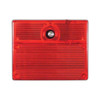
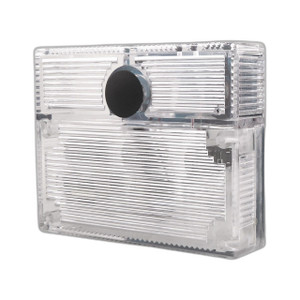
ELK Products ELK-SL1R Red Lens Strobe Light
The ELK Products ELK-SL1R is a wall-mounted strobe light accessory designed for ELK alarm control panel and notification module installations. It delivers synchronized visual alerts—essential for residential and light commercial security deployments where audible sirens alone may be insufficient or where occupant notification must account for hearing-impaired residents. The red lens distinguishes alarm state from other facility status indicators, reducing occupant confusion during security events.
Key Features
- Red Lens Strobe: Colored lens output provides visual differentiation in multi-alert environments. Red is universally recognized as an alarm/danger indicator in building code compliance and occupant awareness contexts.
- Wall-Mount Design: Compact surface-mount form factor integrates into entry points, hallways, and common areas without architectural modification. Suitable for retrofit into existing residential and light commercial installations.
- ELK Control Panel Integration: Direct compatibility with ELK alarm processors and notification modules eliminates the need for third-party relay interfaces. Wiring runs directly from control panel outputs to strobe terminals.
- Synchronous Flashing: Strobe timing aligns with audible alarm output for cohesive occupant notification. Visual-auditory synchronization improves emergency response initiation.
- Low-Current Design: Minimal power draw from control panel auxiliary outputs—suitable for standard 12V notification loops without dedicated power supplies in typical residential panels.
- Residential/Light Commercial Duty: Rated for standard indoor climate conditions. Appropriate for offices, small retail, residential suites, and apartment complexes; not rated for outdoor or harsh industrial environments.
The ELK-SL1R fills a specific gap in alarm system design: occupant notification in environments where siren coverage is acoustically marginal or where visual alerts are legally required (e.g., facilities serving deaf or hard-of-hearing occupants). The red lens also serves a secondary function in multi-purpose buildings—distinguishing security alerts from fire, medical, or facility-status strobes on the same wall.
Installation is straightforward: the strobe mounts to standard electrical boxes or directly to drywall; wiring connects to a dedicated notification zone output on the ELK control panel. No advanced configuration is required—activation is typically achieved through panel programming that ties strobe output to entry/exit delay zones or armed-state transitions. Most ELK installers complete wiring and commissioning in under 30 minutes per unit.
ELK Products notification accessories—including sirens, strobes, and chime modules—are designed to operate on shared 12V loops drawn from the control panel's auxiliary outputs. This architecture reduces installation labor compared to systems requiring isolated power supplies for each accessory. Total power budget across all notification devices must stay within the panel's rated notification output capacity (typically 1.5–2.0A); integrators should verify available amperage before adding strobes to an existing system.
The ELK-SL1R is backed by ELK Products' manufacturer warranty and is fully compatible with all current and legacy ELK alarm control panel models (M1, M1G, RP, M1XEP, and others). It requires no software updates or firmware patches—compatibility is achieved through standard wiring protocols established across the ELK product line for over two decades. For integrators managing mixed-age installations or properties with phased security upgrades, this backward compatibility is operationally valuable.
Marty AllisonPerspective based on aggregated IP Security Depot and affiliated engineering team experience.
We've deployed ELK strobe lights across residential and light commercial retrofit jobs for over a decade, and the ELK-SL1R has proven itself as a reliable secondary notification device. The real value isn't in raw brightness—it's in the ecosystem simplicity and the red-lens color coding. On a typical residential installation, a siren covers 90% of the audible alert need, but occupants in noisy environments (garages, workshops, outdoor spaces) miss the audio cue. Add a red strobe at the entry point or hallway, and compliance with ADA visual notification rules becomes trivial. The red lens also prevents confusion in facilities with mixed-purpose strobes (fire alarm, medical assist, security). We've seen installations where a general-purpose white strobe created occupant panic because users couldn't distinguish between a fire alert and a perimeter breach. Switching to red for security and keeping yellow or white for facility alerts eliminates that cognitive friction. The ELK strobe draws minimal current—typically 200–300mA per unit during flash—so you can run 4–6 units on a single 2A notification loop without issues. The only caveat is brightness: the ELK-SL1R is optimized for indoor, moderate-distance notification (hallways, entry vestibules, apartment units). In open warehouses or outdoor canopy entries, you'll want to either mount multiple units or consider higher-candela third-party strobes; the ELK unit alone won't punch through full daylight at 50+ feet.
Technical Highlights:
- Red Lens Filtering: 630–660nm optical filtering ensures true red output and ADA compliance for visual alarm indicators. Matches industry-standard red strobe color coding across building systems—occupants recognize red strobes as active alarms across all contexts.
- 12V Notification Loop Compatibility: Typical current draw 200–300mA during flash cycle. Allows up to 4–6 units per 2A panel output without relay isolation. No external power supply needed for standard residential deployments.
- Synchronous Flash Timing: Strobe frequency aligns with siren output (typically 0.5–2 Hz configurable through control panel). Synchronized audio-visual alerting improves occupant response latency and reduces false-alarm confusion in multi-tenant or family-unit environments.
- Backward Compatible: Works with all ELK control panel models from M1 legacy through current M1XEP and RP platforms. No firmware updates or module changes required for retrofit into aging systems.
- Wall-Mount Footprint: Compact 4–5 inch height allows installation in tight entry vestibules and above doorframes without sight-line obstruction. Integrates into standard electrical boxes or surface-mounted for quick retrofit.
Deployment Considerations:
- Brightness is moderate: sufficient for indoor hallways and 20–30 foot interior sight lines, but inadequate for outdoor canopy entries or warehouse spaces without multiple-unit clustering or supplementary exterior strobes.
- Current budget matters on older ELK panels with lower-capacity notification outputs. Verify available amperage before adding strobes; 2–3 units are typical on a single 2A loop; additional strobes may require a second notification output or a relay buffer.
- Red lens color locks the device to security-alert use cases—if the installation needs mixed-purpose strobes (fire, medical, general fault), you'll require additional strobe types. Plan your palette upfront to avoid retrofit confusion.
- Configuration is panel-side, not accessory-side. The strobe itself has no programming—all activation logic (delay timers, zone linkage, arming state) lives in the control panel. Installers must understand ELK panel programming to map strobes to the intended alert conditions.
- Wiring is simple but often hidden: notification loops commonly run through conduit or behind baseboards. Diagram every strobe location and loop path during design—undocumented routing creates troubleshooting delays on future service calls.
The ELK-SL1R is the right choice for integrators building or upgrading ELK alarm systems where visual notification is mandatory (ADA compliance, quiet occupancy zones, noisy environments) and cost-effective simplicity outweighs the need for high-candela outdoor performance. For deeper product exploration and compatibility guidance, visit the ELK Products catalog.