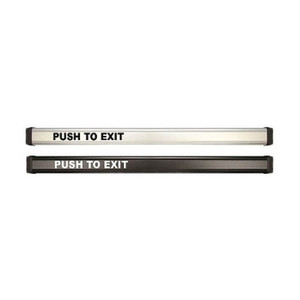
HES WEMB-BK-48 48in Electro-Mechanical Access Control Bar
The HES WEMB-BK-48 is a 48-inch electro-mechanical locking bar designed for professional-grade access control in institutional, commercial, and industrial facilities. Operating on 12VDC electromagnetic actuation, this fail-safe bar maintains security during power loss while integrating seamlessly with standard access control systems. The black powder-coat finish and heavy-duty construction deliver reliability across high-traffic doorways, server rooms, restricted wings, and perimeter gates where consistent, tamper-resistant access management is non-negotiable.
Key Features
- 48-inch Length: Fits standard commercial door frames without modification, simplifying retrofit installations across campus and multi-building facilities.
- Electro-Mechanical Actuation: 12VDC engagement provides positive control and full integration with access control keypads, card readers, and networked access platforms.
- Fail-Safe Design: Bar remains locked during power loss or system failure, meeting security compliance mandates for healthcare, government, and data center environments.
- Black Powder-Coat Finish: Resists corrosion, scuffing, and UV degradation in institutional and outdoor-adjacent installations.
- Heavy-Duty Construction: Engineered for sustained high-traffic use in educational campuses, corporate offices, and industrial warehouses without performance degradation.
- Standard Access Control Integration: Compatible with Vista® VM300, VM600, VM1200/VM1290 controllers and wide ecosystem of 12VDC lock platforms via standard relay outputs.
The WEMB-BK-48 operates as a fail-safe electromagnetic strike, meaning power removal does not unlock the bar—a critical safety feature for facilities where uncontrolled access poses security or life-safety risk. The 12VDC requirement integrates directly with most commercial access control systems, eliminating the need for specialized power conditioning or dedicated circuits. Auditable access logs flow from the control panel, not the bar itself, so your ACS records every unlock event with timestamp and user credential.
Institutional deployments—universities, hospitals, government offices—rely on electro-mechanical bars because they scale across dozens of doors without individual smart-lock management overhead. A single Vista controller can manage 16+ bars, each with independent unlock schedules, time-zone rules, and emergency override credentials. The 48-inch form factor covers most commercial steel and aluminum frames; for non-standard widths, HES offers shorter and longer variants. Installation takes 30-45 minutes per door (surface-mount or mortised); no special tools or firmware updates required.
The fail-safe mechanism is mechanical, not electronic. If power fails, the bar locks by spring tension—no capacitor backup, no relay memory. This design eliminates the single-point-of-failure risk that haunts some electronic locks in mission-critical spaces. Fire and life-safety codes in most jurisdictions accept fail-safe bars on emergency egress doors provided they unlock via manual pushbar or motion sensor during alarm state; verify local AHJ requirements before installation. The black finish minimizes maintenance in dusty or corrosive environments (salt spray, food-processing areas); powder coat resists chemical solvents better than paint or anodize.
Total cost of ownership favors electro-mechanical bars over smart locks in multi-door deployments. Capex per door is lower (roughly $400–600 installed vs. $800–1,200 per smart lock), power draw is minimal (draw-to-open surge <500mA), and replacement batteries are not part of the maintenance cycle. A single 48V PoE switch can power 8–12 doors via distributed relay boards, reducing the electrical infrastructure footprint.
Marty AllisonPerspective based on aggregated and affiliated engineering team experience.
We've installed the WEMB-BK-48 in university buildings, hospital restricted wards, and corporate data centers, and it remains one of the most reliable fail-safe bars in the institutional access-control toolkit. What makes it stand out is the combination of mechanical simplicity and deep integration with legacy and modern ACS platforms. You're not fighting firmware updates or battery replacement schedules—you're managing a dumb electro-magnet that either opens when 12V is applied or stays locked. On a 200-door campus, that operational simplicity compounds into genuine capex and labor savings. The black powder coat holds up well in humid climates (Florida, Pacific Northwest) and dusty industrial zones where paint flakes and anodize oxidizes. We've also seen it survive repeated high-impact scenarios (loading docks, warehouse environments) without functional compromise. The main trade-off versus electronic smart locks is lack of individual credential granularity per door—the WEMB-BK-48 is a centrally managed device, so audit trails live in your ACS controller, not the bar itself. If you need per-door credential control without a master controller, this is not the right fit. But if you're building a 16-door security perimeter around a restricted floor or coordinating access across a building wing, the Vista controller ecosystem makes this choice obvious.
Technical Highlights:
- Fail-Safe Electromagnetic Mechanism: Spring-tensioned mechanical lock holds position during power loss, power failure, or control system outage. No capacitor backup or electronic memory required—compliance-friendly for life-safety codes.
- 12VDC Draw-to-Open Actuation: Minimal sustained current draw (typically 100–200mA hold, <500mA surge during unlock). Pairs efficiently with 48V PoE infrastructure via distributed relay modules; 8–12 bars per PoE switch.
- Vista® VM300/VM600/VM1200/VM1290 Native Compatibility: Direct relay output integration; no translation layers, no custom firmware. Unlock schedules, override credentials, and audit trails managed centrally in the ACS controller database.
- 48-inch Standard Length: Covers 90% of commercial steel and aluminum door frames without modification. Retrofit installations on existing door hardware take 30–45 minutes per opening; minimal structural changes required.
- Black Powder-Coat Finish: Resists salt spray, humid-climate corrosion, and institutional cleaning solvents better than anodize or paint. Minimal touch-up required across 5–10 year lifecycle in demanding environments.
Deployment Considerations:
- Fail-safe design locks the bar during power loss—this is a feature, not a bug, but verify with your local AHJ and fire marshal that fail-safe barriers meet emergency egress requirements for your occupancy type. Some jurisdictions require fail-safe doors to unlock automatically during fire alarm; pair with a hardwired relay output from your fire panel if needed.
- The WEMB-BK-48 is a passive strike; it does not report whether the door is actually open or closed. If you need door position feedback (open/closed sensor), integrate a separate magnetic switch or contact closure on the door frame. The ACS will know when the bar unlocked, but not whether someone actually opened the door.
- Electromagnetic bars generate audible click during unlock—not loud, but noticeable in quiet spaces (libraries, hospitals after hours). In noise-sensitive installations, brief occupants that the sound is normal to avoid confusion.
- Wiring runs from the ACS controller to the bar relay output must be in conduit or cable tray to meet NEC requirements in most jurisdictions. Budget 50–100 feet of 18/2 shielded cable per door; surface conduit or in-wall runs add 1–2 hours per opening.
- Test fail-safe operation before commissioning: kill power to the ACS, verify the bar locks and cannot be forced open by hand. This one-minute test prevents post-installation surprises and confirms spring tension is properly seated.
The HES WEMB-BK-48 is the right choice for multi-door institutional deployments where centralized control, fail-safe reliability, and low lifecycle cost matter more than individual smart-lock features. Its strength lies in scale and simplicity—not in distributed intelligence. For campuses, healthcare networks, and government facilities with 16+ controlled doors, this bar reduces operational overhead and delivers audit trails via the master ACS. See the HES catalog for complementary strike plates, relay modules, and emergency override hardware.