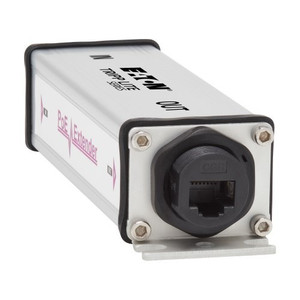
Comnet CLFE8EOU Eight-Channel Ethernet over UTP with Pass-Through PoE
Overview
The Comnet CLFE8EOU is an eight-channel Ethernet extender purpose-built for surveillance networks running over long copper runs. It accepts standard 10/100Mbps Ethernet data on RJ-45 inputs and extends that signal up to 610 meters at 100Mbps (914 meters at 10Mbps) over unshielded twisted-pair (UTP) or coaxial cable without signal degradation. The critical differentiator: pass-through PoE power — the unit accepts IEEE 802.3af PoE from your switch or power adapter and re-delivers up to 10W at 9–15 VDC to eight remote IP cameras, recorders, or edge devices simultaneously. If you're retrofitting analog surveillance infrastructure with IP cameras on existing long-run copper, or deploying cameras across a campus, warehouse, or industrial site where 100-meter standard Ethernet limits won't reach, this is where the CLFE8EOU anchors your topology.
Key Features
- Eight independent Ethernet channels: Each channel transmits 10/100Mbps full-duplex data independently, meaning you can run eight separate camera or edge-device circuits through a single unit without cross-talk or bandwidth collision — critical for multi-building deployments where a centralized NVR sits far from remote sites.
- Pass-through PoE delivery (10W max): The unit itself draws power via PoE (from an 802.3af switch) or via local 2-pin screw terminal (9–36 VDC single-channel, 9–15 VDC for the 8-channel model) and passes that power through to remote devices at the far end of the copper run. This eliminates the need for local power supplies at distant camera locations — a major operational simplification in outdoor or difficult-to-access installations.
- Distance capability: 610m at 100Mbps, 914m at 10Mbps over UTP: Standard Ethernet specs max out around 100 meters; the CLFE8EOU extends to 610 meters at full 100Mbps speed over inexpensive CAT-5 UTP cable. If you drop to 10Mbps (via DIP-switch configuration), you stretch to 914 meters. For coaxial cable runs, you gain distance at the cost of some speed flexibility — up to 1,524 meters at 10Mbps, 610 meters at 100Mbps. Practical example: a warehouse with cameras 400+ meters from the central switch can now feed video directly without intermediate hubs.
- User-selectable data rate and media mode via DIP switches: Configure the unit in the field for 10Mbps or 100Mbps, single-pair or four-pair UTP, local or distant power — no firmware updates, no software login required. This flexibility means one CLFE8EOU SKU handles multiple deployment patterns without stock proliferation.
- Full-duplex symmetric bandwidth: Upstream and downstream rates are identical with low packet loss across the full usable distance. This matters for bi-directional control (pan/tilt commands, configuration uploads) and real-time video streaming — no asymmetric surprises that degrade interactive PTZ performance.
- Multicast, Unicast, and Jumbo Frame support: The unit passes RFC 2544–compliant TCP/IP, UDP, HTTP/HTTPS traffic without rewriting or filtering. If your VMS uses multicast for redundancy or your edge recorder supports Jumbo Frames for efficiency, the CLFE8EOU stays transparent — it won't be the bottleneck.
- Extended operating temperature range (-40°C to +75°C): Covers outdoor unheated cabinets, rooftop installations, and cold-climate sites without derating or failure risk. Storage temperature extends to -40°C to +80°C, so units shipped to winter regions or stored in uncontrolled warehouses won't arrive degraded.
- MTBF > 100,000 hours and environmentally tested per NEMA TS-1/TS-2 and CALTRANS standards: The unit has been third-party validated for mechanical shock, vibration, humidity with condensation, and transient surge protection. In industrial or high-traffic environments (parking lots, roadside camera stations, airports), this certification backing means predictable reliability over years of operation.
- 19-inch rackmount form factor (8-channel model): The CLFE8EOU fits standard 1U rack space, consolidating eight extended networks into a single chassis. This is cleaner than daisy-chaining single-channel units across a rack, and it simplifies cable management when you're feeding multiple distant sites from a central head-end.
- LED status indicators for link and activity on each channel: Troubleshooting a long copper run is easier when you can see at a glance which channels are active and which are down. Ethernet and extended-distance (coax) link lights distinguish between the near and far ends, so you know if the problem is your local connection or the remote camera.
Integration & Compatibility
The CLFE8EOU requires no special drivers, firmware, or VMS integration — it is a passive transparent bridge. Any ONVIF-compliant IP camera, edge recorder, or network device that speaks standard Ethernet will work at the far end. Typical deployment: connect the RJ-45 Ethernet input to your PoE switch (or inject PoE via a local adapter), connect the BNC coax output (or four-pair UTP output, depending on your media choice) to the far-end camera or NVR, and power is delivered automatically. For multi-site surveillance, you can cascade multiple CLFE8EOU units — one per remote building or yard — all fed from a central switch and all feeding video back to a single Milestone, Axis Camera Station, or custom VMS platform without topology constraints.
What's in the Box
Package contents for the 8-channel CLFE8EOU unit include the rackmount chassis, eight RJ-45 Ethernet input ports, and BNC or RJ-45 output connectors for extended-distance media. Exact boxed accessories are not detailed in manufacturer documentation; verify with your sourcing team for cable, rail kit, or optional power supply availability.
Frequently Asked Questions
Q: Can I use the CLFE8EOU to extend a PoE switch's power budget to distant cameras?
A: Yes. The unit passes through up to 10W of PoE power to eight remote devices simultaneously. If each camera draws less than 1.25W, you can power all eight from a single PoE-injected CLFE8EOU. For higher-draw cameras (e.g., motorized zoom, heater/blower), you may need a local power supply at the far end or select the 4-channel or 1-channel variant if you have fewer cameras to power.
Q: What's the difference between running the CLFE8EOU at 10Mbps versus 100Mbps?
A: At 100Mbps, you can extend up to 610m over UTP; at 10Mbps, you stretch to 914m. For a single H.264 or H.265 camera stream (typically 1–8 Mbps depending on resolution and frame rate), 10Mbps is usually sufficient and buys you distance. Use 100Mbps if you're running multiple streams per channel or if your camera requires high-bandwidth features (e.g., multi-stream, metadata, or analytics).
Q: Can I mix UTP and coax runs on the same CLFE8EOU unit?
A: No. The media type (UTP or coax) is selected globally via DIP switch, not per-channel. All eight channels must use the same media type. If you need both UTP and coax in your deployment, you'll need separate units configured for each media.
Q: Does the CLFE8EOU require a VMS license or software subscription?
A: No. It is a transparent hardware bridge with no software, licensing, or cloud dependencies. Once configured via DIP switches, it requires no ongoing management or updates.
Q: What is the warranty on the CLFE8EOU?
A: Comnet offers a lifetime warranty on the CLFE8EOU, covering defects in materials and workmanship for the life of the product.
Q: Is the CLFE8EOU NDAA Section 889 compliant?
A: NDAA compliance is not documented in the manufacturer's evidence for this model. Verify directly with Comnet or your procurement team if NDAA compliance is a requirement.
The Comnet CLFE8EOU solves a real topology problem: standard Ethernet maxes out at 100 meters, but your surveillance site spans 400+ meters of existing copper. Rather than tear out cable and run Ethernet backbone infrastructure, the CLFE8EOU extends each of eight camera feeds independently up to 610 meters at 100Mbps — with pass-through PoE intact, so you're not installing local power supplies in hard-to-reach locations.
Technical Highlights:
- 610m extended distance at 100Mbps (914m at 10Mbps): Standard Ethernet over UTP is limited to 100 meters; the CLFE8EOU's CopperLine® technology pushes that to 610 meters without active repeaters, signal regeneration, or external amplification. For a 400-meter warehouse run, this is a one-box solution that keeps video latency flat and eliminates repeater management.
- Pass-through PoE at 10W for eight channels: The unit accepts PoE from your switch and re-delivers up to 1.25W per camera across all eight channels. This means no local 24VAC or 48VDC supplies at the remote end — fewer points of failure, simpler troubleshooting, and no power management at sites you can't easily visit.
- DIP-switch selectable 10Mbps or 100Mbps, UTP or coax: One unit, four configuration modes. If your copper run is degraded coax or you're running at distance, drop to 10Mbps; if you have clean UTP and need bandwidth for multi-stream analytics, stay at 100Mbps. Field-configurable, no firmware flashing.
- Full-duplex symmetrical bandwidth with low packet loss across the full distance: Upstream and downstream are identical — critical for PTZ camera control, two-way audio, and configuration traffic that needs to reach the camera without latency surprise. RFC 2544 TCP/IP and UDP certification means your VMS and edge devices won't see retransmission storms.
Deployment Considerations:
- The unit is transparent — no learning curve, no configuration menu, no software updates. Once DIP switches are set, it operates passively. But this also means you must plan your media type (UTP vs. coax) upfront; you can't mix them on one unit.
- The 10W power budget is shared across eight channels; if you have eight high-draw cameras (PTZ units with heaters, for example), you'll hit the limit fast. Run the numbers: a typical bullet camera is 5–8W, so if you're powering more than one or two PTZ cameras per CLFE8EOU, add a local power supply at the remote end rather than relying on pass-through PoE alone.
- If you're extending both data and power over long coax in an outdoor industrial environment (parking lots, fairgrounds, airports), the unit's NEMA TS-1/TS-2 and CALTRANS environmental certifications matter — it has been third-party shock, vibration, and surge-tested, so you're not gambling with reliability in high-noise electrical environments.
Deploy the CLFE8EOU when you're retrofitting analog CCTV infrastructure with IP cameras and your copper runs exceed 100 meters, or when you're building a multi-building surveillance network on a campus or industrial site where running new Ethernet backbone would be cost-prohibitive. It's not fancy, but it solves the distance-plus-power problem cleanly.