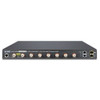
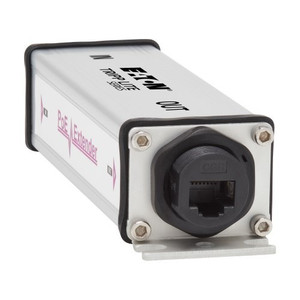
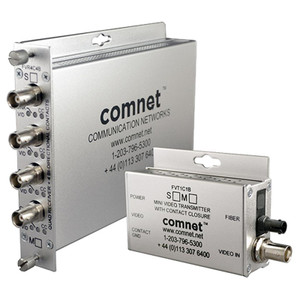
Comnet CLLFE8POEC Eight-Channel Ethernet-over-Coax Extender
Overview
The Comnet CLLFE8POEC is an eight-channel Ethernet-over-copper line extender designed to push 10/100 Mbps Ethernet with PoE+ power delivery over long runs of existing coaxial or twisted-pair cable. If you're retrofitting analog CCTV infrastructure to IP surveillance and need to avoid trenching new fiber, or extending powered cameras across a campus without rewiring, this unit bridges the gap between legacy plant and modern IP networks. The local module injects 30W of PSE PoE+ power (48–56 VDC input) onto each channel independently, allowing you to deploy eight powered devices simultaneously across distances that would normally require multiple drops or active equipment.
Key Features
- Eight independent Ethernet channels: Each channel carries full 10/100 Mbps bandwidth, so you're not multiplexing or time-sharing—eight powered cameras can operate simultaneously without mutual interference or bandwidth starvation.
- 5,000 ft range over coax; 3,000 ft over UTP: At 10 Mbps, you can reach 5,000 feet on coaxial cable, which matters for sprawling industrial campuses or outdoor perimeter systems. At 100 Mbps (the speed most IP cameras use), coax distance drops to 2,000 feet—still useful for medium-span runs where UTP isn't practical.
- 30W PSE PoE+ injection: The CLLFE8POEC generates its own 48–56 VDC power (external power supply sold separately), eliminating the need for a PoE+ switch if you're retrofitting an older site. Each channel can deliver up to IEEE 802.3at power levels—enough for PoE+ turrets, PTZ domes, and high-power IR units that standard 802.3af (13W) switches can't handle.
- Pass-through PoE+ on each channel: If your source is already a PoE+ switch, the CLLFE8POEC passes that power straight through without dropping voltage. Eight channels, eight separate pass-through paths—no collapsed bundles or shared rails.
- DIP-switch selectable data rate: Choose 10 Mbps for maximum distance or 100 Mbps for faster frame rates and dual-stream recording. This flexibility lets you tune each channel to its actual need without overprovisioning bandwidth on longer runs.
- NEMA TS-1/TS-2 and CALTRANS tested: The unit has been independently lab-tested for environmental compliance (ambient temp swings, humidity, mechanical shock, voltage transients). This matters if you're deploying on roadway corridors or traffic systems where standards enforcement is non-negotiable.
- Extended temperature operation –40°C to +75°C: Handles deep-winter and high-summer installations without derating. If your outdoor cabinets see seasonal extremes, the CLLFE8POEC won't become a bottleneck.
- Automatic resettable current limiters: Each channel is protected by solid-state current limiters that trip and reset automatically if a camera draws too much power or a short occurs downstream. No fuses to replace, no field service call for a blown protection circuit.
- LED status indicators: Per-channel Ethernet Link/Activity and PoE Power LEDs give you real-time confirmation that data and power are flowing. Troubleshooting a failed camera run is immediate—you see exactly which channel is dark.
- Multicast, Unicast, Jumbo Frame support: Complies with RFC 2544 TCP/IP standards and standard network protocols (UDP, TCP/IP, HTTP/HTTPs). If your VMS or management system relies on multicast discovery or large-frame PTZ commands, this extender handles it without packet loss or frame fragmentation.
- Symmetric full-duplex bandwidth: Upload and download perform identically—zero packet loss over the rated distance. Important for two-way audio, PTZ control responsiveness, and real-time alert feeds in NOC environments.
- USA design and manufacturing with lifetime warranty: Built in the United States with no grey-market or parallel-import risk. Lifetime warranty covers defects; no tiered warranty degradation over years.
Integration & Compatibility
The CLLFE8POEC pairs with any standard RJ-45 Ethernet source (PoE+ switch, NVR uplink, managed router) and any coaxial or UTP cable run. Remote units (sold separately) are available in 1-channel and 4-channel packages in matched form factors; pair them with the 8-channel local to create a complete extended network. The unit supports RFC 2544 TCP/IP bandwidth testing, so you can validate performance before deployment. Connectors are RJ-45 for Ethernet and female BNC for coax (or RJ-45 for UTP). If you need pass-through power on the remote end (e.g., a powered access control reader or auxiliary device), the CLLFE8POEC supplies 12–15 VDC at up to 12W on all eight channels—separate from the Ethernet data path, so power failures don't black out the network.
What's in the Box
The CLLFE8POEC eight-channel local module ships as a single 1RU rack-mountable unit. Dimensions are 6.1 × 19 × 1.75 inches (15.5 × 48.26 × 4.45 cm); weight is under 5 lbs (2.3 kg). Note: remote units, coaxial cable, power supply for PoE injection, and patch cables are ordered separately.
Frequently Asked Questions
Q: Can I use the CLLFE8POEC with an existing PoE+ switch?
A: Yes. The CLLFE8POEC can operate in pass-through mode, accepting power from your PoE+ switch on the local side and passing it through to remote cameras without any external power supply. This is ideal for retrofit installations where you already have PoE+ switching infrastructure.
Q: What's the maximum distance at 100 Mbps?
A: 2,000 feet (610 m) over both coax and UTP cable. Most IP surveillance cameras operate at 100 Mbps, so this is your practical limit for real-world deployments. At 10 Mbps, you can reach 5,000 feet over coax or 3,000 feet over UTP if your cameras and VMS support lower frame rates.
Q: Does each channel have its own power limiter?
A: Yes. Each of the eight channels includes an automatic resettable solid-state current limiter. If one camera shorts or draws excessive power, that channel's limiter trips, but the other seven channels continue operating normally.
Q: Is the 30W power capacity shared across all eight channels?
A: No. The 30W PSE injection is the total power budget when using an external 48–56 VDC supply. The pass-through PoE+ (from a connected PoE+ switch) is independent and not affected by the 30W PSE limit. Check your power supply wattage and planned camera draw to ensure you don't exceed 30W across all eight channels if using PSE mode alone.
Q: What remote units pair with the CLLFE8POEC?
A: Comnet offers 1-channel and 4-channel remote modules (sold separately) in the same CopperLine family. A complete system typically includes one local (CLLFE8POEC) and one or more remotes deployed at the far end of each coax run. The local injects power; the remote terminates it at the camera site.
Q: Is the CLLFE8POEC NDAA Section 889 compliant?
A: NDAA compliance is not indicated in the available product documentation. If this is a requirement for your procurement, contact the manufacturer or your reseller for formal NDAA certification status.
The CLLFE8POEC is a workhorse for campus and perimeter surveillance where you've got coaxial plant already in the ground but no fiber yet. I've deployed these on warehouse shipping yards and outdoor parking zones where the budget doesn't justify ripping out cable. The key detail: 5,000 feet of reach on coax at 10 Mbps means you can cover a lot of acreage—double the typical UTP range—and the eight independent channels let you stack powered cameras without fighting for power headroom on a single shared supply.
Technical Highlights:
- 30W PSE PoE+ injection (48–56 VDC input): Supplies up to IEEE 802.3at power per channel independently. This matters if you're running high-power PTZ or turret cameras that demand more than standard 802.3af (13W) can deliver. Total budget is 30W across all eight, so do the math on your camera lineup before you order the power supply.
- 2,000 ft coax range @ 100 Mbps; 5,000 ft @ 10 Mbps: Real-world IP cameras typically use 100 Mbps, so expect 2,000 feet as your practical distance. If you need longer runs, trade frame rate or resolution for reach by switching to 10 Mbps mode via DIP switch. The asymmetry (coax vs. UTP) favors coax if you've already got it in place.
- Automatic resettable current limiters per channel: Field-replaceable fuses are gone. Each channel's limiter trips and resets automatically on fault, so a shorted downstream camera doesn't take out your whole cabinet—just that one channel goes dark until you fix the root cause.
Deployment Considerations:
- The CLLFE8POEC is the local unit; you need matching Comnet remote modules (1CH or 4CH, sold separately) at the far end of each coax run. Plan your bill of materials: local + one or more remotes + external 48–56 VDC power supply (if using PSE mode) + cable.
- NEMA TS-1/TS-2 testing is for the 1-channel units only; multichannel units (like this 8-channel) are designed to meet NEMA TS-2 Spec but haven't undergone the same full independent lab certification. If your project requires signed environmental certification, ask the manufacturer for documentation on the 8-channel model specifically.
This is the right pick if you're extending IP surveillance across a sprawling campus or industrial site where you already have coax runs and a tight capex budget. Don't force it into a greenfield fiber design—its value is retrofit economics and distance reach over existing plant.