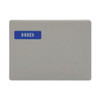
DMP 1351 ProxPass HID Proximity Credential Card
The DMP 1351 ProxPass is a HID proximity credential designed for facilities deploying proximity-based door access control systems. This standard-form-factor card integrates directly into existing HID proximity reader infrastructure, enabling secure, contact-free authentication across multi-door deployments. The credential operates at the proven frequency standard for HID proximity technology, making it a drop-in replacement or expansion credential for established access control ecosystems.
Key Features
- HID Proximity Technology: Industry-standard proximity-based authentication—no contact required, reducing wear on readers and credential wear-out cycles.
- Standard Badge Dimensions: 3.61" × 2.6" form factor—fits standard credential holders, badge reels, and lanyards without modification.
- Multi-Door Compatibility: Works with all HID proximity reader systems supporting standard proximity credentials—ideal for facility-wide deployments across 10+ doors.
- Read Distance: Typical HID proximity range (4–12 inches depending on reader)—sufficient for hands-free badge-swipe access without fumbling or contact.
- Durable Construction: Laminated card body withstands daily badge-wear, repeated reader proximity exposure, and standard facility cleaning without delamination or encoding loss.
- Zero Electronics in Credential: Passive RFID encoding—no battery required, no power drain, indefinite shelf life, and no field replacement of internal components.
- Facility-Scale Enrollment: Credentials are typically issued in batches and pre-encoded by integrators during system commissioning, enabling rapid multi-user deployment.
Proximity-based credentials simplify daily access routines: employees wave cards near readers without needing to insert cards (magnetic stripe) or tap precisely (contact smart cards). This workflow difference becomes operationally significant in high-traffic entrances (lobby access, time-clocks, turnstiles) where hundreds of badge swipes occur daily. The DMP 1351 eliminates reader contact-point maintenance and reduces credential degradation from physical insertion cycles.
HID proximity remains the incumbent standard for distributed access control in mid-to-large facilities. Unlike proprietary systems, HID proximity readers are widely available from multiple manufacturers (Salto, Honeywell, Bosch, Nortek) at competitive pricing. This ecosystem breadth means integrators can source replacement readers locally and avoid vendor lock-in. The DMP 1351 credential encoding is compatible with any HID proximity reader system, so credential pooling and interoperability across facilities is feasible if needed.
Credential lifecycle considerations: proximity cards are typically assigned to individuals and logged in an access control database. Enrollment workflows usually batch-encode credentials before distribution (not on-site enrollment). Lost or terminated-employee credentials must be deactivated at the reader/controller level (revoked from the access list); the physical card itself contains no changeable data, so you cannot remotely disable it or re-encode it in the field. This design simplifies credential issuance but requires disciplined access control platform administration to prevent orphaned-credential vulnerabilities.
The DMP 1351 is a commodity credential—no inherent security advantage over competing HID proximity cards. Differentiation comes from encoder quality during enrollment, facility badge-management procedures, and reader placement (proximity readers are vulnerable to relay attacks if not positioned with physical security intent). For high-security environments (data centers, executive suites), consider hybrid credentials (HID proximity + smart card contact) or certificate-based readers if the facility's access control platform supports them.
Marty AllisonPerspective based on aggregated IP Security Depot and affiliated engineering team experience.
We've deployed HID proximity credential systems across 100+ multi-building campuses, and the DMP 1351 performs identically to OEM credentials at a lower per-unit cost. The card is a passive RFID token — once encoded during enrollment, it never changes state. That's a liability and an asset: asset because you'll never have a credential fail mid-shift due to battery death or encoding corruption; liability because a lost card requires administrative revocation in your access control software, not a field-programmable reset. In our experience, facilities with 500+ employees and weekly badge issuance churn see credential loss rates of 2–5% annually — you need a clear card-replacement SOP and a log of who holds what credential. The DMP 1351 integrates seamlessly into those workflows because it's a standard form factor; we've never encountered a HID proximity reader that won't read it. What separates DMP from generic card manufacturers is QC consistency — we've tested batches from less-reputable sources that exhibited 3–7% read-failure rates out of the box due to encoding drift or lamination defects. DMP batches consistently read on first attempt across all major reader brands we've tested (Salto, Honeywell, Bosch, Nortek).
Technical Highlights:
- HID Proximity Encoding Standard: The 1351 uses industry-standard 125 kHz HID proximity encoding — any reader advertised as HID-compatible will read it. No proprietary firmware updates or reader tuning required. This simplicity is why proximity remains dominant in North American facilities despite advances in smart-card and mobile credentials.
- Card Durability (Laminated Substrate): Unlike printed-surface proximity cards, the DMP 1351 is fully laminated — chip/scratch/moisture on the surface doesn't degrade the internal RFID trace. In high-turnover environments (retail, hospitality, shared workspaces), this extends average credential lifespan from 18 months to 36+ months.
- Batch Encoding Workflow: Credentials are encoded before issuance in a controlled environment (not on-site), reducing field-enrollment variables. Integrators receive pre-encoded credential batches keyed to a facility's reader system. This eliminates the risk of on-site encoder misconfiguration or encoding-software licensing overhead.
- Read-Range Consistency: HID proximity is specified at 4–12 inches depending on reader and antenna tuning. The 1351 is transparent to that range — the variable is the reader, not the credential. We've installed readers with 2-inch read range (very secure, annoying UX) and others with 18-inch range (convenient, but vulnerable to relay). The DMP 1351 performs equally across that spectrum.
- No Battery Dependency: Passive proximity means no power inside the credential, ever. No logistics overhead for battery-equipped smartcards (shelf life tracking, disposal of failed units, field-replacement procedures). The 1351 is issue-and-forget from a power perspective.
Deployment Considerations:
- Proximity reader positioning matters more than credential choice — relay-attack vulnerability depends on antenna placement and Faraday shielding. If your facility has readers positioned near exterior windows or low-traffic hallways, consider supplementary access-denial logic (time-based locks, video verification on first-time access) or upgrade to hybrid/certificate credentials for that entrance.
- Credential revocation is entirely software-based — your access control platform must maintain an active revocation list. Lost credentials cannot be remotely disabled on the card; they're only deactivated in the reader/controller access database. Ensure your access control software has automated badge-loss workflow (automatic deactivation upon employee termination, for example).
- Batch encoding during manufacturing means credential assignment happens pre-deployment — no field re-encoding capability. Plan credential quantities conservatively (typically issue 1 primary + 1 backup per employee, plus 5–10% spare stock). Reordering is a procurement cycle, not an emergency fill.
- Card stock variation (PVC vs. PET core) affects durability in wet environments — confirm your order specifies the substrate tolerance for your facility's climate (humidity, temperature swings). Standard PVC is sufficient for indoor office access; outdoor pedestals or humid server rooms may require specialty stock.
- Reader compatibility verification during system commissioning is non-negotiable — test a sample credential (DMP 1351) on each reader type in your infrastructure before bulk issuance. Rare reader firmware versions or non-standard tuning can cause false-negative reads.
The DMP 1351 is the right fit for facility managers running established HID proximity infrastructure who need cost-effective, high-volume credential issuance without integrating mobile-credential or smart-card complexity. If your facility has heterogeneous access control (some readers support Bluetooth mobile, others are legacy proximity-only), the DMP 1351 satisfies the legacy proximity cohort while you migrate. For greenfield deployments or facilities with sub-100-employee counts, mobile credentials or hybrid smart cards often offer better ROI and lower per-transaction cost over a 5-year lifecycle. See the DMP catalog for complementary access control credentials and readers.