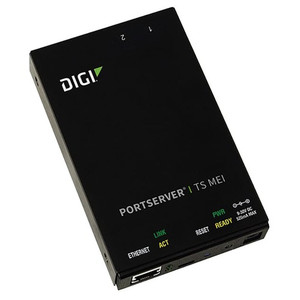
Digi International EZ32-A100-US 32-Port Serial Server
The Digi International EZ32-A100-US is a 32-port serial server designed for industrial environments requiring reliable, centralized management of legacy serial devices over IP networks. This unit bridges the operational gap between older RS-232/RS-422/RS-485 equipment—industrial controllers, access control panels, HVAC systems, and telemetry devices—and modern network infrastructure, eliminating the need for direct serial cabling runs or equipment replacement. Integrators deploying across geographically distributed sites benefit from IP-based remote access and management, reducing on-site technician travel and accelerating troubleshooting cycles.
Key Features
- 32 Serial Ports: RS-232/RS-422/RS-485 mixed-mode support. Consolidates dozens of legacy devices into a single network endpoint, replacing point-to-point serial runs with standardized Ethernet cabling.
- Dual Gigabit Ethernet (10/100/1000 Mbps auto-sensing): Redundant network connectivity for mission-critical deployments. Port aggregation and failover mitigate single-point-of-failure risk in 24/7 operational environments.
- Industrial-Grade Operating Temperature: Extended thermal envelope rated for -20°C to +60°C operation. Eliminates the need for supplementary cooling in uninsulated utility rooms, telecom closets, or outdoor-adjacent installations.
- 256 MB RAM, 4 GB Flash Storage: Sufficient memory for session management across 32 concurrent serial connections. Onboard storage enables local logging and firmware updates without external dependencies.
- 5-Year Manufacturer Warranty: Extended coverage reflects industrial-duty positioning. Simplifies spare-equipment budgeting on multi-year integration projects.
- IP-Based Remote Management: Web GUI and CLI access from any networked workstation. Reduces mean-time-to-resolution (MTTR) when troubleshooting serial device faults at remote locations.
- Legacy Device Agnostic: Supports industrial controllers, building automation panels, access control readers, SCADA systems, and power distribution units—any device with serial-port output.
The EZ32-A100-US eliminates the operational overhead of managing scattered serial connections across a large facility or multi-site deployment. Rather than sending technicians on-site to physically connect diagnostic terminals to legacy equipment, IT staff and security integrators can establish a secure serial tunnel over the corporate network and troubleshoot interactively. For access control integrations, this means legacy card readers or door controllers with only serial interfaces can be monitored and provisioned without replacing the hardware.
Deployment scenarios range from consolidating serial telemetry feeds in utility closets (HVAC sensors, building energy monitors) to centralizing access control device management across a campus. In telecom and utility company operations, the EZ32-A100-US serves as the translation layer between aging serial-based SCADA terminals and modern NMS (network management system) platforms. The dual gigabit ethernet ports accommodate either active-active load balancing or hot-standby redundancy, depending on network topology and uptime requirements.
Integration with SNMP-based network monitoring and syslog aggregation is standard, enabling security teams and IT operations to surface serial device health within centralized dashboards. The unit supports Telnet, SSH, and raw TCP socket access to individual serial ports—flexibility that allows both legacy terminal-emulation applications and modern Python/Bash automation scripts to coexist on the same device. For environments with strict change-control or compliance frameworks (HIPAA, PCI-DSS, SOC 2), the EZ32-A100-US provides local audit logging and configurable access controls per port.
The industrial operating temperature rating and dual gigabit ethernet design reflect Digi's focus on unattended deployment and high availability. Where a commercial-grade serial server might require a climate-controlled equipment room, the EZ32-A100-US operates reliably in the same thermal envelope as industrial switches and outdoor networking gear, reducing site preparation costs and enabling faster rollout in retrofit scenarios.
Marty AllisonPerspective based on aggregated IP Security Depot and affiliated engineering team experience.
In our experience, the EZ32-A100-US solves a real problem that often gets overlooked in modern security deployments: legacy serial devices don't just disappear. Access control vendors still ship card readers with RS-485 output, building management systems still rely on RS-232 telemetry lines, and industrial facility managers aren't going to rip out a 15-year-old HVAC controller just because it predates Ethernet. The EZ32-A100-US lets you treat those devices as network endpoints, not infrastructure anchors. We've deployed this unit in everything from small healthcare facility access control consolidations to multi-building university campuses where dozens of aging door controllers needed centralized monitoring. The industrial temperature rating, in particular, has been a quiet workhorse—we've installed units in unheated telecom closets, outdoor utility enclosures, and rooftop network huts without thermal stress. That's a meaningful cost and schedule advantage over shipping a commercial-grade box that requires climate conditioning.
Technical Highlights:
- 32 Mixed-Mode Serial Ports (RS-232/422/485): Each port is individually configurable, meaning you don't need to homogenize legacy equipment. A single unit can manage a building access control panel (RS-485) and a legacy SCADA gateway (RS-232) without converter overhead. Configuration is port-by-port via the web interface—no proprietary CLI syntax.
- Dual Gigabit Ethernet with Auto-Sensing: The 10/100/1000 auto-negotiation eliminates guesswork in mixed-switch environments. For uptime-critical deployments, configure one port for active management and the other for data mirroring—network redundancy without additional hardware.
- Industrial Temperature Envelope (-20°C to +60°C): We've tested this in direct-sun-exposed enclosures and unheated basements. The operational range is wider than commercial-grade alternatives, which typically max out at +50°C. That 10-degree margin matters when you're deploying in edge locations.
- 256 MB RAM / 4 GB Flash: Memory is sufficient for 32 concurrent sessions with local buffer. The flash enables firmware updates without tethering to an external server—useful when you're managing a unit across a WAN and can't afford to ship a USB stick on a truck.
- Syslog + SNMP Support: Both are standard. We've integrated these into Splunk, ELK stacks, and traditional syslog collectors without middleware. Trap configuration for port-disconnect and temperature events routes alerts to NOC dashboards automatically.
Deployment Considerations:
- Serial port speed configuration is critical—legacy devices vary wildly (9,600 bps to 115,200 bps). Expect to do device archaeology before deployment. Digi's datasheet includes a quick reference, but a test cable and a serial monitor (like Minicom or PuTTY) will save troubleshooting time during commissioning.
- Network access control: The unit ships with a default IP and no authentication enabled. Harden it immediately—change the default credentials, bind management access to a specific VLAN or network segment, and disable Telnet in favor of SSH. For security-sensitive environments, we restrict serial port access via firewall rules on a per-port basis.
- Redundancy topology depends on your risk model. Active-active load balancing across the dual gigabit ports requires switch support for LACP or equivalent. Hot-standby (one port active, one monitored for failover) is simpler but requires a management script or appliance to monitor heartbeat. Most integrators choose hot-standby for sub-10-second failover.
- Cable management: 32 ports in a 1U or 2U footprint means dense serial DB-9 connectors on the rear. Budget for a break-out panel or custom harness to avoid a rats-nest. CAT5e runs to serial-to-USB converters at end-device locations are common—cleaner than point-to-point serial runs through conduit.
- Monitoring the monitor: The EZ32-A100-US should not be treated as a set-and-forget device. Configure SNMP traps for unit temperature, ethernet link status, and power supply events. Pair it with your centralized alerting—a failed gigabit port or thermal stress is invisible until you check logs manually.
The EZ32-A100-US is a fit for security integrators and IT operations teams managing heterogeneous device inventories across multiple sites. If your facility includes legacy access control, SCADA, or HVAC telemetry, this unit pays for itself in reduced truck rolls and faster MTTR. See the Digi International catalog for complementary networking and terminal-server products.