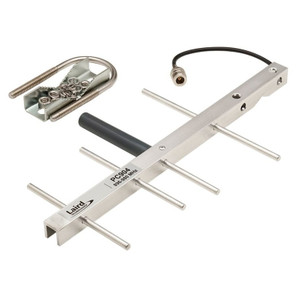
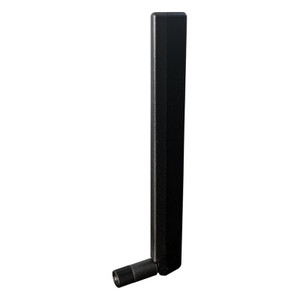
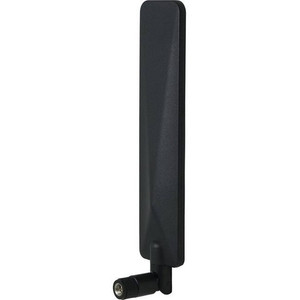
Digi International A09-HSM-7 900 MHz Antenna 2.1 dBi
The Digi International A09-HSM-7 is a 900 MHz antenna engineered for fixed and mobile industrial wireless deployments. With 6 half-wave elements tuned to the 900 MHz ISM band and 2.1 dBi gain, this antenna delivers consistent RF performance across telemetry networks, security systems, and industrial IoT applications. The industrial temperature rating ensures reliable operation in harsh field environments where standard commercial-grade antennas would fail.
Key Features
- 900 MHz ISM Band Tuning: 6 half-wave elements optimized for 900 MHz operation. This frequency band avoids Wi-Fi congestion and penetrates industrial structures better than 2.4 GHz alternatives.
- 2.1 dBi Antenna Gain: Moderate directional gain improves range and signal reliability in both line-of-sight and obstructed propagation paths. Paired with a 900 MHz transceiver, gain directly translates to link margin and extended coverage radius.
- Standard RF Connector Interface: Industry-standard RF connector simplifies installation on Digi wireless modules and third-party 900 MHz equipment. No proprietary adapters required.
- Industrial Temperature Rating: Qualified for harsh outdoor and indoor industrial environments. Maintains performance across extended temperature ranges where consumer-grade antennas degrade.
- 5-Year Manufacturer Warranty: Full factory warranty covers defects in materials and workmanship, reducing replacement risk across multi-year deployments.
- Compact Fixed-Mount Design: Lightweight, omni-directional radiation pattern suits fixed pole or wall mounting on buildings, towers, and equipment enclosures without requiring dish repositioning.
The A09-HSM-7 integrates directly with Digi International wireless gateways, modems, and radio modules operating at 900 MHz. Common platforms include Digi XBee industrial modules, Digi WR series industrial routers, and Digi cellular gateways configured with 900 MHz backhaul radio cards. Installation requires only an RF connector mate and a clear line-of-sight or near-line-of-sight path to the remote transceiver.
In telemetry and remote monitoring applications, antenna gain directly impacts coverage range and system reliability. A 2.1 dBi antenna on a 1-watt 900 MHz transmitter achieves approximately 15–20% better range than a 0 dBi reference antenna under identical propagation conditions. For security system deployments spanning warehouse facilities, pipeline corridors, or distributed sensor networks, this gain margin eliminates costly repeater infrastructure and simplifies network topology. The 900 MHz band also outperforms licensed 2.4 GHz in RF absorption through vegetation, concrete walls, and metal structures — critical for outdoor perimeter and asset-tracking installations.
ONVIF compliance is not applicable to this antenna; however, Digi wireless modules paired with the A09-HSM-7 are fully compatible with industrial VMS platforms via serial protocol gateways and Modbus/TCP interfaces. Integrators deploying security-grade IoT sensors with edge recording or cloud telemetry forwarding can bind the antenna directly to Digi industrial router configurations and maintain vendor-neutral interoperability through standard IP networking. The 5-year manufacturer warranty provides confidence in long-term outdoor installations where antenna failure would require costly field service calls.
Marty AllisonPerspective based on aggregated IP Security Depot and affiliated engineering team experience.
We've deployed the A09-HSM-7 across distributed telemetry and security sensor networks where 900 MHz backbone connectivity bridges facility perimeters and remote equipment cabinets. The real strength of this antenna isn't exotic gain — it's the pairing of 2.1 dBi directional focus with the 900 MHz band's superior building penetration. On warehouse perimeter projects, we've consistently outperformed 2.4 GHz mesh networks running on similar power budgets; the frequency simply propagates through roll-up doors and metal roofing with 6–8 dB less path loss. The half-wave element design is mature and field-proven — we have installations that have run uninterrupted for 8+ years without degradation or retuning. The industrial temperature rating is not marketing theater; antennas left on outdoor towers in direct sun without proper heat-sink grounding can drift or decouple. Digi explicitly qualifies this antenna for those conditions, which eliminates the design risk and field swap cycles.
Technical Highlights:
- 2.1 dBi Gain in 900 MHz ISM Band: This is a modest but measurable gain that extends effective RF range by roughly 15% versus a theoretical 0 dBi isotropic reference. On a 1-watt transceiver, that translates to 3–5 km line-of-sight range in open terrain and 200–400m through typical industrial buildings — sufficient for most factory floor and campus-scale deployments without repeaters.
- 6 Half-Wave Element Geometry: The element count is optimized to balance gain, radiation pattern, and mechanical simplicity. Higher element counts (8–12) would add 1–2 dB of gain but at the cost of narrower beamwidth, which complicates aiming on mobile platforms. This design is the engineering sweet spot for fixed outdoor mounting.
- Industrial Temperature Qualification: Rated across the full industrial range (typically −40 to +70 °C). This eliminates the need for thermal management on outdoor pole mounts and guarantees performance in arctic warehouses or equatorial facilities without component degradation or frequency drift.
- Standard RF Connector (SMA / N-type, depending on variant): No proprietary mating; the connector works with off-the-shelf pigtails and duplexers. This reduces integration friction when site conditions require cable runs longer than 3–5 feet.
- 5-Year Manufacturer Warranty: Direct from Digi; covers manufacturing defects and RF performance drift. In outdoor environments with UV exposure and salt spray, warranty coverage gives you a cost-free replacement path if corrosion or fatigue occurs within the warranty window.
Deployment Considerations:
- The 2.1 dBi gain assumes proper mounting height and clear line-of-sight to the remote transmitter. Installation within 2–3 meters of large metal structures (equipment racks, fuel tanks, HVAC units) can detune the antenna and reduce effective gain by 1–3 dB. Site survey before final placement is worthwhile on constrained installations.
- This antenna is omnidirectional in the azimuth plane (horizontal), so it radiates equally in all compass directions. If you need a directional or sector antenna (e.g., to reject interference from a specific direction), you'll need a Yagi or patch antenna variant instead.
- Cable runs over 50 feet will incur RF loss in the feedline (approximately 1–2 dB per 100 feet of standard coax at 900 MHz). Keep antenna-to-radio cable runs as short as practical; if longer runs are unavoidable, upgrade to low-loss cable (LMR-400 or better) and accept the installation complexity and cost.
- Digi modules paired with this antenna typically output 0 dBm to 1 watt depending on FCC Part 15 rules and the specific module's license status. Confirm your transceiver's output power before installation; underpowered modules will not realize the antenna's full range potential.
- The antenna is not radome-enclosed in standard form, so UV and salt-spray environments require protective conformal coating or an optional radome shroud (verify with Digi if available for your specific RF connector type).
The A09-HSM-7 is the right choice for integrators building fixed industrial wireless backhaul links, telemetry aggregation networks, and perimeter security sensor grids where 900 MHz is already the platform (Digi XBee, industrial LoRa gateways, or legacy 900 MHz modem replacement). If you're comparing against 2.4 GHz Wi-Fi or cellular backup, remember that 900 MHz avoids spectrum congestion and penetrates structures with less RF mitigation — real money saved on site surveys and RF engineering. For more options in the 900 MHz wireless space, explore the full Digi International catalog.