Dell 490-BKQJ NVIDIA RTX A1000 8GB Half-Height Professional Graphics Card
Overview
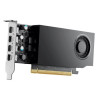
The Dell 490-BKQJ is a half-height professional graphics card built around the NVIDIA RTX A1000, carrying 8 GB of GDDR6 memory on a PCIe 4.0 x8 interface. At 6.40 × 2.70 inches with a 0.75-inch single-slot profile and a weight of just 0.30 lb, it targets workstations and servers where physical space is genuinely constrained — think rack-optimized workstations, small-form-factor deployments, and edge rendering nodes where a full-height double-wide card simply will not fit. If your chassis has a low-profile slot and you need verified professional GPU capability, the 490-BKQJ is purpose-built for that constraint.
Key Features
- 8 GB GDDR6 on a 128-bit bus: At 192 GB/s peak memory bandwidth, the A1000 handles real-time viewport rendering, moderate AI inferencing workloads, and multi-stream decode without the memory-starvation issues that plague consumer half-height cards. 8 GB is enough headroom for most CAD assemblies, security analytics models, and multi-display composition tasks — though if you're running large transformer models or dense point clouds exceeding 6–7 GB active, plan for a higher-memory variant.
- 2304 CUDA cores: This core count puts the RTX A1000 well above entry-level workstation GPUs, delivering parallel throughput suited to real-time video analytics, image processing pipelines, and CUDA-accelerated simulation — tasks where a consumer GPU's lack of ECC and driver certification would be a liability.
- PCIe 4.0 x8 interface: Doubles the available bandwidth ceiling compared to PCIe 3.0 x8, and runs correctly in PCIe 3.0 x8 or x16 slots via backward compatibility. In edge servers and compact workstations where x16 slots are scarce, x8 operation at Gen 4 speeds keeps the GPU from becoming a CPU-to-GPU bottleneck in data-intensive workflows.
- Four Mini DisplayPort 1.4a outputs: Drive up to four independent displays at resolutions up to 7680 × 4320 (8K) from a single half-height card. For video wall controllers, multi-monitor surveillance review stations, or financial trading desks squeezed into compact chassis, four outputs from one low-profile slot is a real layout advantage.
- DirectX 12.0 / Shader Model 6.6 / OpenGL 4.6: Full API coverage for modern visualization software, digital forensics tools, and VMS platforms that use GPU-accelerated rendering. Shader Model 6.6 support future-proofs the card against software stacks that are beginning to require SM6.x for denoising and compute shaders.
- Half-height, single-slot form factor (0.75 in wide, 0.30 lb): The physical footprint means this card installs in 1U and 2U rack workstations, small-form-factor towers, and embedded computing chassis where a standard dual-slot card would either not fit or would block adjacent PCIe lanes. At 0.30 lb, thermal and mechanical stress on the PCIe slot is minimal.
- CUDA support: CUDA-capable silicon means the card participates in GPU-accelerated workflows beyond display — including deep learning inference at the edge, OpenCV GPU pipelines, and NVIDIA-accelerated VMS analytics engines that require a certified CUDA platform rather than consumer GeForce hardware.
Integration and Compatibility
The 490-BKQJ connects via PCIe 4.0 x8 and is backward compatible with PCIe 3.0 and 4.0 slots in x8 or x16 configurations. The half-height bracket is installed from the factory — verify your chassis ships a half-height slot cover or includes the appropriate bracket before ordering if your system uses a different bracket standard. The card exposes four Mini DisplayPort 1.4a connectors; active Mini DP-to-DisplayPort or Mini DP-to-HDMI adapters are required for monitors without native Mini DP inputs — budget for those separately. DisplayPort 1.4a supports DSC (Display Stream Compression), which is what enables the 7680 × 4320 maximum resolution across all four outputs simultaneously on capable monitors.
On the software side, NVIDIA's professional driver stack (not the GeForce Game Ready branch) is the appropriate install for this card. Professional drivers provide ISV certification for CAD, VMS, and visualization applications, and carry the stability guarantees that enterprise deployments require. DirectX 12.0, OpenGL 4.6, and Shader Model 6.6 are all supported, covering the full range of current-generation workstation applications. No TV tuner is integrated, and Dual Link DVI is not supported — this is a pure DisplayPort-output card.
For surveillance and physical security deployments specifically, the RTX A1000's CUDA platform supports GPU-accelerated decoding and analytics in VMS platforms that expose NVIDIA hardware acceleration (NVDEC). Pairing the professional GPU lineup with a capable NVR or VMS server running H.265 multi-stream feeds is a common deployment pattern for high-camera-count review stations. Consult your VMS vendor's GPU compatibility list before finalizing — most major platforms publish supported GPU models.
For broader context on workstation components and how GPU selection fits into a larger compute build, or if you're evaluating network video recorders that pair with a dedicated GPU workstation for analytics and review, those categories are worth cross-referencing during your system design phase.
Frequently Asked Questions
Q: Will the 490-BKQJ fit in a standard 1U rack workstation with a low-profile PCIe slot?
A: Yes. The 490-BKQJ measures 6.40 × 0.75 × 2.70 inches and is designed specifically as a half-height card. It will install in any chassis with a half-height PCIe slot. Confirm your chassis provides a half-height slot bracket — some systems ship with full-height brackets only and require a separate low-profile bracket.
Q: Does the 490-BKQJ require external PCIe power connectors?
A: Based on the available specifications, no external power connector is documented for this card. The RTX A1000 in half-height form is designed to operate within standard PCIe slot power limits. Verify against your specific chassis power budget before finalizing your build.
Q: Can I run four 4K monitors simultaneously from the 490-BKQJ?
A: Yes. The card supports up to four independent displays via four Mini DisplayPort 1.4a outputs, with a maximum resolution of 7680 × 4320 per display. Active Mini DP adapters are needed for monitors without native Mini DisplayPort inputs.
Q: Is the 490-BKQJ compatible with PCIe 3.0 slots?
A: Yes. PCIe 4.0 is backward compatible with PCIe 3.0 slots. The card will operate at PCIe 3.0 speeds when installed in a Gen 3 slot — bandwidth is halved relative to Gen 4, but for most display-driving and moderate compute workloads this is not a practical bottleneck.
Q: What is the difference between this card and a consumer GeForce card of similar performance?
A: The RTX A1000 uses professional (Quadro-class) drivers with ISV certification for workstation applications, ECC memory support, and a half-height form factor not available on most consumer cards. Consumer GeForce cards are not certified for CAD, VMS analytics platforms, or enterprise visualization software. For environments requiring driver stability guarantees and software certification, the professional variant is the correct choice.
Q: Does the 490-BKQJ support CUDA-based GPU acceleration for video analytics?
A: Yes. The RTX A1000 is CUDA-capable with 2304 CUDA cores, supporting NVIDIA's NVDEC hardware decode engine and general CUDA compute workloads. VMS platforms and analytics engines that expose NVIDIA GPU acceleration (such as those using NVIDIA DeepStream or hardware-accelerated decoding) can leverage this card — confirm your specific software's GPU compatibility list.
The 490-BKQJ is one of the few ways to get a genuinely professional-class GPU — 2304 CUDA cores, 8 GB GDDR6 at 192 GB/s, four Mini DisplayPort outputs — into a half-height PCIe slot. I see this card come up most often when an integrator is building a compact surveillance review station or an edge analytics node inside a 1U or 2U chassis where a full-height card isn't physically possible. The half-height constraint eliminates most of the market; the RTX A1000 is one of the few options that doesn't force a compromise on driver certification or display output count to get there.
Technical Highlights:
- 192 GB/s memory bandwidth: At 192 GB/s over a 128-bit GDDR6 bus, the A1000 won't bottleneck multi-stream H.265 decode or moderate deep learning inference tasks — meaningful for analytics workloads that push GPU memory hard. Consumer half-height alternatives typically top out at lower bandwidth figures on narrower buses.
- Four Mini DP 1.4a outputs at up to 8K: Driving four displays at 7680 × 4320 from a single half-height slot is the headline spec that makes this card useful for video wall controllers, multi-pane VMS review stations, and dense visualization setups. That output density from a 0.75-inch wide card is genuinely uncommon.
- PCIe 4.0 x8 at 0.30 lb: The card's weight and narrow slot profile reduce mechanical stress on the motherboard slot — relevant in vibration-prone edge deployments and rackmount systems where card sag or bracket flex causes intermittent contacts over time.
Deployment Considerations:
- The four outputs are Mini DisplayPort — not full-size DP, not HDMI. Budget for active adapters for each monitor that lacks native Mini DP input. Passive adapters may not support the full 1.4a bandwidth needed for 4K @ 60Hz or 8K output.
- This is an x8 electrical card in PCIe 4.0. In a system where the slot runs at x4 electrical (common in some dense-blade chassis), bandwidth drops to Gen 4 x4 — adequate for display workloads, but worth confirming before ordering for high-throughput compute tasks.
For a compact surveillance analytics node — specifically a 1U rackmount workstation running a CUDA-accelerated VMS with four independent monitor outputs — the 490-BKQJ is the card I'd spec. It's not the right pick if your workload demands more than 8 GB VRAM or a full x16 electrical connection, but for constrained-chassis professional GPU deployments, the form factor and output count combination is difficult to match.