Dell 490-BKFY NVIDIA RTX A800 40GB HBM2 PCIe 4.0 Graphics Card
Overview
The Dell 490-BKFY is a professional-grade discrete GPU built around the NVIDIA RTX A800 processor and 40 GB of HBM2 memory — a configuration aimed squarely at compute-intensive workloads: AI inference, deep learning training, large-scale data analytics, and high-throughput visualization pipelines. At 240 W TDP in a full-height, full-length dual-slot form factor, it occupies the upper tier of workstation and server GPU deployment, and the specs justify the footprint.
If you are evaluating the 490-BKFY (often searched as 490 BKFY) for a rack-integrated AI compute build or a visualization server refresh, the specs below are what actually drive the buying decision.
Key Features
- 40 GB HBM2 Memory: High Bandwidth Memory 2 on a 5120-bit memory bus delivers 1,555.2 Gbit/s of memory bandwidth. In practice, this means large AI models and datasets that would overflow a 24 GB GDDR6 card load and run without paging — critical for training runs that span multi-billion parameter models or for inference workloads where latency from memory spills is unacceptable.
- 6,912 CUDA Cores: The RTX A800 GPU packs 6,912 CUDA cores, providing the parallel compute throughput needed for tensor operations, simulation workloads, and parallel rendering tasks. For deep learning, this core count directly maps to how many matrix multiply-accumulate operations the card can execute simultaneously — more cores mean shorter epoch times on training jobs.
- PCIe 4.0 x16 Interface: The PCIe 4.0 x16 host interface doubles the host-to-device bandwidth available on PCIe 3.0 systems. For data-pipeline workflows where the CPU streams large batches to the GPU continuously, this headroom matters — you are less likely to bottleneck at the bus even under sustained multi-stream loads.
- 240 W Typical Power Draw: At 240 W, thermal and power planning are non-negotiable parts of deployment. Your rack or workstation chassis must support this TDP with adequate airflow, and your PSU must have the headroom. The active single-fan cooling system handles the thermal load, but confirm your chassis airflow specification before committing.
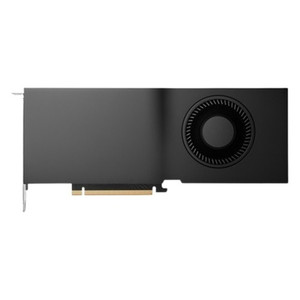
- Full-Height/Full-Length, Dual-Slot Form Factor: The FH/FL dual-slot design means this card requires a standard full-height PCIe slot and two slot widths of clearance. It will not fit low-profile or single-slot chassis. The physical envelope is 10.50 × 4.40 × 2.00 inches — verify slot clearance in dense rack configs where adjacent cards or cable bundles can conflict.
- Active Cooling: The single-fan active cooler manages the 240 W load under sustained compute. In a chassis with restricted airflow — or in a poorly ventilated rack — ambient temperature rise will trigger throttling before the rated TDP. Plan for adequate rack cooling, especially if multiple GPUs are co-located in the same system.
- PCIe + Ethernet Interface Support: Beyond the PCIe x16 data interface, the card supports Ethernet connectivity, enabling direct fabric integration scenarios relevant to multi-node compute clusters where GPU-to-GPU communication or storage connectivity routes over a network fabric rather than purely over the PCIe bus.
- 2.60 lb Card Weight: At 2.60 lb, the 490-BKFY is on the heavier end for a discrete card. In vertical-mount workstation chassis, verify that your motherboard PCIe slot and any retention bracket can support this weight long-term without flex or connector stress.
Integration and Compatibility
The 490-BKFY uses a standard PCIe 4.0 x16 interface and is backwards compatible with PCIe 3.0 x16 slots, though at reduced bandwidth. It is sourced through TD Synnex distribution and is a Dell-integrated SKU, making it appropriate for Dell workstation and server platforms where Dell-validated components are required for warranty or support purposes. Verify your target system's power supply capacity against the 240 W typical draw, and confirm chassis GPU clearance against the 10.50-inch card length before ordering.
Frequently Asked Questions
Q: What is the memory bandwidth of the Dell 490-BKFY?
A: The 490-BKFY delivers 1,555.2 Gbit/s of memory bandwidth via its 5120-bit HBM2 memory bus — a figure that supports sustained large-batch AI inference and training workloads without memory bottlenecking.
Q: Will the 490-BKFY fit in a low-profile or compact chassis?
A: No. The 490-BKFY is a full-height, full-length (FH/FL) dual-slot card measuring 10.50 inches long. It requires a standard full-height PCIe x16 slot with two slots of adjacent clearance. Low-profile or small-form-factor chassis are not compatible.
Q: What is the typical power consumption of the 490-BKFY?
A: Typical power draw is 240 W. Your system's PSU and chassis cooling must be sized to handle this TDP under sustained compute loads — confirm both before deployment.
Q: Is the 490-BKFY PCIe 3.0 compatible?
A: Yes — the card uses a PCIe 4.0 x16 interface, which is backwards compatible with PCIe 3.0 x16 slots. However, host-to-device bandwidth will be reduced on PCIe 3.0 systems, which may affect throughput on data-pipeline-intensive workloads.
Q: How many CUDA cores does the RTX A800 in the 490-BKFY have?
A: The RTX A800 GPU on the 490-BKFY includes 6,912 CUDA cores, providing the parallel compute throughput required for deep learning, simulation, and large-scale analytics workloads.
Q: What is the weight of the 490-BKFY card?
A: The card weighs 2.60 lb. Ensure your motherboard PCIe slot and chassis GPU retention bracket can support this weight, particularly in vertically oriented workstation chassis.
The spec that defines where the 490-BKFY sits in a compute stack is the 5120-bit HBM2 memory bus delivering 1,555.2 Gbit/s of bandwidth — that is not a number you see on GDDR6-based cards at any price point. When I am evaluating this card for a customer running large AI inference deployments or training jobs, that bandwidth figure is what makes or breaks the conversation. The 490-BKFY earns its place in builds where model size or batch throughput has already saturated narrower memory buses.
Technical Highlights:
- 40 GB HBM2 at 1,555.2 Gbit/s: The high-capacity HBM2 stack means you can load models that would require two or more smaller GDDR6 cards, avoiding the added latency and complexity of NVLink or multi-GPU sharding for workloads that fit within 40 GB.
- 6,912 CUDA Cores: The RTX A800 core count maps directly to parallel training and inference throughput — on batch inference jobs, more cores reduce per-batch latency, which matters in production serving environments where SLA is measured in milliseconds.
- 240 W TDP in a Dual-Slot FH/FL Envelope: Packing this compute into a standard dual-slot full-height card is the system integration win here — you get near-datacenter-class GPU bandwidth without needing a specialized chassis, provided you have the thermal and PSU headroom.
Deployment Considerations:
- At 10.50 inches and 2.60 lb, card sag in vertical-mount workstation chassis is a real concern over time — use a GPU support bracket if your chassis does not include a factory retention solution, and verify that the adjacent PCIe slots are clear before installing.
- The 240 W typical TDP is a sustained figure, not a peak — size your PSU with at least 20% headroom above total system draw, and confirm rack cooling can handle the thermal output if you are co-locating multiple cards in the same enclosure.
The 490-BKFY is the right call for a Dell-integrated AI inference server or a workstation build where the workload has already demonstrated it saturates 24 GB GDDR6 cards — specifically large language model serving, multi-stream video analytics pipelines, or scientific simulation environments where model and dataset sizes push past what lower-memory GPUs can hold without paging.