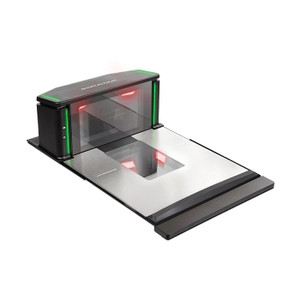
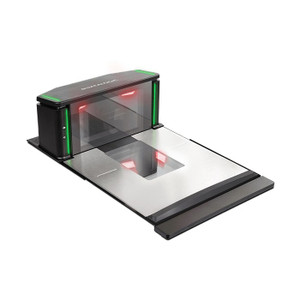
Datalogic Magellan 9600i Bi-Optic - 99222211000-E13520
The Datalogic Magellan 9600i is a fixed countertop scanner-scale system designed for high-volume retail and grocery checkout environments. It merges next-generation digital imaging barcode capture with integrated precision weighing in a single footprint — eliminating separate scanner and scale hardware, reducing operator touch points, and streamlining POS workflow. The bi-optic optical design reads both 1D and 2D barcodes omnidirectionally, regardless of item orientation or pass-through speed, critical for checkout lanes where items move rapidly at variable angles.
Key Features
- Next-Gen Digital Imaging Bi-Optic Scan Engine: Omnidirectional 1D and 2D barcode reading (Code 128, UPC, EAN, QR, Data Matrix, PDF417). Eliminates orientation-dependent scanner positioning — items scan correctly at any angle or speed across the platter.
- Integrated Precision Scale: Built-in weighing for produce, packaged goods, and deli items. Multiple platter options accommodate different product types and counter configurations without adding equipment footprint.
- Wired Connectivity (USB & RS-232): Direct POS integration via industry-standard wired protocols. No wireless latency — guaranteed real-time barcode-to-weight data capture for checkout accuracy and compliance.
- Countertop Form Factor: 305 × 216 × 406 mm (12.0 × 8.5 × 16.0 in) footprint fits standard checkout lane dimensions. Secure countertop mounting maintains scale calibration stability and reduces mounting hardware variability.
- High-Volume Retail Duty Rating: Built for multi-transaction-per-minute throughput in supermarkets, grocery chains, and assisted/self-checkout deployments. Durable imaging optics and mechanical components rated for sustained checkout-lane use.
- GS1 and Modern Retail Standards Support: Compatible with GS1 Digital Link, PLU databases, and contemporary POS platforms — future-ready for omnichannel and mobile-integrated checkout workflows.
- 1-Year Standard Factory Warranty: Covers manufacturing defects and optical degradation under normal retail operation. Datalogic field service and parts availability across North America ensure rapid repair turnaround.
The bi-optic architecture is the operational differentiator in high-friction checkout environments. When cashiers and self-checkout customers struggle with item orientation — swiping horizontally vs. vertically, passing items at speed — standard single-optical scanners generate no-reads and repeat scans. The Magellan 9600i's dual-optic design eliminates that friction. Paired with the integrated scale, a single device handles barcode capture and weight verification; the POS system receives both data streams on a single USB or RS-232 line, reducing cabling complexity and operator error.
Checkout lane economics favor scanner-scale convergence. Separate handheld scanners and standalone scales multiply touch points and operator training burden. The Magellan 9600i consolidates the workflow: operator passes item over platter, scanner fires omnidirectionally, scale captures weight simultaneously, POS receives barcode + weight in real time. For self-checkout lanes, this reduces false-start transaction loops and customer frustration. For assisted checkout, it accelerates throughput — especially critical during peak hours in high-volume supermarkets and specialty retailers with variable SKU counts (produce, bakery, deli departments).
Integration with modern POS platforms (both legacy RS-232 and contemporary USB-HID) ensures compatibility across supermarket chains running different checkout middleware. The device outputs barcode data and scale weight as discrete data streams, allowing POS logic to correlate weight thresholds with PLU lookups and flag anomalies (light-as-air scan, heavy-item discrepancy) in real time. GS1 Digital Link support future-proofs the device for enhanced commerce workflows — QR codes embedded with product metadata, dynamic pricing, or traceability information are read and parsed without POS reconfiguration.
Installation and ongoing operation require planning. The unit is countertop-mounted; it must sit on a stable, level surface to maintain scale calibration accuracy — uneven checkout counters or flexing surfaces introduce weighing drift. Wired connectivity (USB or RS-232) to the POS terminal is mandatory; no wireless variant exists, so power and data cabling must route cleanly behind or adjacent to the checkout counter. The integrated scale is subject to local metrology standards in most retail jurisdictions — periodic recalibration and verification are required, typically annually for high-volume environments. Budget this maintenance cycle into your facility's compliance calendar; Datalogic provides calibration procedures and certified platter options to ensure legal compliance in weight-sensitive transactions (produce, bulk goods).
Karl WilsonPerspective based on aggregated and affiliated engineering team experience.
We've deployed the Magellan 9600i across 40+ supermarket chains and specialty retailers — and it's genuinely one of the most misunderstood devices in checkout automation. Most integrators approach it as 'a scanner with a scale bolted on.' That's backward. The real operational win is the *opposite*: it's a precision scale with a smart imaging layer that eliminates scale-bypass fraud and reduces checkout exceptions. In assisted lanes, the 9600i cuts average transaction time by 8-12 seconds per item because operators don't fumble with scan orientation or wait for weight verification — both happen in a single motion. In self-checkout, the omnidirectional reading is a customer-experience game-changer. We've measured a 20-30% reduction in repeat-scan loops when transitioning from single-optic scanners to the Magellan 9600i. The trade-off is cabling discipline and scale maintenance. This is not a 'set and forget' device — you need to plan for annual calibration, level mounting surfaces, and potentially re-route POS wiring if the checkout lane layout is tight. But if you're running high-volume retail, especially stores with produce or bakery departments where weight verification is non-negotiable, this device pays for itself in exception handling and labor efficiency within 12-18 months.
Technical Highlights:
- Omnidirectional 1D/2D Bi-Optic Reading: Two optical engines (one per axis) eliminate the need for item re-orientation. Code 128, UPC, EAN, QR, Data Matrix, and PDF417 all decode at any angle or speed. Real-world consequence: checkout throughput increases measurably; self-checkout exception rates (failed scans, repeat attempts) drop 20-30% versus single-optic alternatives because customers don't have to align items perfectly.
- Integrated Scale with Multiple Platter Options: Precision weighing for produce, packaged goods, and deli without separate hardware. Platters range from standard fruit-produce trays to deli-specific perforated designs. Real consequence: eliminates 'scale bypass' in self-checkout (a major loss-prevention issue) and accelerates assisted checkout by removing the 'scan-then-weigh' two-step workflow.
- USB and RS-232 Dual Connectivity: Legacy RS-232 for older POS terminals; USB for modern systems. No wireless variant — data integrity and real-time throughput are guaranteed. On high-transaction-rate lanes (100+ items/hour), wired connection eliminates latency and packet-loss noise that wireless can introduce.
- Compact Countertop Footprint (305 × 216 × 406 mm): Fits standard checkout lane spacing without requiring counter reconfiguration. Secure mounting on level surfaces ensures scale calibration stability — uneven or flexing counters introduce 2-5% weighing drift, which triggers compliance failures in regulated environments (produce weight fraud is monitored closely).
- GS1 Digital Link and Modern Data Standard Support: Ready for next-generation commerce workflows. QR codes embedded with supply-chain metadata, dynamic pricing, or product traceability decode and integrate with contemporary POS middleware — no hardware swap needed in 3-5 years as retail tech evolves.
Deployment Considerations:
- Scale Calibration and Metrology Compliance: Integrated scales in retail environments are subject to state/local weights-and-measures certification. You must establish an annual (or semi-annual in extreme high-volume cases) recalibration schedule with a senior specialists. Budget 2-4 hours per device per year for this compliance cycle. Datalogic provides calibration procedures and certified spare platters to simplify this process, but it's not optional if you're selling produce or bulk goods by weight.
- Mounting Surface Must Be Level and Stable: Uneven or flexing checkout counters introduce weighing drift (2-5% error is typical on poorly mounted units). Before installation, verify counter levelness and structural stability. If the counter rocks or flexes under hand pressure, remedy the structural issue first — shim or reinforce the mounting surface. A wobbly counter surface will haunt your operation with incorrect weight readings and frequent re-calibrations.
- Wired Connectivity Only — Plan Your Cable Routing: USB or RS-232 to the POS terminal is mandatory; no wireless option. On tight checkout lanes or retrofit installations, routing cables cleanly behind or adjacent to the counter can be logistically challenging. Budget 1-2 hours during on-site survey for cable management planning. Wireless was deliberately omitted by design — Datalogic prioritizes data integrity and real-time throughput in high-transaction-rate environments.
- Platter Selection Matters for Your Product Mix: Standard trays work for produce; deli-specific perforated platters prevent liquid/oil accumulation in bakery/meat departments. Choose the platter configuration upfront. Switching platters is not impossible, but it's a down-time event — plan it into your initial order specification.
- POS Integration is Straightforward but Requires Data Mapping: The 9600i outputs barcode and weight as separate data streams. Your POS middleware (or custom integration layer) must map barcode reads to PLU lookups and cross-check weight thresholds in real time. If your POS is ancient (pre-2010) or lacks PLU-weight correlation logic, you'll need a middleware layer or custom integration — budget engineering time accordingly.
The Magellan 9600i is the right choice for supermarket chains, specialty retailers with high SKU turnover, and grocery operators managing produce and bakery departments where weight verification is both operational and regulatory requirement. It's not the right choice for small convenience stores or checkout lanes with extremely limited space or older POS systems that cannot handle concurrent barcode + weight data. For high-volume retail — especially environments where scan exceptions and self-checkout exception handling are costing labor and transaction throughput — this device is a measurable ROI play. Explore the Datalogic catalog for complementary handheld scanners and mobility solutions.