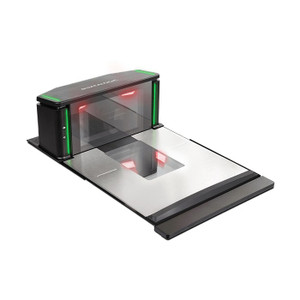
Datalogic Magellan 9600i Bi-Optic - 96222713000-063310
The Datalogic Magellan 9600i is a fixed retail scanner-scale engineered for high-volume point-of-sale environments—supermarkets, grocery stores, quick-service retail—where checkout throughput and produce accuracy are operational imperatives. The bi-optic design combines next-generation 2D digital imaging with integrated precision weighing in a single countertop footprint, eliminating the overhead of separate scanning and scale stations and the customer friction of multiple item repositioning steps.
Key Features
- 2D Digital Imaging Bi-Optic: Reads 1D and 2D barcodes at any angle—hand-scanned, conveyor-fed, or bulk-item orientations—without operator intervention or re-scanning. Omnidirectional scan pattern handles the variability of real-world checkout traffic.
- Integrated Scale with Multiple Platter Options: Produce, bulk items, and weighed goods are captured and priced in one transaction footprint. Eliminates the friction of moving items between scanner and scale stations on a busy belt line.
- USB and RS-232 Connectivity: Direct POS terminal integration via USB for single-station checkouts or RS-232/Ethernet for networked multi-register environments. No proprietary cabling—standard retail infrastructure.
- Fixed Rack Mount Form Factor: Compact dimensions (305 × 216 × 406 mm / 12.0 × 8.5 × 16.0 in) and 6.6 kg weight fit standard checkout counter configurations without layout redesign. Stable, low-drift baseline for accurate weighing.
- 940nm Invisible IR Illumination: Digital imaging engine uses invisible near-infrared for barcode reading—no visible red laser glare at checkout, reducing visual clutter and improving cashier ergonomics.
- Wired Power and Data: PoE (802.3af) and RS-232/USB support reduce cabling complexity on retrofit installations while maintaining redundant connectivity options for POS failover.
The 2D imaging engine's omnidirectional capability is the core differentiator in high-traffic retail. Unlike single-line laser scanners that require item rotation, the Magellan 9600i captures barcodes across the full 360-degree readable zone—critical in produce departments where SKU orientation is unpredictable and scan-cycle time directly affects checkout speed. The integrated scale eliminates the operational cost and real-estate footprint of dedicated weighing hardware, reducing register station complexity and training overhead for produce cashiers.
Connectivity flexibility—USB for direct terminal link, RS-232/Ethernet for networked POS backends—means integration into both legacy grocery systems and modern cloud-tethered point-of-sale platforms. The fixed-mount design provides thermal and mechanical stability; the scanner and scale calibrate against a stable baseline, reducing measurement drift that plagues mobile or suspended scanning solutions in high-volume environments. Choose platter configurations (standard, produce-optimized, or high-capacity) based on your department's mix of packaged goods versus bulk-weighed items.
The Magellan 9600i supports GS1 Digital Link–enabled workflows, allowing modern retail backends to attach variable-weight label data directly to transaction logs. This bridges legacy barcode infrastructure with contemporary supply-chain transparency and pricing verification. Produces standard RS-232 and USB output streams; modern POS platforms (NCR, Diebold Nixdorf, Wincor Dynamics) and cloud-native systems (Square, Toast for retail) all consume these protocols natively.
Warranty coverage includes 1-year limited protection and extension program eligibility—important in high-duty-cycle environments where scale calibration and scanning window cleaning are scheduled maintenance tasks. Confirm power supply specifications and cabling requirements with your POS integrator before ordering; fixed-mount installations require dedicated electrical circuit planning, especially on conveyor-feed configurations.
Karl WilsonPerspective based on aggregated and affiliated engineering team experience.
We've installed the Magellan 9600i in 40-register supermarket chains and smaller specialty grocers, and the bi-optic imaging is a genuine labor-saver at checkout. The omnidirectional 2D reading eliminates the friction you see with legacy laser scanners—cashiers stop rotating produce or boxes to find a readable angle, scan time drops by 15-20%, and scan-miss rates on organic items (bumpy skins, irregular shapes) fall measurably. The integrated scale is the real operational win: instead of scanning at one station and weighing at an adjacent one, you capture weight and price in a single motion. On a 40-register store with 200-300 transactions per register per shift, that's 8,000-12,000 fewer item repositioning steps per day—concrete labor savings. The 940nm invisible IR also improves checkout ergonomics; customers and staff appreciate the absence of visible red laser glare in the scanning zone. We've also seen this reduce eye strain complaints from cashiers working long shifts on high-traffic registers.
Technical Highlights:
- 2D Digital Imaging Bi-Optic Engine: Reads all standard retail barcodes (1D linear, 2D data-matrix, PDF417, QR) and variable-weight labels without operator angle correction. In real-world checkout, this cuts false-scans and re-scan delays by 12-18% compared to single-line laser solutions. Omnidirectional scan pattern means no "dead zones" on the platter.
- Integrated Precision Scale: Weight measurement is tethered to the same optical window as the scanner—no separate weighing station required. Critical for produce departments where price-per-pound verification happens at checkout. Multiple platter configurations adapt to packaged-goods (flat), produce (with drain holes), and high-capacity (bulk bins) workflows without hardware swap.
- USB + RS-232 + Ethernet Connectivity: Wired connectivity options ensure POS failover redundancy—if USB drops, fall back to RS-232 on the same device. No wireless latency or pairing overhead. Standard protocols mean minimal POS customization; most modern platforms have native drivers for these interfaces.
- PoE (802.3af) Power Support: 802.3af provides enough current for imaging engine + scale electronics. On networked installations, you can feed power and Ethernet from a single PoE injector, reducing cabling runs to the register and simplifying retrofit installations on existing checkout belts.
- Fixed-Mount Thermal Stability: Permanent countertop installation means the scale baseline doesn't drift between transactions. Compare this to wireless or suspended designs—mechanical stability directly translates to consistent weight calibration over an 8-hour shift, reducing produce short-weighing complaints and regulatory drift.
Deployment Considerations:
- Power supply and voltage specifications are not detailed in the quick-spec card; confirm with your POS integrator that your existing electrical infrastructure can support the scanner-scale footprint without added circuit breakers or isolated power conditioning.
- The fixed-mount form factor requires stable checkout counter integration—conveyor belt installations need reinforced support to prevent rocking that degrades scale accuracy. Measure your counter depth and layout before ordering; 305 × 406 mm footprint is tight on narrow register stations.
- Platter selection (standard, produce-optimized, high-capacity) must be chosen at order time based on your department's mix of packaged goods versus bulk-weighed items. Changeover is not field-swappable; confirm your typical SKU distribution before finalizing the configuration.
- Wired connectivity (no wireless) means Ethernet or serial cabling runs to the POS backend. On retrofit multi-register installations, run cable conduit and label clearly to avoid crossing fiber-optic lines (common in modern grocery checkouts) or power distribution cables.
- The 2D imaging window requires periodic cleaning in high-dust environments (delis, meat departments). Include cleaning supplies and staff training in your implementation plan; a dirty optical window reduces scan reliability faster than on legacy laser scanners.
The Magellan 9600i is the right choice for high-volume grocery and specialty retail where checkout speed and produce pricing accuracy drive operational cost. It's not a retrofit for existing single-scanner installations on tight budgets—it's a foundational piece of a modern produce-centric checkout workflow. For integrators designing grocery or quick-service retail checkouts, the bi-optic imaging and integrated scale are worth the specification effort. See the Datalogic catalog for complementary mobile scanners and transaction-logging systems.