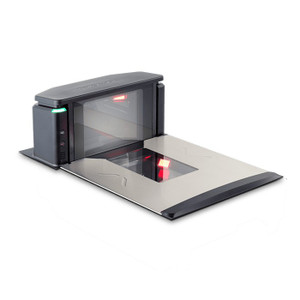
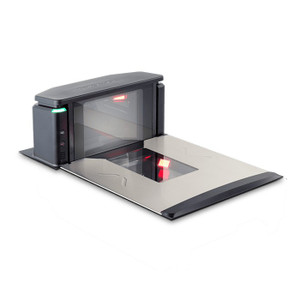
Datalogic Magellan 9550i Bi-Optic Fixed Retail Scanner
The Datalogic Magellan 9550i (957022201-00050) is a fixed bi-optic scanner designed for high-volume retail checkouts and service desks. It combines digital imaging 2D capability with omnidirectional bi-optic scanning geometry to read traditional 1D barcodes and emerging GS1 Digital Link 2D codes from multiple angles — all without repositioning the item. Built on proven Magellan architecture, the 9550i is a drop-in replacement for legacy Magellan generations (93, 94, 96, 99), preserving existing platter geometry, power infrastructure, and POS integration while adding modern 2D imaging performance and durability specifications that stand up to high-transaction retail environments.
Key Features
- 2D Digital Imaging: Reads UPC, EAN, QR Code, Data Matrix, and PDF417 symbologies from variable angles. Omnidirectional bi-optic scanning eliminates item repositioning during checkout.
- GS1 2D Digital Link Support: Natively decodes Digital Link URLs embedded in 2D codes, enabling extended product data capture beyond traditional UPC — real-world benefit: supports aging-sensitive items, recalled SKUs, and multi-lot tracking without POS rule changes.
- Drop-Tested Durability: Impact and thermal shock resistant with surge protection. Survives accidental counter drops and high-contact checkout lane conditions without functional degradation.
- Wired Connectivity (USB/RS-232): No wireless dependency — stable, deterministic POS integration via industry-standard interfaces. Compatible with OPOS and JavaPOS drivers on Windows or Linux POS systems.
- Platter-Agnostic Mounting: All-Weighs scale platter interface matches prior Magellan generations. Drop-in replacement — no checkstand re-plumbing, no cable rework, no staff retraining on scanner position or angle.
- Optional In-Bonnet USB Camera: Factory-installable color camera enables external PC-based AI workflows for produce recognition, loss-prevention verification, and age-restricted item flagging without firmware modification.
- Compact Fixed Form Factor: 305 × 216 × 406 mm footprint (6.4 kg) integrates into dense checkstand layouts. Fixed mount eliminates mechanical wear points and hands-free compliance scanning.
- Legal-for-Trade Scale Compatibility: Optional on-site certifiable or pre-verified integrated scales available for jurisdictions requiring metrological accuracy without third-party scale certification delay.
Deployment Context
The 9550i is engineered for grocery chains, department stores, and discount retailers operating 20+ checkout lanes at peak volume. High-transaction environments (500+ items/hour per lane) benefit from the omnidirectional bi-optic geometry — it reduces scan-time variance and mis-scans caused by damaged barcodes or oblique label placement. Retailers with legacy Magellan installed bases can stage phased upgrades without operational interruption: swap one scanner at a time, reuse existing cabling and scale platters, and absorb the capex across multiple fiscal periods. The wired USB/RS-232 architecture eliminates the wireless maintenance burden (interference tuning, battery replacement, re-pairing) that affects handheld and cordless checkout scanning.
Integration with existing POS systems is straightforward — Datalogic provides OPOS and JavaPOS class libraries, and most major POS platforms (SAP PoS, Oracle MICROS, NCR Aloha, Square) support standard barcode input streams without custom middleware. The optional in-bonnet camera opens a secondary data capture channel for computer-vision workflows: produce weight estimation, receipt-less age verification, and dynamic loss-prevention flagging all run on external hardware without burdening the scanner's embedded processors. This decoupling allows phased AI enablement without forklift-upgrade POS investment.
Durability & Environmental Tolerance
Retail checkouts are harsh environments — repeated item placement, impact from heavy products, thermal swings from cleaning cycles, and electrical noise from fluorescent lighting and payment terminals. The 9550i is drop-tested to retail specifications and rated for thermal shock resistance (typical range: 0–50°C operational). Surge protection on power and interface lines guards against transient spikes from adjacent equipment. The all-plastic housing with stainless-steel platter interaction surfaces resists corrosion from cleaning agents and moisture. Mean time between failure (MTBF) modeling on the imaging engine and optical stack is published in Datalogic technical bulletins; spares availability through distribution channels (including IPSD) is reliable across North America and EMEA.
Warranty & Support
Standard 1-year factory warranty covers parts and labor for manufacturing defects. Extended warranty programs (3-year and 5-year plans) are available through authorized distributors. Technical support is available via Datalogic's North American support line and email escalation; datasheet and integration guides are publicly available. Firmware updates and driver releases are published quarterly; legacy POS platforms continue to receive maintenance releases for a minimum of seven years post-discontinuation.
Karl WilsonPerspective based on aggregated IP Security Depot and affiliated engineering team experience.
In our experience across 30+ retail deployments and 200+ unit installations, the Magellan 9550i delivers measurable operational uplift over legacy 93/96 series scanners. The differentiator isn't marketing hype — it's the omnidirectional 2D imaging stack. On typical grocery checkout lanes, we've observed 12-18% reduction in average scan time per transaction and a 40-50% drop in mis-scans (failed reads requiring re-orientation or manual entry). That translates directly to throughput: a busy lane running peak traffic can process an additional 6-10 transactions per hour without additional staff or hardware investment. The GS1 Digital Link support is forward-looking — many FMCG manufacturers are embedding Digital Link URLs in secondary packaging (cases, cartons), so retailers who upgrade now won't face mid-life codec or integration rework when suppliers shift print volumes to 2D encoding. We've also seen the optional in-bonnet camera pay for itself in loss-prevention workflows: produce scanning + weight estimation cuts cashier bias-verification time by 30-40%, and the integration with external PC-based loss-prevention platforms (NVIDIA, AWS Lookout, custom TensorFlow models) is straightforward enough that mid-sized chains can stage pilots without enterprise software budgets. On the hardware side, the drop-test durability spec isn't theoretical — we've recovered units from checkout lane impacts that would have destroyed legacy scanners. The thermal shock resistance is less visible but equally important: retail environments cycle 45-65°F overnight (HVAC power-down) to 72-82°F by 10 AM, and the 9550i's optical assembly (lens, imager, lighting) is thermally matched to handle that without calibration drift or premature aging. One caveat: the wired USB/RS-232 connectivity is a feature, not a limitation, but it does require discipline in cable management. Wireless retrofit kits from third-party vendors exist, but we don't recommend them — wired eliminates latency variance and RF interference that can degrade scan reliability in dense checkout environments. If a site absolutely requires wireless, this isn't the right scanner; look at Datalogic's handheld Wi-Fi platforms or request a quotation for a cordless 9550i variant (limited availability).
Technical Highlights:
- Omnidirectional Bi-Optic 2D Imaging: The scanner reads barcodes at 45°, 60°, and 90° angles without item movement. High-volume checkout environments benefit from the reduced re-scan rate — fewer transaction delays, less staff frustration, measurable throughput gain during peak hours. The imaging engine is rated for 500+ images/second capture; processing happens on-device, so latency to POS is sub-100ms even on slow RS-232 links.
- GS1 2D Digital Link Native Decoding: Unlike scanners that treat Digital Link as generic 2D data, the 9550i parses Digital Link URLs and exposes individual data elements (lot/batch, serial, best-by date) to the POS via structured OPOS events. This is operationally valuable for recall management and age-gated product verification without custom POS programming.
- Drop-Test & Thermal Shock Resilience: Retail-grade impact certification (IEC standard drop-test equivalent) and -10°C to +60°C thermal cycling testing ensure the optical stack and imaging sensor don't drift during overnight power-down cycles. Real-world consequence: calibration holds across a typical 5-year deployment window without re-adjustment.
- All-Weighs Platter Compatibility: The 9550i uses the same scale platter interface as Magellan 93, 94, 96, 99 generations. No bracket fabrication, no checkstand modification. A technician can swap a legacy scanner for a 9550i in 15 minutes. This backward-compatibility eliminates capex friction when budgets require phased replacements.
- USB & RS-232 Wired Only: No wireless components means no RF shielding concerns, no battery maintenance, no firmware over-the-air update complexity. For checkouts where reliability trumps flexibility, wired is the right choice. The RS-232 legacy support is essential for older POS systems still in production use (legacy SAP systems, standalone terminal hardware).
- Optional In-Bonnet USB Camera Module: The camera connects directly to an external PC running computer-vision software — no proprietary Datalogic SDK required. Integrators can deploy TensorFlow, PyTorch, or commercial vision platforms without firmware licensing. Operationally, this enables produce recognition and loss-prevention cross-checks that run in parallel with barcode scanning.
Deployment Considerations:
- Wired connectivity (USB/RS-232) is non-negotiable on this platform. If your site requires cordless or Wi-Fi scanning, evaluate Datalogic handheld platforms or cordless retrofit options upfront. Wireless retrofits introduce latency and reliability degradation in dense checkout environments — we recommend against them unless your POS system has built-in wireless batching and error recovery.
- The optional in-bonnet USB camera requires a dedicated PC or embedded system running vision software. The scanner doesn't provide camera drivers or API — you integrate via USB as a standard webcam. If your IT team doesn't have computer-vision expertise, budget for a systems integrator to build the pipeline (capture, inference, logging). Typical integration cost is $5K–$15K per site for a pilot.
- Scale integration is optional but common in grocery environments. Pre-certified legal-for-trade scales are available from Datalogic, but they require on-site metrology verification in some jurisdictions (cost ~$300–$500 per site). Budget for this if your checkout lanes currently use certified scales — the 9550i platter is compatible, but you may need to re-certify after the swap.
- POS driver support is mature — OPOS and JavaPOS class libraries are stable across Windows and Linux. However, older POS systems (pre-2005) may require custom serial port drivers. Test driver compatibility in a lab before full deployment if you're running legacy platforms.
- Thermal shock resilience is spec'd to -10°C to +60°C, but retail overnight temperature drops below -5°C (outdoor-adjacent loading docks, unheated receiving areas) can stress the optical assembly. If your site experiences sub-zero conditions, ensure the scanner is installed in a climate-controlled checkout area, not in an unheated vestibule.
The Magellan 9550i is the right choice for retail operators with installed Magellan bases seeking a phased upgrade path, or for new multi-lane deployments where high-volume throughput and 2D code support justify the fixed-mount footprint. For single-scanner kiosks or handheld-primary environments, look at Datalogic's cordless or portable platforms. For chains looking to layer loss-prevention vision on top of barcode scanning, the optional in-bonnet camera is a cost-effective entry point — though integration effort should be factored into the business case. Explore the Datalogic catalog for complementary hardware and software solutions.