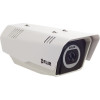
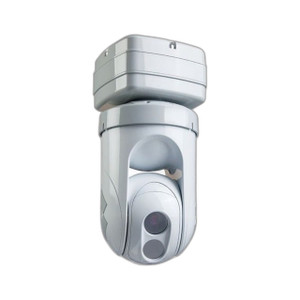
FLIR 427-9030-07-00 Fixed Thermal Security Camera
The FLIR 427-9030-07-00 is a fixed thermal imaging camera built for perimeter and critical-infrastructure detection where visible-light cameras fail — total darkness, smoke, fog, and glare. It uses an uncooled VOx microbolometer at 320x240 thermal resolution to detect heat signatures rather than reflected light, which is why thermal cameras like the 427-9030-07-00 catch intrusions that IR-illuminated cameras miss beyond their illuminator range. This is a detection tool first, not an identification camera — pair it with a visible-light camera on the same pole if you need to identify faces or read plates.
Overview
Thermal sensors don't need any light source to form an image; they read the heat differential between a person or vehicle and the background scene. That makes the 427-9030-07-00 a fit for open perimeters, fence lines, and yard approaches on FLIR's thermal and visible camera line where installing IR illuminators across hundreds of feet isn't practical. The 320x240 resolution is modest compared to megapixel visible cameras, but resolution isn't the relevant metric for thermal detection — thermal contrast against the background is, and that's a function of the microbolometer's sensitivity, not pixel count.
Key Features
- 320x240 Uncooled VOx Microbolometer: Vanadium oxide microbolometers hold detection performance over years of continuous operation without the moving parts or maintenance cycle of a cooled thermal sensor — relevant for a camera mounted on an unmanned perimeter pole you don't want to service every season.
- NETD <50 mK thermal sensitivity: A lower noise-equivalent temperature difference means the sensor resolves smaller heat differences against the background — the practical effect is better detection of a person walking a tree line at dusk versus a camera with a noisier, higher-NETD sensor.
- 30 Hz frame rate (US) / 8.3 Hz (export): Full 30 Hz output tracks a moving subject smoothly for live monitoring and VMS motion analytics; the 8.3 Hz export variant exists for units shipped under ITAR-restricted frame rate limits — confirm which variant you're ordering before deployment planning.
- IP66 environmental sealing: IP66 stops driving rain and wind-blown dust from reaching internal electronics on an outdoor pole or wall mount. It is not a submersion rating — don't spec this for underwater or pressure-washed applications that need IP67/IP68.
- -50°C to 75°C operating range: This is a wide-swing rating built for exposed sites — arctic perimeter fencing, desert substations, rooftop equipment yards — where a standard-rated commercial camera would shut down or drift out of spec.
- PoE+ or 24 VAC power: PoE+ lets you run data and power over one Cat5e/6 run from a PoE+ switch, cutting conduit and electrician time versus a dedicated 24 VAC circuit. The 24 VAC option stays available for sites already wired for legacy analog camera power.
- ONVIF Profile S, RTSP, and H.264: Profile S conformance means the 427-9030-07-00 integrates into any ONVIF-compliant VMS without a proprietary driver, and RTSP gives you a direct stream path if you're building a custom monitoring integration. H.264 keeps bandwidth and storage load predictable on existing NVR infrastructure — pair it with a compatible network video recorder sized for the channel count.
- NDAA-compliant: Clears Section 889 procurement restrictions for federal, state, and local government projects and any contractor work that flows through federal funding — a hard requirement on public-sector and critical-infrastructure bids, not just a nice-to-have.
Integration & Compatibility
The 427-9030-07-00 speaks ONVIF Profile S over RTSP, so it drops into most commercial VMS platforms without a custom plugin. Because it's a detection-focused thermal unit rather than a full analytics platform, plan your fence-line or perimeter design around pairing it with your VMS's video motion or line-crossing analytics rather than expecting onboard deep-learning object classification — the evidence here doesn't support onboard analytics claims, so don't spec it as an all-in-one AI camera. For sites that need both detection and identification, budget for a second visible-light camera on the same mount and review outdoor IP camera options with matching IP66 ratings so both units survive the same environment. If you're new to mixing thermal and visible sensors on one perimeter, a camera selection guide is worth a read before finalizing the bill of materials — thermal coverage math works differently than lux-based visible camera coverage. Power planning matters too: confirm your PoE+ switch has budget headroom before adding this unit to an existing PoE switch run, since undersized PoE budgets are a common install-day surprise on multi-camera thermal deployments.
Frequently Asked Questions
Q: Is the FLIR 427-9030-07-00 NDAA-compliant?
A: Yes. The 427-9030-07-00 is NDAA-compliant, which clears it for federal Section 889 procurement and government-funded infrastructure projects.
Q: What resolution does the 427-9030-07-00 thermal sensor use?
A: It uses a 320x240 uncooled VOx microbolometer with thermal sensitivity (NETD) under 50 mK.
Q: Can the 427-9030-07-00 run on Power over Ethernet?
A: Yes. It accepts PoE+ or 24 VAC power, so it can run on a single Ethernet cable from a PoE+ switch or on existing 24 VAC wiring.
Q: What IP rating does the 427-9030-07-00 carry, and can it be mounted outdoors?
A: It's rated IP66, which protects against driving rain and dust for outdoor pole, wall, or fence-line mounting. It is not rated for submersion.
Q: What's the operating temperature range on the 427-9030-07-00?
A: -50°C to 75°C, rated for extreme cold and heat exposure on exposed perimeter sites.
Q: Does the 427-9030-07-00 work with third-party VMS platforms?
A: Yes. It supports ONVIF Profile S, RTSP, and H.264, which covers integration with most ONVIF-compliant VMS software.
I spec thermal units like the FLIR 427-9030-07-00 (often searched as 427 9030 07 00) for perimeter jobs where the client wants to know someone's approaching the fence line before they're close enough for a visible camera's IR illuminator to matter. NETD under 50 mK is the number I actually look at first on a thermal spec sheet — it tells you how well the sensor separates a body from background clutter, not the resolution number everyone fixates on.
Technical Highlights:
- NETD <50 mK: Sub-50 mK sensitivity keeps a walking person's thermal signature distinct from ambient background noise, which is what actually drives reliable detection range in the field — not raw pixel count.
- -50°C to 75°C operating range: I've had commercial-grade cameras choke in a hard freeze; this range covers sites from cold-storage yards to desert substations without a heated enclosure.
- PoE+ or 24 VAC power: Gives you flexibility on retrofit jobs — if the site already has 24 VAC analog camera wiring in place, you're not forced to run new Cat6 to every pole.
Deployment Considerations:
- Confirm frame rate variant before ordering — the 30 Hz US version and the 8.3 Hz export-restricted version are not interchangeable once a job is quoted for continuous motion tracking.
- 320x240 resolution means this is a detection camera, not an identification camera — don't sell it as a face or plate reader; pair it with a visible-light camera on the same pole for ID-grade footage.
This is the unit I reach for on unmanned substation perimeters and long fence-line runs where an intrusion needs to be flagged in total darkness before someone reaches the fence, not after.