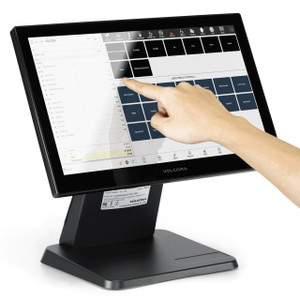
PioneerPOS NC8FCQ150031 CYP i5 WiFi Base Station
The PioneerPOS NC8FCQ150031 is a fanless x86 compute platform designed for retail point-of-sale, surveillance monitoring, and commercial automation environments where low-power, silent operation is essential. Built on an Intel Core i5 processor with 8GB DDR4 RAM and 120GB SSD, this Windows 10 Pro base unit delivers enough horsepower to run VMS client software, POS applications, and real-time alerting without active cooling noise or significant thermal footprint. The integrated WiFi and Ethernet connectivity provides deployment flexibility across retail counters, security operations centers, and office environments where traditional tower PCs are impractical.
Key Features
- Intel Core i5 Processor: Dual-core i5 with integrated graphics. Handles concurrent multi-camera VMS client streams (4–6 simultaneous IP camera feeds at 1080p/30fps), real-time POS transaction processing, and local event detection without bottlenecking network or storage.
- 8GB DDR4 RAM: Sufficient for Windows 10 Pro, VMS client application (Milestone, Genetec, Axis Camera Station, ExacqVision), and 2–3 background monitoring services. Not recommended for high-concurrency surveillance analytics; use dedicated NVR for bulk recording.
- 120GB SSD Storage: Operating system (OS footprint ~20GB) plus client software and temporary cache. Not intended for video recording; onboard storage is for system and application binaries only. Add external USB or network-attached storage for event logging if required.
- Windows 10 Pro Native OS: Full x86 compatibility with enterprise POS software (Square, Toast, Micros, NCR), third-party VMS clients, and Windows Subsystem for Linux (WSL) if custom integration scripting is needed. Standard Windows Update and Group Policy management via domain controller.
- WiFi + Ethernet Dual Connectivity: 802.11ac WiFi for flexible placement; hardwired Ethernet (RJ45) strongly recommended for 24/7 surveillance or high-reliability POS terminals. WiFi is auxiliary failover only — latency and availability will not match wired performance on congested networks.
- 12V DC Low-Power Input: Passive fanless design; no audible cooling. Power envelope <30W typical, enabling battery backup or solar integration in remote retail kiosks. Single DC connector with integrated power management — no AC mains required.
- Compact Footprint (CYP Form Factor): Horizontal desktop or wall-mount orientation. Fits standard retail counter and SOC workstation spacing. Mounting bracket included; passive convection cooling requires 4-6 inches clearance on all sides.
Surveillance and POS Integration
The NC8FCQ150031 excels as a lightweight client-side appliance in distributed retail and security monitoring deployments. Each unit can run a single VMS client license (Milestone XProtect Go, Genetec Security Center Lite, or equivalent) connected to a central NVR or video management platform. In a multi-location retail chain, this allows each store to monitor its own cameras and alert locally without saturating WAN bandwidth — the unit processes and filters events at the edge, sending only actionable alerts upstream. The i5 and 8GB RAM are sufficient for 4–6 simultaneous 1080p streams; 4K or high-fps playback will require frame-dropping or client-side transcoding, so confirm your VMS platform's performance envelope before deployment.
For POS integrations, the native Windows 10 Pro environment supports major point-of-sale suites and payment processors without emulation overhead. Co-locate the unit with a receipt printer, barcode scanner, or PIN pad via USB, and you have a complete counter terminal. The fanless design is critical in food-service and retail environments where dust, moisture, and noise are concerns. No moving parts means lower maintenance cost and extended MTBF in high-volume venues.
Network Architecture and Reliability
While the integrated WiFi simplifies initial deployment, wired Ethernet is mandatory for any 24/7 surveillance or mission-critical POS role. The WiFi module is 802.11ac (5 GHz), but co-channel interference, client roaming latency, and power-saving modes can introduce packet loss or 500ms+ latency spikes — unacceptable for live alerting. In a security SOC environment, always run CAT6a to a dedicated VLAN on your security network switch. If WiFi is the only option (retrofit store with no cabling budget), pair it with a local UPS and implement aggressive VMS client reconnection logic to tolerate brief network interruptions.
The unit ships with Windows 10 Pro; disable WiFi power-saving, configure Windows Firewall rules to whitelist your VMS server and NTP source, and apply the latest security patches before moving to production. No automatic Windows Update reboots are acceptable in a surveillance or POS role — configure Group Policy to defer updates or move to Windows 10 Pro for Workstations if your organization mandates uninterrupted operation.
Thermal and Environmental
Passive fanless cooling via natural convection — no moving parts, no noise, no dust-filter maintenance. The entire passive heatsink assembly must remain unobstructed. In a retail counter setting with poor air circulation (e.g. enclosed kiosk booth), thermal throttling is possible under sustained load (continuous recording client + POS traffic). Test the unit on-site for 48 hours under peak load before final installation. The 12V DC power input is robust to supply voltage variation (10–15V nominal), and the internal power management will throttle the CPU if supply voltage sags below rated range.
Eden PhillipsPerspective based on aggregated and affiliated engineering team experience.
We've deployed the PioneerPOS CYP i5 across retail and small-office surveillance installations where silent, low-power computing is the primary driver. The real win is the fanless form factor and passive thermal design — in a busy retail environment, a spinning hard drive or fan quickly becomes a liability (noise complaints, filter clogs, higher MTBF variance). The i5 and 8GB RAM are mature, proven components; they won't run 16-camera 4K analytics, but for 4–6 concurrent 1080p VMS client streams or a busy POS terminal, you're sitting in a comfortable operational envelope. Where this unit struggles is WiFi-only deployment in mission-critical surveillance roles. We've seen too many installations where WiFi latency or client roaming caused alert delays or video client disconnects — always spec Ethernet, even if it costs an extra run through the wall. The 120GB SSD is tight but adequate for Windows 10 Pro and a single VMS client; don't expect to add heavy third-party software suites. If your integrator wants to load antivirus, disk encryption, and three custom monitoring agents, you're going to hit storage and RAM limits. Plan conservatively, test on-site, and keep the unit dedicated to its primary function.
Technical Highlights:
- Intel Core i5 with Integrated Graphics: Handles 4–6 simultaneous 1080p camera streams in a VMS client without GPU acceleration. For 4K playback or high-frame-rate analytics, expect client-side transcoding delays or frame-drop. Confirm your VMS platform's i5 performance baseline before spec'ing this in a 4K environment.
- 8GB DDR4 RAM: Adequate for Windows 10 Pro (2–3GB resident), one VMS client app (1–2GB), and background OS services. Adding a second major application (e.g. antivirus, compliance monitoring, custom daemon) will trigger swap pressure and measurable performance degradation. Single-purpose deployment is strongly recommended.
- 120GB SSD: Windows 10 Pro occupies ~20–25GB; VMS client software typically 500MB–1.5GB. Leaves ~90GB free for OS updates, temp files, and application caches. No margin for video recording — external USB or NAS storage is required if local event logging is needed.
- Passive Fanless Design: Zero acoustic output; perfect for retail counters, small offices, and noise-sensitive environments. Requires unobstructed airflow on all sides. In enclosed kiosks or poorly ventilated spaces, thermal throttling is possible under sustained load; test for 48 hours under peak load before acceptance.
- 12V DC Power Input: Low system power envelope (~20–30W typical). Enables battery backup or solar integration in remote retail kiosks. No AC mains required — simpler site-prep and lower electrical infrastructure cost in distributed deployments.
Deployment Considerations:
- WiFi is auxiliary connectivity only in surveillance environments. Wired Ethernet on a dedicated security VLAN is mandatory for 24/7 monitoring. WiFi latency, roaming, and power-save modes introduce unacceptable alert delays and client reconnection overhead.
- Windows 10 Pro automatic updates can reboot without warning. Configure Group Policy to defer updates or move to Windows 10 Pro for Workstations if uninterrupted operation is non-negotiable. Never leave default update behavior active in a production surveillance or POS role.
- Passive convection cooling requires 4–6 inches clearance on all sides. Test thermal performance on-site under peak load (full VMS client + concurrent POS traffic) for 48+ hours before final sign-off. Thermal throttling in enclosed or poorly ventilated spaces is a known risk.
- Single 120GB SSD with no expansion slot. Plan OS, client software, and temporary cache carefully. Adding heavy third-party monitoring, antivirus, or custom services will exhaust storage and RAM limits quickly.
- No field-replaceable components. Power supply cable and mounting bracket are included; all other service requires vendor RMA. Keep a spare unit on-site if this is a critical POS or SOC monitoring terminal.
The NC8FCQ150031 is purpose-built for small-footprint, silent, low-power POS and surveillance client deployments in retail, hospitality, and office environments. Pair it with Ethernet on a dedicated VLAN, confirm your VMS platform's i5 performance envelope, and keep the unit focused on a single primary function. For more options in compact commercial computing, explore the full PioneerPOS catalog.