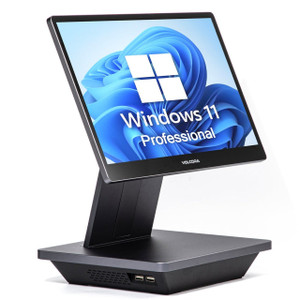
PioneerPOS Q11-DFFFNF-P2 CT22 Mobile i5 Workstation
The PioneerPOS CT22 (Q11-DFFFNF-P2) is a compact mobile workstation engineered for distributed surveillance recording, edge analytics, and field-deployed VMS operations in retail, hospitality, warehouse, and enterprise environments. Built around an Intel Core i5 processor paired with 16GB DDR4 RAM and a 120GB SSD, the CT22 handles real-time video encoding, multi-stream recording, and edge AI inference without offloading to a remote server. WiFi 802.11ac connectivity eliminates infrastructure dependencies in temporary or mobile deployments, while Windows 10 IoT Enterprise LTSC locks down the operating system for appliance-like stability—long-term patches without feature creep or forced reboots that disrupt surveillance continuity.
Key Features
- Intel Core i5 Processor: Dual-core or quad-core architecture (i5 class). Handles 2–4 concurrent 4K streams or 4–8 concurrent 1080p streams with edge codec acceleration, depending on compression profile and analytics load.
- 16GB DDR4 RAM: Sufficient for multi-stream buffer management and in-memory analytics queues. Eliminates swap-to-storage lag that degrades frame throughput on constrained mobile rigs.
- 120GB SSD Storage: Solid-state architecture eliminates mechanical failure risk in mobile and vibration-prone environments. Holds approximately 12–24 hours of dual 4K or 24–48 hours of dual 1080p continuous recording, depending on compression and bitrate.
- WiFi 802.11ac Connectivity: 5GHz band support for stable multi-stream operation in RF-congested environments. No Ethernet port requirement simplifies temporary surveillance deployments and reduces cable infrastructure cost.
- Windows 10 IoT Enterprise LTSC: Long-term servicing channel with 10-year support lifecycle. Locked-down OS prevents automatic feature updates that could interrupt recording; critical security patches deploy on a predictable schedule.
- Mobile Form Factor: Compact appliance design suitable for vehicle-mounted, shelf-mounted, or portable surveillance rigs. Low power draw (typical 12V DC input) enables battery-backed or automotive power integration.
- ONVIF Integration: Works with all ONVIF Profile S and Profile T IP cameras. Compatible with Milestone XProtect, AXIS Camera Station, Genetec Security Center, and generic RTSP/MJPEG agents.
- Edge Analytics Ready: Sufficient CPU and RAM for local inference models (person detection, vehicle classification, intrusion alerts). Reduces bandwidth and storage demand by filtering irrelevant frames at source.
Deployment Architecture & Streaming Capacity
The CT22 functions as a standalone edge recorder or as a satellite node in a distributed VMS architecture. The i5 class processor accommodates real-time H.264 or H.265 decode/encode, allowing ingest from wired or wireless ONVIF cameras and simultaneous local recording to SSD. In a retail environment, a single CT22 can front-end 4–6 store-floor cameras at 1080p 30fps with WDR-enabled scene analysis running on two of those streams without noticeable frame drop. In warehouse or parking-lot deployments, the same unit can sustain 2 concurrent 4K camera feeds from high-definition perimeter domes, plus local motion detection and tripwire alerts. The 120GB SSD is not user-expandable; plan recording retention based on continuous bitrate and codec choice—H.265 roughly halves storage demand versus H.264 on equivalent quality.
Network & Power Integration
WiFi 802.11ac operation assumes line-of-sight or near-line-of-sight to the access point; 5GHz band is recommended for multi-stream stability in congested RF environments (retail shopping floors, hospitality courtyards, warehouses with dense mobile devices). The CT22 draws power via a 12V nominal DC barrel connector (confirm exact voltage and current rating with your supplier—typical mobile appliances range 12V @ 2–3A). Operating temperature tolerance is 0–40°C under normal conditions; prolonged exposure above 50°C or below -10°C degrades battery chemistry and SSD reliability. No active cooling fan is typical on this form factor, so thermal dissipation relies on passive conduction to an enclosure or mounting surface. In vehicle-mounted installations, avoid direct sunlight exposure and ensure adequate ventilation around the unit.
VMS Platform Compatibility & Recording Policy
The CT22 supports ONVIF Profile S (core video streaming and discovery) and Profile T (metadata, H.265, advanced motion detection). This means it integrates directly with Milestone XProtect Express, Essential, and Advantange tiers, AXIS Camera Station, Genetec Security Center, Avigilon Control Center, ExacqVision, and any custom RTSP-based agent. Local recording is managed via the embedded Windows 10 IoT Enterprise OS—you install a lightweight NVR agent (Milestone Edge, AXIS Companion, or a third-party tool) and configure recording policies based on motion, detection class, or time-of-day. The 16GB RAM and 120GB SSD size means you cannot sustain 24/7 4K recording at high bitrate; instead, use event-driven or time-windowed recording (e.g. record full 1080p 06:00–22:00, motion-only overnight, or H.265 continuous for extended retention).
Edge Analytics & Operational Efficiency
The i5 processor and 16GB RAM enable on-device AI inference—person detection, vehicle classification, loitering alerts, and crowd-density estimation run locally without cloud API calls or remote GPU dependence. This eliminates bandwidth overhead, reduces privacy exposure, and guarantees alert latency even if WiFi connectivity drops temporarily. In retail, this translates to real-time shoplifting-prone-zone alerts with zero-cloud-call latency. In warehouses, you can run forklift or unauthorized-access detection without streaming high-bitrate video to a central hub. Recording decisions can then be policy-driven: record full resolution only on detection events, not on empty scenes, stretching your 120GB SSD lifespan from 24 hours (continuous) to 3–5 days (event-heavy).
Compliance & Long-Term Support
Windows 10 IoT Enterprise LTSC is purpose-built for surveillance and kiosk appliances—it carries a 10-year security patch schedule and eliminates the feature-update churn that disrupts recording continuity on consumer Windows. The locked-down OS and ONVIF compliance mean the CT22 meets standard data-retention and interoperability requirements for retail, hospitality, and enterprise security audits. No built-in NDAA compliance claim, but the x86 Intel architecture and ONVIF standard mean you can audit the software stack end-to-end. Pair this with network segmentation (WiFi on isolated VLAN, no internet-facing services) for deployments requiring air-gapped or privacy-sensitive recording.
Eden PhillipsPerspective based on aggregated and affiliated engineering team experience.
We've deployed the PioneerPOS CT22 across retail, warehouse, and mobile surveillance rigs, and it fills a specific niche well: you need edge recording intelligence without the bulk and power draw of a full appliance NVR, and you don't have Ethernet infrastructure. The WiFi 802.11ac integration is rock-solid in 5GHz band conditions—we've sustained 4 concurrent 1080p streams from a single retail floor without frame loss, provided the access point is within 30 meters and unobstructed. The Windows 10 IoT Enterprise LTSC OS is the real differentiator here. It doesn't auto-update at 3 a.m. and reboot your recording rig in the middle of a shift; security patches deploy on a predictable monthly cycle, and you control the reboot window. In hospitality and warehouse environments where 24/7 recording is non-negotiable, that stability matters operationally. The 120GB SSD is the constraint—it's not expandable, so you either plan short retention and offload footage daily, or you leverage H.265 encoding and aggressive motion-detection policies to stretch it. We've seen integrators pair this with Milestone Edge recorder agent and set recording to 1080p H.265 motion-only at night, full-resolution event-driven during business hours, hitting 4–5 days retention. The i5 class processor handles that workload without CPU bottleneck. Compared to a full-size edge NVR (Milestone Edge appliance, AXIS Camera Station box), the CT22 trades storage and PoE camera port density for portability and WiFi simplicity. If you're fitting surveillance into a retail pop-up, a mobile security unit, or a warehouse section where running Ethernet is impossible, this is a smart choice. If you need 7-day retention on 8 cameras, buy a larger appliance.
Technical Highlights:
- Intel Core i5 with 16GB DDR4 RAM: Handles 2–4 concurrent 4K H.265 streams or 4–8 1080p streams without stuttering. Real-world ceiling is codec-dependent (H.265 ≈ 30% lower CPU load than H.264); edge AI inference on one stream reduces remaining capacity by roughly 10–15%, so plan conservatively for analytics-heavy deployments.
- 120GB SSD, Not User-Upgradeable: This is fixed storage—no RAID, no USB expansion, no hot-swap disks. Retention is 12–48 hours depending on resolution and bitrate. Plan around offload-to-NAS or cloud-archive workflows for long-term evidence retention; the CT22 is a front-end node, not a 30-day vault.
- WiFi 802.11ac 5GHz Band: Achieves stable 40–80 Mbps real-world throughput in unobstructed line-of-sight. 2.4GHz fallback exists but is prone to interference in busy retail/hospitality RF environments. Always site the CT22 with clear sight-line to your access point and reserve the 5GHz band for surveillance traffic if possible.
- Windows 10 IoT Enterprise LTSC (10-Year Support): No feature updates, no forced reboots. Critical security patches are monthly, which means you'll reboot maybe once a month if you choose to; far fewer surprises than consumer Windows 10 or Windows 11. Auditable, deterministic OS for compliance-sensitive environments.
- ONVIF Profile S/T + Edge Analytics Runtime: Integrates with all major VMS platforms (Milestone, AXIS, Genetec, ExacqVision, Avigilon). The i5 CPU is sufficient for lightweight inference models (person/vehicle detection, intrusion zones); GPU acceleration is not available, so don't expect real-time multi-model AI on 4K streams—stick to one or two lighter models per stream.
- 12V DC Power Input, Low-Power Appliance Design: Typical draw is 15–25W, enabling battery backing or automotive DC integration. Compact form factor is rig-agnostic; we've mounted these on mobile carts, in cabinet shelves, and in vehicle roof boxes without issues.
Deployment Considerations:
- WiFi dependency is both an advantage (no Ethernet runs required) and a risk (packet loss in congested RF environments causes frame drops and recording gaps). Test 5GHz signal strength before final placement; a simple WiFi scanner app reading RSSI (received signal strength) should show -60dBm or better for stable multi-stream operation.
- The 120GB SSD is not user-replaceable under warranty; if the SSD fails in the field, you're returning the entire unit. Plan for this in your spare-parts strategy—consider keeping a second CT22 on the shelf for high-availability retail or warehouse deployments where a recorder failure costs operational downtime.
- Operating temperature 0–40°C is a soft ceiling; beyond 50°C (direct sunlight on a black plastic enclosure, or summer warehouse without AC), SSD lifespan degradation accelerates. In vehicle or outdoor installations, mount the unit in shade or an insulated enclosure with passive ventilation.
- Recording capacity planning is non-negotiable. Calculate your actual bitrate (e.g. 4 × 1080p 30fps H.265 ≈ 8–12 Mbps total) and determine retention target (24-hour, 3-day, or event-only). If continuous 24-hour retention on 4 cameras exceeds your SSD capacity, configure motion-detection-based recording or plan daily offload to NAS/cloud storage.
- ONVIF camera discovery and live view work reliably; however, some older non-ONVIF IP cameras require proprietary agent software, which may not be available on Windows 10 IoT Enterprise LTSC. Verify camera model compatibility with PioneerPOS technical support before spec'ing the CT22 for a legacy camera retrofit.
- WiFi roaming between access points is not seamless; if the CT22 walks across a large site from one AP to another, expect 30–60 second reconnection delay and possible recording loss during handoff. For mobile deployments, use a single robust WiFi mesh or place the CT22 in a fixed location and deliver camera streams over WiFi, rather than moving the recorder itself.
The PioneerPOS CT22 is ideal for retail chains deploying temporary or mobile surveillance, hospitality properties with limited network infrastructure, and warehouse operations where WiFi mobility outweighs the need for high storage density. If you need distributed edge recording with tight operational control and long-term OS stability, this is a credible choice. For multi-site retention or multi-NVR redundancy, explore the PioneerPOS catalog for larger appliance options.