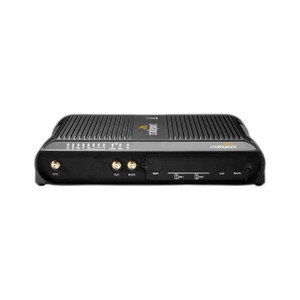
Cradlepoint TAA-MAA3-1700120B-NA IBR1700 Mobile Router
Overview
The Cradlepoint TAA-MAA3-1700120B-NA (IBR1700 Series) is a mobile-grade router purpose-built for in-vehicle and remote connectivity where standard fixed infrastructure isn't available. The unit integrates a 4-port Gigabit Ethernet switch with Wi-Fi 5 (802.11ac Wave 2) and multi-mode cellular support (3G and 4G), delivering 1.2 Gbps modem throughput. TAA compliance means it qualifies for federal procurement and GSA schedules — a hard requirement in many enterprise and government integrations. This is not a consumer-grade device; it's engineered for mobile deployment where network resilience and standards compliance matter.
Key Features
- 4-Port Gigabit Ethernet Switch: Provides wired connectivity for up to four devices (cameras, sensors, workstations) without a separate switch. Each port runs at full Gigabit speeds, so you're not bottlenecked on local network throughput between connected devices.
- Wi-Fi 5 (802.11ac Wave 2): Client devices can connect wirelessly at speeds competitive with modern laptop and tablet chipsets. Wave 2 includes multi-user MIMO, which helps when multiple wireless clients transmit simultaneously — practical in vehicle or warehouse scenarios with several mobile devices.
- Multi-Mode Cellular (3G/4G): The router automatically selects the best available cellular standard based on signal strength and coverage. This fallback capability is critical in rural logistics operations or areas with patchy LTE; the device won't drop to dead air if 4G signal falters.
- 1.2 Gbps Modem Throughput: Real-world cellular performance depends on signal strength and your carrier's network, but this modem ceiling is well above typical 4G LTE speeds in most U.S. markets. For warehouse automation or vehicle telemetry, this means you can sustain multiple simultaneous data streams without hitting the router's limit.
- TAA Compliance: Meets Trade Agreements Act requirements, eliminating procurement friction for federal buyers, state/local government, and large enterprises with TAA-only purchasing policies. Avoids the cost and delay of alternate approvals.
- IEEE 802.3 Ethernet and 802.11a/n/ac Wireless: Standard protocols ensure compatibility with any ONVIF-compliant camera, network appliance, or wireless client. No vendor lock-in on the wireless or wired side.
Integration & Compatibility
The TAA-MAA3-1700120B-NA works with standard IP-based devices: IP cameras via the Ethernet ports, standard enterprise network video recorders or cloud services over cellular, and any 802.11ac wireless client. Because it's ONVIF-compliant and exposes standard Ethernet, it integrates with most VMS platforms without custom drivers or firmware patches.
In mobile and edge scenarios — vehicle-mounted surveillance, temporary site monitoring, remote facility telemetry — the router's ability to seamlessly switch between cellular and Ethernet backhaul means you don't need to reconfigure cameras or recorders when the truck moves or the site changes coverage.
When to Choose a Different Model
If your deployment is stationary and you have fixed broadband (cable, fiber, or fixed wireless), a wired enterprise switch is likely cheaper and simpler. If you need higher cellular throughput (5G), look for newer models in the Cradlepoint lineup that support 5G NR. If you're not subject to TAA compliance, non-TAA variants may offer better pricing.
Deployment Context
This router excels in mobile command centers, armored vehicles, and temporary or rapid-deployment monitoring where you need a single device to consolidate Ethernet connectivity and provide cellular failover. Logistics companies use it to backhaul vehicle-mounted camera streams; security integrators deploy it in temporary event or disaster-recovery setups; and government agencies rely on it because TAA compliance removes procurement uncertainty.
Frequently Asked Questions
Q: Is the TAA-MAA3-1700120B-NA compatible with all IP cameras?
A: Yes, provided they support standard Ethernet (IEEE 802.3). Any ONVIF-compliant IP camera will work. Non-ONVIF proprietary cameras may work too if they use standard TCP/IP, but confirm with the camera manufacturer.
Q: Can I use this router indoors and outdoors?
A: The router itself is designed for mobile deployment (vehicle interiors, equipment enclosures). It is not rated for continuous outdoor mounting. Consult the detailed environmental specifications in the product datasheet for operating temperature and humidity limits.
Q: Does the TAA-MAA3-1700120B-NA support PoE power delivery to cameras?
A: No. The Ethernet ports are standard Gigabit connections without PoE injection. You'll need a separate PoE injector or PoE switch if your cameras require PoE.
Q: What is the cellular coverage requirement?
A: The router requires either 3G or 4G LTE signal. It will not function on 2G networks alone. 5G is not supported on this model. Coverage depends entirely on your carrier and location.
Q: Is firmware upgradeable?
A: Cradlepoint routinely releases firmware updates. Consult the manufacturer's support portal for details on update mechanisms and compatibility with your carrier and device configuration.
Ted PerryPerspective based on aggregated and affiliated engineering team experience.
The Cradlepoint TAA-MAA3-1700120B-NA stands out in mobile and edge deployments where TAA compliance is mandatory and cellular fallback is non-negotiable. The 1.2 Gbps modem throughput is more than adequate for most vehicle-mounted camera systems and IoT telemetry, and the 4-port Gigabit switch eliminates the need for a separate switching appliance in space-constrained mobile rigs.
Technical Highlights:
- 1.2 Gbps Modem Throughput: Supports multiple simultaneous video streams and sensor data uploads without cellular bottleneck — a meaningful advantage in multi-camera mobile deployments.
- 4-Port Gigabit Ethernet: Full line-rate switching between connected devices means no internal switch fabric constraints; cameras, edge recorders, and workstations communicate at wire speed.
- Wi-Fi 5 with 802.11ac Wave 2: Multi-user MIMO handles several wireless clients in the same vehicle or work area without significant throughput degradation, useful when field technicians need mobile device connectivity alongside static camera and sensor streams.
- TAA Compliance: Eliminates procurement delays and alternate-approval costs in federal, state, and large enterprise buying cycles — quantifiable savings in RFQ cycles.
Deployment Considerations:
- The router does not include PoE; cameras must be powered separately or via a standalone PoE injector, adding bulk and power draw in tight mobile enclosures.
- 3G/4G performance is carrier- and location-dependent. In areas with weak signal, throughput will degrade significantly below the 1.2 Gbps ceiling. Always validate carrier coverage maps for your deployment zones before committing.
- No built-in environmental hardening; the device is rated for vehicle interiors and controlled enclosures, not continuous outdoor exposure. If mounted on a vehicle exterior, use a weatherproof enclosure rated for your climate.
Best fit: government and enterprise mobile surveillance, vehicle telematics, temporary or rapid-deployment monitoring where TAA compliance is a purchase gate and cellular is the primary backhaul. Less suitable for stationary, fixed-broadband environments or deployments requiring 5G or on-board PoE injection.