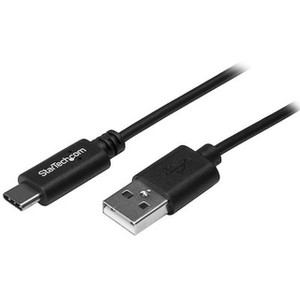
StarTech USB2AC1M USB-A to USB-C Cable, 3.3 ft
Overview
The StarTech USB2AC1M is a 1-meter (3.3 ft) USB 2.0 Type-A to USB Type-C cable built for connecting USB-C peripherals to standard USB-A host ports. USB-IF certified and constructed with a dual-layer aluminum-Mylar foil plus braid shield, this cable is engineered for reliable data transfer at 480 Mbps — the full USB 2.0 theoretical ceiling — without the signal degradation that afflicts cheaper unshielded alternatives. If you're deploying USB-C devices in commercial environments and need a cable that meets spec rather than approximately meets spec, USB2AC1M is worth the consideration.
For integrators wiring USB-C barcode scanners, access control readers, or enrollment stations into a rack or workstation, the 1-meter length keeps cable runs tidy without excess slack. This is not a high-wattage charging cable or a USB 3.x data cable — understand those boundaries before specifying it.
Key Features
- USB-IF Certified: USB2AC1M carries USB Implementers Forum certification, meaning the cable has been independently tested to the USB 2.0 specification. In practice, this reduces the risk of enumeration failures, intermittent disconnects, or device compatibility complaints — problems that plague uncertified alternatives.
- 480 Mbps Data Rate: USB 2.0 Hi-Speed throughput at 480 Mbps is sufficient for virtually every USB-C peripheral that doesn't require mass storage or video — scanners, badge readers, enrollment cameras, audio devices, and most HID peripherals run well within this ceiling. If your device requires USB 3.x speeds, this cable is not the correct choice.
- Dual-Layer Shielding — Aluminum-Mylar Foil + Braid: The combination of aluminum-Mylar foil and a braided outer shield provides both high-frequency noise rejection (foil) and low-frequency interference protection (braid). In environments with motor drives, fluorescent lighting, or other EMI sources — common in warehouses and industrial spaces — this matters for maintaining a clean signal.
- 20/28 AWG Wire Gauge: The 20 AWG power conductors (heavier gauge = less resistance over the cable run) paired with 28 AWG data conductors follow USB 2.0 best practices. This gauge combination supports adequate power delivery for bus-powered USB-C devices without excessive voltage drop across the 1-meter run.
- Nickel-Plated Connectors: Nickel plating on both the USB-A and USB-C connectors provides corrosion resistance and maintains consistent contact resistance through repeated insertion cycles. For shared workstations or enrollment kiosks where cables are plugged and unplugged frequently, this extends connector service life compared to bare copper.
- PVC Jacket with 0.6 in width and 0.3 in height profile: The flexible PVC jacket keeps the cable manageable in tight spaces. At 1.4 oz (41 g), it won't stress connector ports on lightweight tablets or thin clients when routed to the side.
- Lifetime Warranty: StarTech backs the USB2AC1M with a lifetime warranty — an unusual commitment for a cable at this price tier and a meaningful signal that the product is built to specification rather than to a cost floor.
- Operating Temperature 0°C to 35°C: Rated for standard indoor commercial environments. This is not a cable for outdoor enclosures or unheated warehouse spaces in winter — storage temperatures extend to -10°C to 80°C, but operating range is office/datacenter standard.
Integration and Compatibility
The USB2AC1M connects any USB 2.0 Type-A host port to a USB Type-C device. This covers a wide range of current peripherals — USB-C enrollment scanners, fingerprint readers, badge printers, web cameras, and HID input devices. The USB-C end is not reversible in terms of the cable itself (it has a defined A end and a C end), but the USB-C connector on the device side inserts in either orientation as the standard allows.
This cable is USB 2.0 only. It will not unlock USB 3.x transfer speeds even if both the host and device support them — the 20/28 AWG construction and USB 2.0 certification define the performance ceiling. For USB 3.x applications, specify a cable with the appropriate SuperSpeed rating and AWG profile. For USB cable accessories including USB 3.x and USB-C to USB-C options, review the full StarTech cable lineup.
Pairing this cable with USB-C access control readers or enrollment peripherals connected to a StarTech USB hub or workstation dock is a common deployment pattern. Ensure the host port or hub provides adequate bus power (500mA for USB 2.0) to run bus-powered devices without a separate supply.
Frequently Asked Questions
Q: What is the data transfer rate of the USB2AC1M?
A: The USB2AC1M supports USB 2.0 Hi-Speed data transfer at up to 480 Mbps. It does not support USB 3.x SuperSpeed or SuperSpeed+ rates regardless of host or device capability.
Q: Is the USB2AC1M suitable for outdoor or industrial temperature environments?
A: The operating temperature range is 0°C to 35°C, which covers standard indoor commercial and office environments. Storage temperature extends to -10°C to 80°C. It is not rated for outdoor or sub-zero operating conditions.
Q: Does the USB2AC1M support USB Power Delivery (USB PD) or high-wattage charging?
A: No. The USB2AC1M is a USB 2.0 cable and supports standard USB 2.0 bus power (up to 500mA / 2.5W). It does not support USB Power Delivery profiles required for laptop charging or fast-charge applications.
Q: What is the warranty on the USB2AC1M?
A: StarTech provides a lifetime warranty on the USB2AC1M.
Q: Why does shielding matter on a short USB cable?
A: The USB2AC1M uses a dual-layer shield — aluminum-Mylar foil combined with a braided outer layer. In environments with EMI sources such as motor drives, wireless equipment, or fluorescent lighting, unshielded cables can experience signal errors or intermittent disconnects. The dual-layer construction reduces this risk in commercial installations.
Q: Will the USB2AC1M work with any USB-C device?
A: The cable will work with any USB-C device that operates at USB 2.0 speeds — including HID peripherals, scanners, readers, and most web cameras. Devices that require USB 3.x data rates or USB Power Delivery for charging will be limited by the cable's USB 2.0 specification.
The USB2AC1M gets specified more often as an afterthought than a deliberate choice, and that's where integrators run into trouble. The USB-IF certification here is the detail that actually matters — I've seen uncertified 1-meter USB-A to USB-C cables fail enumeration on fingerprint enrollment stations and USB-C badge readers in ways that look like driver or firmware issues until you swap the cable. The dual-layer aluminum-Mylar foil plus braid shielding on the USB2AC1M is another spec worth noting: in a server room or access control head-end cabinet next to PoE switches and patch panels, that shielding combination keeps the 480 Mbps link stable.
Technical Highlights:
- USB-IF Certification: Independent certification to the USB 2.0 spec reduces enumeration failures and intermittent disconnect events on HID and scanner peripherals — common failure modes with uncertified cables in commercial deployments.
- 20/28 AWG Construction: Heavier 20 AWG power conductors minimize voltage drop over the 1-meter run, supporting reliable bus power delivery to USB-C peripherals drawing up to 500mA without a separate supply.
- Dual-Layer EMI Shielding: Aluminum-Mylar foil handles high-frequency noise rejection; the braided outer layer handles low-frequency interference — together they protect the 480 Mbps signal in electrically noisy head-end environments.
Deployment Considerations:
- At 1 meter (3.3 ft), this cable fits tightly managed rack or workstation installs — if your USB-C device sits more than a meter from the host port, you need a different length or an active extension.
- Operating temperature tops out at 35°C — don't install this inside enclosed equipment cabinets without adequate ventilation, and don't spec it for any outdoor or unheated space application.
The USB2AC1M is the right cable for access control enrollment workstations, USB-C reader connections at a head-end, or any commercial installation where USB-IF compliance and EMI shielding matter more than price per foot.