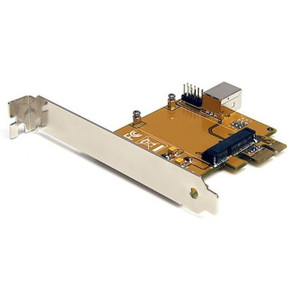
StarTech PEX1000SFP2 PCIe x1 SFP Gigabit Fiber Network Adapter
Overview
The StarTech PEX1000SFP2 is a single-port PCI Express gigabit network adapter that adds an SFP fiber slot to any desktop or rackmount PC with an available PCIe x1 lane. If your surveillance server, NVR workstation, or network video recording PC lacks a fiber uplink — either because the onboard NIC is copper-only or you need to isolate camera traffic on a dedicated fiber segment — this card solves the problem without replacing your host hardware. It draws a maximum of 3.2W, fits a standard PCIe x1 slot, and ships with a low-profile bracket so it installs cleanly in both full-height and 1U/2U rackmount chassis. The Realtek RTL8168H and Marvell 88E1111B1 chipset combination handles fiber network adapters reliably at 1Gbps full-duplex.
Key Features
- 1Gbps Full-Duplex via SFP Slot: The single SFP port delivers up to 1000 Mbps in each direction simultaneously — 2 Gbps aggregate full-duplex — so high-bitrate camera streams from a 16- or 32-channel IP system won't saturate the uplink. The SFP form factor lets you swap in the fiber transceiver that matches your existing plant: single-mode, multimode, or direct-attach copper.
- PCIe x1 Bus Interface: Installing into a PCIe x1 slot means no wasted lane bandwidth and broad motherboard compatibility. The card will also seat in x4, x8, or x16 PCIe slots if your x1 slot is occupied — useful in servers where larger slots are more accessible.
- Realtek RTL8168H + Marvell 88E1111B1 Chipset: Both chipsets have mature driver support across Windows Server, Linux, and common NVR operating environments. You're not fighting obscure driver issues during a commissioning window.
- 3.2W Maximum Power Draw: At 3.2W peak, this card won't stress a server PSU or trigger thermal issues in a dense rack. Low-power operation also matters in environments where the host PC runs continuously — 24/7 surveillance infrastructure included.
- MTBF of 770,619 Hours: That works out to approximately 88 years of theoretical mean-time-between-failures. For a card sitting in an always-on recording server, reliability projections like this matter more than they would in a workstation used intermittently.
- Low-Profile Bracket Included: Ships with both standard and low-profile brackets, so you don't need to source a separate bracket if the host is a 1U rackmount. This is a detail that matters on job sites where finding LP hardware on short notice isn't easy.
- Dual LED Indicators: A green Link LED and a yellow Activity LED give you immediate visual confirmation that the fiber link is up and passing traffic — useful during initial commissioning and for quick field checks without pulling up a management console.
- 48 KB Buffer: The onboard packet buffer handles burst traffic without dropping frames — relevant when multiple high-resolution camera streams arrive simultaneously during motion events.
- Operating Temperature 0°C to 45°C: Rated for standard indoor server room and IT closet environments. This is not an extended-temp card — if the host chassis is in an uncontrolled space that exceeds 45°C, address the thermal environment before deploying.
Integration and Compatibility
The PEX1000SFP2 connects to any fiber Ethernet switch or media converter with a matching SFP port. The SFP slot accepts industry-standard 1G SFP transceivers — single-mode LC for long runs, multimode LC for in-building fiber backbones, or BiDi SFPs if you're running single-strand fiber. It does not include a transceiver; select one that matches your fiber plant and wavelength requirements. On the host side, the card requires a PCIe x1 or larger slot and a supported OS with available driver support for the Realtek RTL8168H. For surveillance deployments, this card pairs naturally with network video recorders and dedicated recording servers that need a direct fiber uplink to an access-layer switch aggregating IP cameras. The 1Gbps ceiling is appropriate for systems up to roughly 16–32 cameras at typical H.265 bitrates; for larger channel counts with simultaneous 4K streams, evaluate whether a 10GbE uplink is required instead. Check the StarTech networking line for additional adapter options if throughput requirements exceed 1Gbps. Compatible networks run at 1000 Mbps; the card is not rated for 10GbE or 2.5GbE operation.
Frequently Asked Questions
Q: What SFP transceiver do I need to use with the PEX1000SFP2?
A: The card's SFP slot accepts standard 1G SFP transceivers — no transceiver is included. Choose single-mode LC for long-distance runs, multimode LC for in-building backbone connections, or a BiDi SFP for single-strand fiber. The transceiver must be rated for 1Gbps; 10G SFPs are not compatible with this card's 1GbE operation.
Q: Will the PEX1000SFP2 fit in a 1U rackmount server?
A: Yes. The card ships with both a standard-profile and a low-profile bracket. The low-profile bracket allows installation in 1U and 2U rackmount chassis with half-height PCIe slots. Card dimensions are 5.0 in (L) × 4.6 in (H) × 0.7 in (W) in standard configuration.
Q: Does the PEX1000SFP2 work with Linux-based NVR software?
A: The Realtek RTL8168H chipset has broad driver support across Windows and Linux environments. Confirm driver availability for your specific NVR OS distribution before deploying, as StarTech does not publish a specific NVR software compatibility list for this card.
Q: What is the warranty on the PEX1000SFP2?
A: StarTech provides a 2-year manufacturer warranty on the PEX1000SFP2.
Q: Can the PEX1000SFP2 be used in a PCIe x4 or x8 slot instead of x1?
A: Yes. PCIe slots are backward compatible — the card will seat and function in any PCIe x1, x4, x8, or x16 slot. It will operate at x1 electrical speeds regardless of which slot it occupies, which is sufficient for 1Gbps Ethernet.
Q: What is the maximum operating temperature for the PEX1000SFP2?
A: The card is rated for 0°C to 45°C (32°F to 113°F) operating temperature. It is designed for standard indoor IT environments. Storage temperature range is wider: -20°C to 70°C (-4°F to 158°F).
The spec that stands out to me on the PEX1000SFP2 is the MTBF rating: 770,619 hours. For a card that's going to sit inside an always-on surveillance recording server and never get touched again after commissioning, that reliability figure matters far more than most buyers realize when they're comparing budget adapters without published MTBF data.
Technical Highlights:
- 2 Gbps Aggregate Full-Duplex: 1Gbps in each direction simultaneously — enough headroom for 16–32 camera channels at typical H.265 bitrates without the uplink becoming the bottleneck during peak recording events.
- 3.2W Max Power Draw: Well within the power budget of any PCIe x1 slot spec. In dense 1U/2U rackmount servers where PSU headroom is tightly allocated across storage, compute, and networking, 3.2W is a non-issue.
- 48 KB Onboard Buffer: Handles simultaneous burst traffic from multiple camera streams arriving during motion events — reduces the risk of dropped packets when the host CPU is momentarily occupied with recording tasks.
Deployment Considerations:
- The 0°C to 45°C operating range is the real constraint here — confirm the server chassis is in a conditioned room before deploying. An IT closet without climate control that peaks above 45°C in summer will push this card out of spec.
- No SFP transceiver is included. Budget and specify the transceiver separately based on your fiber plant — single-mode runs, multimode backbone, or BiDi for single-strand. Mismatching wavelengths is the most common field error with SFP-based adapters.
For a dedicated surveillance recording workstation or NVR server being connected directly to a fiber access-layer switch aggregating IP cameras in a conditioned data closet or server room, the PEX1000SFP2 is a straightforward, low-risk addition — mature chipset, published reliability data, and a low-profile bracket that actually fits the 1U chassis you're likely working with.