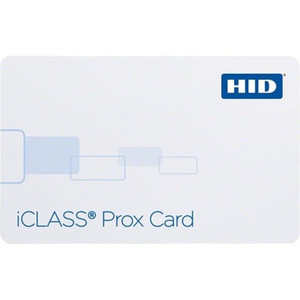
HID 2122CGGNNN Composite iClass/Prox 16K/16 Credential
When your access control deployment spans both legacy proximity and newer iClass infrastructure, credential management becomes a migration headache. The HID 2122CGGNNN delivers dual-technology credentialing in a composite form factor, letting you phase in iClass readers without invalidating existing prox investments or forcing full badge replacements across multi-site installations.
Key Features
- Dual iClass 16K (16 application areas) and 125 kHz proximity technology in single credential
- Composite construction provides balance of durability and printability for photo badge programs
- Standard CR80 credit card dimensions for existing printer compatibility
- 16K bit memory configuration supports multiple applications on single card
- HID proximity technology ensures backward compatibility with legacy 125 kHz readers
- iClass 13.56 MHz contactless smart card technology for encrypted, secure access
- Suitable for direct-to-card thermal transfer or dye-sublimation printing
- Programmed credential format allows central enrollment across reader generations
The composite construction makes this credential particularly suitable for environments requiring photo identification alongside access control. Unlike clamshell credentials that limit print surface options, the 2122CGGNNN accepts standard card printer output while maintaining RF performance across both frequency bands. The 16K memory allocation provides headroom for multiple facility codes, time-based permissions, or auxiliary applications like cashless vending without requiring separate credentials.
During reader upgrades, this dual-technology approach eliminates the forced-march scenario where you must swap every credential simultaneously with reader deployment. Facilities can migrate building-by-building or door-by-door, with cardholders carrying credentials that authenticate at both prox and iClass readers. The composite format withstands typical wear from daily badge holder use while remaining thin enough for standard access control wallet configurations, making it appropriate for corporate campuses, educational facilities, and healthcare environments managing phased technology transitions.