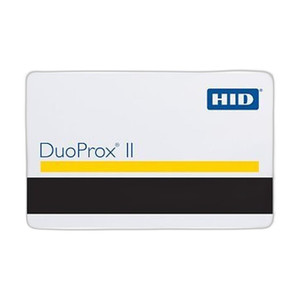
HID 1536LGGMN Composite Duoprox II Programmable Proximity Card - Front Gloss, Back Gray
Access control deployments demand credential media that balances security, durability, and professional appearance across mixed-technology environments. The HID 1536LGGMN delivers programmable dual-frequency capability in a composite construction designed for organizations migrating between proximity standards or maintaining legacy and modern readers simultaneously. The front gloss finish accepts high-quality photo ID printing while the gray back provides a professional corporate aesthetic suitable for employee badging programs.
Key Features
- Duoprox II dual-frequency technology supports both 125 kHz proximity and 13.56 MHz contactless standards on a single credential
- Programmable architecture allows site-specific encoding and customization during deployment
- Composite construction provides durability for daily badge handling and swipe environments
- Front gloss surface optimized for direct-to-card photo ID printing with dye-sublimation printers
- Gray back finish delivers professional appearance for corporate badging applications
- Standard CR80 credit card dimensions (3.375" x 2.125") ensure compatibility with existing badge holders and lanyards
- Compatible with HID proximity readers and multi-technology reader platforms
Dual-technology credentials solve a common integration challenge: bridging legacy 125 kHz proximity infrastructure with newer high-frequency systems during phased upgrades. Rather than maintaining separate credential stocks or forcing simultaneous infrastructure replacement, the 1536LGGMN allows controlled migration while maintaining backward compatibility. Employees carry one card that works across both reader generations, simplifying administration and reducing helpdesk calls during technology transitions.
The composite substrate strikes the practical balance integrators need between printability and physical durability. Unlike rigid PVC cards that can crack under stress or laminated cards that delaminate with repeated pocket wear, composite construction flexes without permanent deformation while maintaining print surface integrity through typical 3-5 year badge lifecycles. The gloss front surface accepts high-resolution photo images and text without specialized overlaminates, reducing per-card costs in high-volume badging operations. For organizations requiring both visual identification and electronic access control in a single credential platform, this card format delivers the functionality without requiring integrators to stock multiple SKUs for different use cases.