
Speco Technologies H40HR80TB vs Speco Technologies H40HR32TB: Specification Comparison
Both the H40HR80TB and H40HR32TB are Speco Technologies 40-channel NDAA-compliant hybrid recorders sharing the same channel architecture — 24 TVI, 8 hybrid TVI/IP switchable, and 8 dedicated IP channels — in a rack-mount chassis. The primary distinction is onboard storage capacity: 80TB versus 32TB. This comparison evaluates the two units across storage and retention, channel/connectivity specifications, and integration features to help installers and IT buyers determine which model fits their deployment scale.
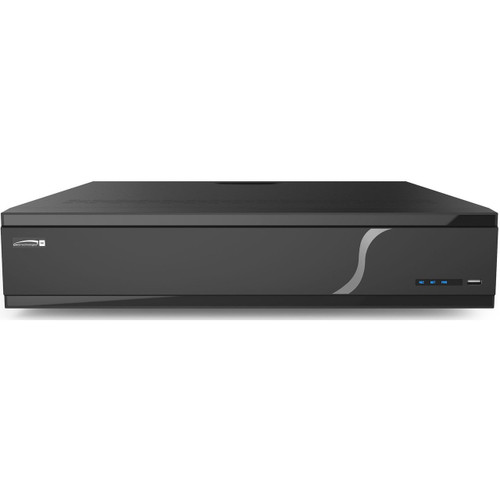
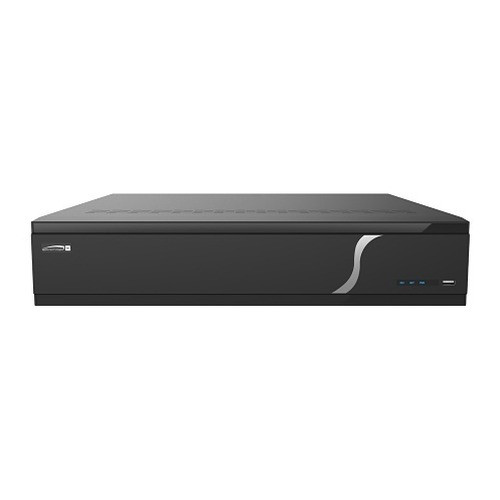
In This Guide
- How much onboard storage do you get, and what does that mean for retention?
- Are the channel counts, network interfaces, and PoE capabilities identical between the two models?
- What do the specs say about operating environment, audio, compression, and NDAA compliance?
- Which should you choose: the H40HR80TB or the H40HR32TB?
- Side-by-Side Specs
- FAQ
How much onboard storage do you get, and what does that mean for retention?
The H40HR80TB ships with 80TB of internal storage, while the H40HR32TB ships with 32TB onboard. That is a 2.5× difference in raw capacity within the same chassis footprint. For a 40-channel deployment recording continuously at 8fps and 8MP (H.265), the extra 48TB on the H40HR80TB directly extends on-device retention without requiring external NAS arrays or more frequent archiving cycles.
The H40HR32TB datasheet lists a storage range of 4TB–160TB, suggesting it supports expansion beyond its 32TB base configuration, though the spec does not detail the expansion mechanism. No equivalent expandable storage range is listed for the H40HR80TB. Buyers with strict on-premises retention policies (e.g., 90-day mandates) should calculate their bitrate × channel count against both figures before specifying either unit.
Are the channel counts, network interfaces, and PoE capabilities identical between the two models?
Channel architecture is effectively identical on both units: 24 TVI + 8 hybrid TVI/IP switchable + 8 IP channels = 40 total. Both support simultaneous TVI analog and IP recording. Both specify dual NIC with network redundancy (H40HR80TB labels it 'Dual NIC with redundancy for high-bandwidth IP deployments'; H40HR32TB specifies RJ45 × 2 at 1000Mbps each), providing failover continuity during network events.
A notable divergence: the H40HR32TB lists PoE (802.3af) support, which is not specified for the H40HR80TB. If the installation requires the recorder itself to power IP cameras directly via PoE without a separate switch, only the H40HR32TB has that spec documented. Conversely, the H40HR80TB spec does not mention PoE at all — installers should confirm with Speco before designing a PoE-from-recorder topology on the 80TB model.
What do the specs say about operating environment, audio, compression, and NDAA compliance?
Both units share NDAA compliance, H.265/H.264 compression, 8MP maximum resolution at 8fps, rack-mount form factor, and IR low-light notation. Both carry a 2-year warranty. The H40HR32TB provides an explicit operating temperature range of 14°F to 122°F (−10°C to 50°C), which is absent from the H40HR80TB spec sheet — relevant for deployments in non-climate-controlled server rooms or edge closets.
Audio handling differs: the H40HR80TB lists 'Audio input' only, while the H40HR32TB specifies 'Two-way' audio, meaning it supports both audio in and out. For installations requiring intercommunication, public address, or audio verification workflows, the H40HR32TB has the documented two-way capability. The H40HR32TB also lists ONVIF compatibility indirectly via its IP channel support and package contents (DDNS, P2P, line crossing, area intrusion, abandoned object detection), whereas the H40HR80TB explicitly lists ONVIF: Yes.
Which should you choose: the H40HR80TB or the H40HR32TB?
Our take: The H40HR80TB is the stronger choice when maximizing on-device retention is the primary requirement — its 80TB internal storage delivers 2.5× the capacity of the H40HR32TB's 32TB, directly reducing the need for external arrays on high-channel-count, long-retention mandates. However, the H40HR32TB holds three documented advantages the H40HR80TB lacks: PoE (802.3af) output for powering cameras directly from the recorder, two-way audio support versus input-only, and a stated operating temperature range (14°F–122°F) useful for validating non-conditioned environments. Both units match on channel count (40CH), NDAA compliance, dual-NIC redundancy, H.265/H.264 compression, and 8MP/8fps performance. Specify the H40HR80TB for high-density IP deployments with large retention budgets and a separate PoE switching layer; specify the H40HR32TB where integrated PoE, two-way audio, or thermal qualification documentation is required.
Side-by-Side Comparison
Spec-for-spec, from manufacturer data.
| Specification | Speco Technologies H40HR80TB | Speco Technologies H40HR32TB |
|---|---|---|
| SKU | H40HR80TB | H40HR32TB |
| Total Channels | 40 (24 TVI + 8 Hybrid + 8 IP) | 40 (24 TVI + 8 Hybrid + 8 IP) |
| Onboard Storage | 80TB | 32TB |
| Storage Range (spec'd) | — | 4TB – 160TB |
| NDAA Compliant | Yes | Yes |
| Network Interface | Dual NIC with redundancy | RJ45 × 2 (1000Mbps each), redundant |
| PoE Support | — | 802.3af |
| Audio | Input only | Two-way (in + out) |
| Compression | H.265; H.264 | H.265; H.264 |
| Max Resolution | 8MP (3840 × 2160) | 8MP |
| Frame Rate | 8fps | 8fps |
| ONVIF | Yes | — |
| Operating Temperature | — | 14°F to 122°F (−10°C to 50°C) |
| Mount Type | Rack | Rack |
| Warranty | 2-year | 2-year |
| Datasheet | /content/product-datasheets/H40HR80TB.pdf | /content/product-datasheets/H40HR32TB.pdf |
Frequently Asked Questions
Which should you choose: the H40HR80TB or the H40HR32TB?
The H40HR80TB is the stronger choice when maximizing on-device retention is the primary requirement — its 80TB internal storage delivers 2.5× the capacity of the H40HR32TB's 32TB, directly reducing the need for external arrays on high-channel-count, long-retention mandates. However, the H40HR32TB holds three documented advantages the H40HR80TB lacks: PoE (802.3af) output for powering cameras directly from the recorder, two-way audio support versus input-only, and a stated operating temperature range (14°F–122°F) useful for validating non-conditioned environments. Both units match on channel count (40CH), NDAA compliance, dual-NIC redundancy, H.265/H.264 compression, and 8MP/8fps performance. Specify the H40HR80TB for high-density IP deployments with large retention budgets and a separate PoE switching layer; specify the H40HR32TB where integrated PoE, two-way audio, or thermal qualification documentation is required.
Is the H40HR80TB or H40HR32TB better for larger deployments needing long on-site retention?
The H40HR80TB is the better fit for long-retention requirements: its 80TB of internal storage is 2.5× the H40HR32TB's 32TB base. For a 40-channel site recording continuously, that additional capacity directly extends how many days of footage are stored on-device before archiving. The H40HR32TB lists a 4TB–160TB storage range suggesting expandability, but the base unit ships with only 32TB.
Can either recorder power IP cameras directly via PoE without a separate switch?
Based on the provided specifications, only the H40HR32TB lists PoE (802.3af) support. The H40HR80TB does not have PoE documented in its spec sheet. If the design relies on the recorder to power cameras without a dedicated PoE switch, the H40HR32TB is the only model with that spec confirmed.
Do both models support two-way audio for intercoms or audio-verification workflows?
No. The H40HR32TB specifies two-way audio (input and output). The H40HR80TB lists only 'Audio input,' meaning audio output is not documented for that model. Deployments requiring speaker output, intercom integration, or audio challenge functions should specify the H40HR32TB based on available specs.
Get a Second Opinion on Your Camera Choice
Share your site layout, coverage goals, and budget. Our team will validate the camera selection, flag anything we would change, and recommend products that match the use case.