
Speco Technologies H40HR80TB vs Speco Technologies H40HR: Specification Comparison
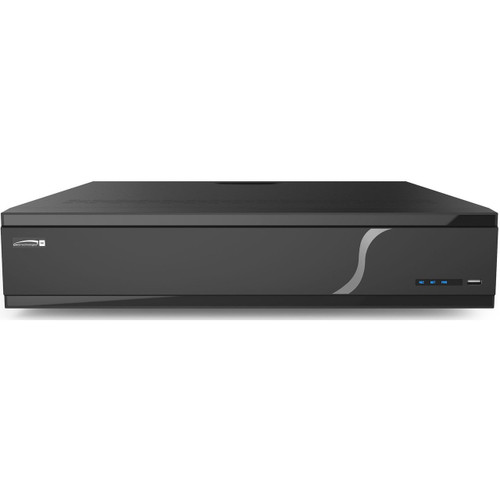
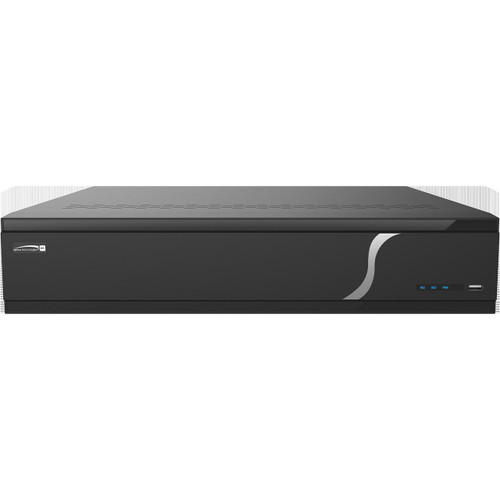
Both products are Speco Technologies 40-channel NDAA-compliant hybrid recorders designed to support mixed analog TVI and IP camera deployments in a rack-mount chassis. The H40HR80TB and H40HR share the same core channel architecture — 24 TVI plus hybrid and IP channels — and target the same integrator market segment. The primary differentiators center on internal storage capacity, warranty length, and the presence or absence of specific networking and audio specifications documented in each product's datasheet.
In This Guide
- How much storage capacity and channel flexibility does each recorder provide?
- What networking, redundancy, and interface specifications does each unit provide?
- How do NDAA compliance, environmental ratings, warranty coverage, and video analytics compare?
- Which should you choose: the H40HR80TB or the H40HR?
- Side-by-Side Specs
- FAQ
How much storage capacity and channel flexibility does each recorder provide?
The H40HR80TB ships with 80TB of internal storage as a fixed factory configuration, eliminating the need for external storage arrays in most mid-to-large deployments. The H40HR does not specify a single fixed storage figure; instead its spec sheet lists a range of 4TB to 160TB, indicating it is offered across multiple storage SKU variants and can be scaled to 160TB — twice the H40HR80TB's stated capacity — at the high end.
Channel architecture is identical at the top line for both: 40 channels total. The H40HR80TB explicitly breaks this down as 24 TVI + 8 hybrid (TVI/IP switchable) + 8 dedicated IP channels. The H40HR's spec sheet describes 24 TVI analog channels plus 8 configurable hybrid channels and 8 dedicated IP channels, which is structurally the same layout. Neither model specifies a maximum IP camera resolution per channel beyond the 8MP / 3840×2160 figure shared by both.
What networking, redundancy, and interface specifications does each unit provide?
The H40HR80TB specifies a dual NIC architecture with network redundancy, directly supporting high-bandwidth IP camera deployments where a single network failure cannot be tolerated. The H40HR's spec sheet lists RJ45 × 2 at 1000 Mbps, which physically represents two Gigabit Ethernet ports. Whether H40HR's dual port implementation includes active failover redundancy equivalent to H40HR80TB's stated redundancy is not confirmed in the provided specs.
The H40HR additionally documents PoE (802.3af) support and P2P services in its package contents, neither of which appears in the H40HR80TB specification set. P2P remote access and free US-based DDNS are listed for the H40HR. The H40HR80TB datasheet does not reference PoE output, DDNS, or P2P. Buyers requiring PoE camera powering from the recorder itself should note this distinction.
How do NDAA compliance, environmental ratings, warranty coverage, and video analytics compare?
Both recorders are NDAA-compliant, making them eligible for federal, state, and local government contracts. Neither spec set references specific NDAA section citations beyond the compliance claim itself.
The H40HR is the only unit with a documented operating temperature range: 14°F to 122°F (-10°C to 50°C). The H40HR80TB provides no operating temperature specification in the provided data. For installations in unconditioned spaces, this is a meaningful gap in the available H40HR80TB documentation.
Warranty coverage differs: the H40HR carries a 3-year warranty versus the H40HR80TB's 2-year warranty — a 50% longer coverage period. On analytics, the H40HR spec sheet lists line crossing, area intrusion, and abandoned object detection. The H40HR80TB spec sheet does not enumerate supported analytics. Audio also diverges: the H40HR80TB lists audio input only, while the H40HR specifies two-way audio. Both support H.265 and H.264 compression and share an 8MP maximum resolution.
Which should you choose: the H40HR80TB or the H40HR?
Our take: The H40HR80TB is the stronger choice when a deployment requires a single, fixed high-density storage configuration — 80TB internal — and explicit dual-NIC network redundancy is a procurement requirement. The H40HR80TB delivers 80TB out of the box with documented network redundancy, while the H40HR's 4TB–160TB range indicates it is available at storage levels both well below and well above the H40HR80TB's fixed 80TB. However, the H40HR holds three concrete advantages: a 3-year warranty versus 2 years, a documented operating temperature range (14°F–122°F) that H40HR80TB lacks, and two-way audio versus audio input only. The H40HR also lists PoE (802.3af), built-in analytics (line crossing, area intrusion, abandoned object), and P2P/DDNS services — none of which are confirmed for the H40HR80TB. For government or enterprise sites needing a guaranteed 80TB single-chassis solution, the H40HR80TB is appropriate; for sites prioritizing longer warranty, environmental certainty, onboard analytics, or PoE, the H40HR spec set is more fully documented.
Side-by-Side Comparison
Spec-for-spec, from manufacturer data.
| Specification | Speco Technologies H40HR80TB | Speco Technologies H40HR |
|---|---|---|
| SKU | H40HR80TB | H40HR |
| Total Channels | 40 (24 TVI + 8 Hybrid + 8 IP) | 40 (24 TVI + 8 Hybrid + 8 IP) |
| Internal Storage | 80TB (fixed) | 4TB – 160TB (range) |
| Max Resolution | 8MP / 3840×2160 | 8MP |
| Compression | H.265; H.264 | H.265; H.264 |
| Frame Rate | 8fps | — |
| Dual NIC / Redundancy | Yes (documented) | RJ45 × 2 at 1000Mbps (redundancy not confirmed) |
| PoE Output | — | PoE (802.3af) |
| Audio | Audio input | Two-way audio |
| NDAA Compliant | Yes | Yes |
| Warranty | 2-year | 3-year |
| Operating Temperature | — | 14°F to 122°F (-10°C to 50°C) |
| ONVIF | Yes | — |
| Video Analytics | — | Line crossing, area intrusion, abandoned object |
| Remote Access | — | P2P and US-based DDNS (included) |
| Mount Type | Rack | Rack |
Frequently Asked Questions
Which should you choose: the H40HR80TB or the H40HR?
The H40HR80TB is the stronger choice when a deployment requires a single, fixed high-density storage configuration — 80TB internal — and explicit dual-NIC network redundancy is a procurement requirement. The H40HR80TB delivers 80TB out of the box with documented network redundancy, while the H40HR's 4TB–160TB range indicates it is available at storage levels both well below and well above the H40HR80TB's fixed 80TB. However, the H40HR holds three concrete advantages: a 3-year warranty versus 2 years, a documented operating temperature range (14°F–122°F) that H40HR80TB lacks, and two-way audio versus audio input only. The H40HR also lists PoE (802.3af), built-in analytics (line crossing, area intrusion, abandoned object), and P2P/DDNS services — none of which are confirmed for the H40HR80TB. For government or enterprise sites needing a guaranteed 80TB single-chassis solution, the H40HR80TB is appropriate; for sites prioritizing longer warranty, environmental certainty, onboard analytics, or PoE, the H40HR spec set is more fully documented.
Is the H40HR80TB or H40HR better for larger deployments needing more than 80TB?
Based on the provided specs, the H40HR is listed with a storage range up to 160TB, which exceeds the H40HR80TB's fixed 80TB internal capacity. If a deployment requires more than 80TB in a single unit, the H40HR's upper storage tier is the only option documented here. The H40HR80TB does not specify expandability beyond its stated 80TB.
Which recorder has the longer warranty?
The H40HR carries a 3-year warranty per its specifications. The H40HR80TB is rated at 2 years. That is a 12-month difference in documented coverage.
Does either recorder support onboard video analytics?
Only the H40HR lists supported analytics in the provided specifications: line crossing, area intrusion, and abandoned object detection. The H40HR80TB specification set does not enumerate any analytics capabilities. Buyers requiring confirmed onboard analytics should note this difference until H40HR80TB documentation is verified.
Get a Second Opinion on Your Camera Choice
Share your site layout, coverage goals, and budget. Our team will validate the camera selection, flag anything we would change, and recommend products that match the use case.