
i-PRO S8544L vs i-PRO S8574L: Specification Comparison
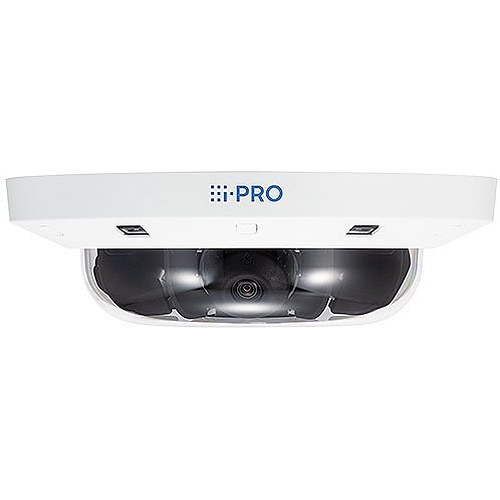
Both the i-PRO WV-S8544L and WV-S8574L are 4-sensor, 180° panoramic multi-sensor dome cameras designed for outdoor perimeter coverage, sharing the same physical form factor, PoE+ power budget, and general platform generation. The comparison focuses on where they diverge: per-sensor resolution and total pixel count, IR range, low-light sensitivity, WDR capability, and lens configuration — the specs that most directly govern deployment distance, lighting conditions, and coverage density requirements for a B2B integrator choosing between the two models.

In This Guide
How do the imaging specs compare?
The WV-S8544L uses four 1/2.7-type CMOS sensors at 2688×1520 per channel (approximately 4MP each), for a combined 16MP capture array. Its motorized varifocal lens covers 2.9–7.3 mm with 2.5x optical zoom and up to 10.5x extra zoom at 640×360, giving the installer adjustable field of view (43–100° horizontal per sensor) without requiring physical repositioning. Minimum illumination is specified at 0.12 Lux (B&W), WDR reaches a maximum of 108 dB (Super Dynamic On, Level 31), and IR range is 20 m at 30 IRE / 15 m at 50 IRE. DORI detection distance at wide is 45.1 m and at tele reaches 136.5 m.
The WV-S8574L uses four 1/2.8-type CMOS sensors. Its per-channel maximum resolution is 3840×2160 (8MP each), yielding a combined ~32MP array, and the spec sheet tags it at 33MP total. The lens is a fixed 3.1 mm prime with a 1:1.4 maximum aperture — wider than the S8544L's f/2.0 at wide — and covers 108° horizontal × 56° vertical per sensor with no optical zoom. Minimum illumination is 0.05 Lux (B&W with IR), WDR tops out at 120 dB (Super Dynamic On, Level 31), and IR range doubles to 40 m at 30 IRE. DORI detection is 55.8 m. On every pure imaging metric — pixel count, low-light sensitivity, dynamic range, and IR throw — the S8574L leads; the S8544L's advantage is its motorized zoom, which the S8574L entirely lacks.
What about installation and environment?
Both cameras share an identical physical footprint: ø300 mm × 90 mm (H) dome, 3.3 kg, aluminum die-cast body with PC dome and stainless steel screws, IP67/IP66 (IEC 60529), NEMA 4X (UL50E), IK10 impact resistance, and wind resistance up to 40 m/s (~89 mph). Operating temperature for the S8544L is listed as –40 to +60 °C with a note that active operation is –20 to +60 °C; the S8574L spec simply states –40 to +60 °C without a restricted active-operation caveat, though both include Temish anti-condensation elements. The S8544L also lists a heater in its anti-condensation system; the S8574L spec does not mention a heater, only the Temish element and moisture absorption gel.
Power draw is identical: PoE+ (IEEE 802.3at), 25.4 W for both, PoE Class 4. Both carry UL 62368-1, c-UL, CE, IEC 62368-1, FCC Part 15 Class A, and NEMA TS 2 compliance. Adjusting angles are the same: ±125° pan, ±10–105° tilt, ±90° yaw, ±30° twist. From a cabling, mounting, and power infrastructure standpoint, the two units are interchangeable.
Which fits your VMS and analytics better?
Both models run on the Ambarella CV2 SoC, support ONVIF Profiles G/M/S/T, H.265/H.264 CBR/VBR and MJPEG, up to 24 simultaneous users, microSDXC edge storage, SNMPv1/v2/v3, MQTT, IEEE 802.1X, and FIPS 140-2 Level 3 security (NXP secure element). Audio hardware is identical on both: 3.5 mm stereo mini jack input with plug-in power, 3.5 mm stereo jack output at 600Ω/–20dBV, G.726 ADPCM and G.711 compression, and full-duplex transmission. AI sound classification (gunshot, yell, vehicle horn, glass break) is present on both.
The analytics sets diverge slightly in labeling. The S8544L spec lists 'AI Motion Detection, Privacy Guard, Face & Vehicle Detection,' while the S8574L lists 'AI Video Motion Detection, Face Detection, People Detection.' Both support VMD (4 areas), SCD (1 area), and audio detection as alarm sources. The S8544L spec explicitly names 'Privacy Guard' as an AI analytic; the S8574L spec does not list it by that label. External I/O differs: the S8544L offers 3× Alarm IN, 2× Alarm OUT, and 1× AUX OUT as discrete terminals; the S8574L lists 3× Alarm IN/OUT terminals without specifying dedicated AUX OUT. Integrators needing a separate AUX relay output should verify terminal configuration against the S8574L installation guide before specifying.
Which should you choose: the S8544L or the S8574L?
Our take: The WV-S8574L is the stronger choice when maximum pixel density, low-light reach, and IR throw are the primary selection criteria. Its four 8MP sensors deliver a ~33MP combined capture array versus the S8544L's 16MP, its minimum illumination is 0.05 Lux versus 0.12 Lux, its dynamic range is 120 dB versus 108 dB, and its IR range is 40 m versus 20 m — concrete advantages for large-perimeter or poorly lit sites. The WV-S8544L is the better fit when the installer needs per-sensor field-of-view flexibility: its 2.9–7.3 mm motorized varifocal lens with 2.5x optical zoom allows angle adjustment after mounting, which the S8574L's fixed 3.1 mm prime cannot offer. The S8544L also includes a heater in its anti-condensation system, relevant in climates where the –40 °C lower limit is regularly reached. Both models are otherwise equivalent in platform, power, enclosure, and VMS integration.
Side-by-Side Comparison
Spec-for-spec, from manufacturer data.
| Specification | i-PRO S8544L | i-PRO S8574L |
|---|---|---|
| Total Resolution (Combined) | 16MP (4 × 4MP / 2688×1520) | ~33MP (4 × 8MP / 3840×2160) |
| Image Sensor | 4 × 1/2.7-type CMOS | 4 × 1/2.8-type CMOS |
| Lens / Focal Length | 2.9–7.3 mm motorized varifocal, 2.5x optical zoom | 3.1 mm fixed prime, no optical zoom |
| Angular Field of View (per sensor) | 43–100° H / 24–56° V (varifocal range) | 108° H / 56° V (fixed) |
| Maximum Aperture | f/2.0 (wide) – f/3.0 (tele) | f/1.4 |
| Minimum Illumination | 0.12 Lux (B&W) | 0.05 Lux (B&W with IR) |
| IR Range | 20 m (30 IRE) / 15 m (50 IRE) | 40 m (30 IRE) |
| WDR / Dynamic Range | Max. 108 dB (Super Dynamic On, Level 31) | Max. 120 dB (Super Dynamic On, Level 31) |
| DORI Detect Distance | 45.1 m (wide) / 136.5 m (tele) | 55.8 m (fixed) |
| Max Frame Rate | 30 fps | 30 fps |
| Video Compression | H.265, H.264 (CBR/VBR), MJPEG | H.265, H.264 (CBR/VBR), MJPEG |
| IP / Environmental Rating | IP67/IP66, NEMA 4X, IK10 | IP67/IP66, NEMA 4X, IK10 |
| Operating Temperature | –40 to +60 °C (active: –20 to +60 °C) | –40 to +60 °C |
| Anti-Condensation System | Temish element + Heater + moisture absorption gel | Temish element + moisture absorption gel (no heater listed) |
| Power Input / PoE Class | PoE+ (IEEE 802.3at), 25.4 W, Class 4 | PoE+ (IEEE 802.3at), 25.4 W, Class 4 |
| External I/O | 3× Alarm IN, 2× Alarm OUT, 1× AUX OUT | 3× Alarm IN/OUT terminals (no dedicated AUX OUT listed) |
| Edge Storage | microSDXC | microSDXC |
| AI Analytics (per spec) | AI Motion Detection, Privacy Guard, Face & Vehicle Detection | AI Video Motion Detection, Face Detection, People Detection |
| ONVIF Profiles | G / M / S / T | G / M / S / T |
| Dimensions | ø300 mm × 90 mm (H) | ø300 mm × 90 mm (H) |
| Weight | 3.3 kg (7.28 lbs) | 3.3 kg (7.28 lbs) |
| Warranty | 5-year | 5-year |
Frequently Asked Questions
Which should you choose: the S8544L or the S8574L?
The WV-S8574L is the stronger choice when maximum pixel density, low-light reach, and IR throw are the primary selection criteria. Its four 8MP sensors deliver a ~33MP combined capture array versus the S8544L's 16MP, its minimum illumination is 0.05 Lux versus 0.12 Lux, its dynamic range is 120 dB versus 108 dB, and its IR range is 40 m versus 20 m — concrete advantages for large-perimeter or poorly lit sites. The WV-S8544L is the better fit when the installer needs per-sensor field-of-view flexibility: its 2.9–7.3 mm motorized varifocal lens with 2.5x optical zoom allows angle adjustment after mounting, which the S8574L's fixed 3.1 mm prime cannot offer. The S8544L also includes a heater in its anti-condensation system, relevant in climates where the –40 °C lower limit is regularly reached. Both models are otherwise equivalent in platform, power, enclosure, and VMS integration.
Is the S8544L or S8574L better for low-light and long-range IR coverage?
The S8574L is spec'd for better low-light performance: 0.05 Lux minimum illumination versus 0.12 Lux on the S8544L, and 40 m IR range at 30 IRE versus 20 m. Its WDR is also higher at 120 dB versus 108 dB. For dimly lit or large open-area perimeter applications, the S8574L's imaging specs are meaningfully stronger.
Can I adjust the field of view on either camera after installation?
Only the S8544L supports post-installation field-of-view adjustment. It has a motorized varifocal lens (2.9–7.3 mm, 2.5x optical zoom) with motorized focus, allowing angle changes from 43° to 100° horizontal per sensor without physically repositioning the unit. The S8574L uses a fixed 3.1 mm prime lens at a fixed 108° horizontal field of view per sensor — no optical zoom is available.
Are there differences in the external I/O terminals between the two models?
Yes. The S8544L spec lists 3× Alarm IN, 2× Alarm OUT, and 1× AUX OUT as discrete terminal types. The S8574L spec describes 3× Alarm IN/OUT terminals but does not separately list a dedicated AUX OUT terminal. Integrators who require a separate AUX relay output should verify the S8574L's terminal wiring diagram before specifying the unit.
Get a Second Opinion on Your Camera Choice
Share your site layout, coverage goals, and budget. Our team will validate the camera selection, flag anything we would change, and recommend products that match the use case.