
i-PRO CP630 vs i-PRO WVCP304: Specification Comparison
Both the i-PRO WV-CP630 and the i-PRO WVCP304 are analog indoor box cameras built around a 1/3-inch interline transfer CCD sensor, targeting legacy coaxial infrastructure where IP migration is not yet planned. Each delivers Day/Night switching and VMD analytics, placing them in the same resolution tier (650–700 TVL) and form-factor category. This comparison evaluates how their imaging capabilities, installation requirements, and integration profiles differ to help installers and procurement teams select the correct unit for a specific site.
In This Guide
How do the imaging specs compare?
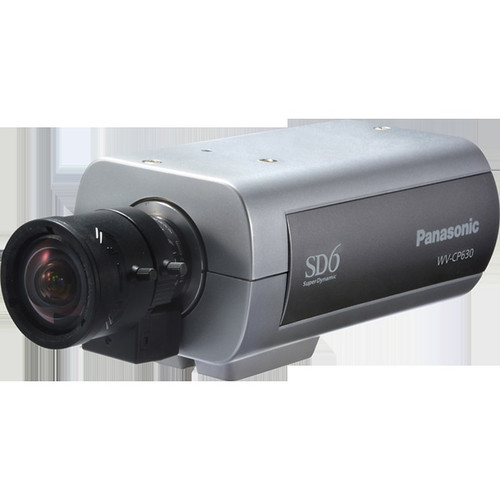
The WV-CP630 is rated at 700 TVL with a minimum illumination of 0.08 lux (color) and 0.008 lux (B/W) at F1.4, using IR-assisted Day/Night switching. Its standout imaging feature is Super Dynamic 6 with Adaptive Black Stretch (ABS), a wide dynamic range processing engine that reduces halo artifacts and recovers shadow detail in mixed-lighting environments such as retail floors or corridors with bright exit signs. Lens compatibility is open: the spec lists optional Panasonic mounts (WV-LZA61/2S, WV-LZ62/8S) as well as compatible third-party lenses, but focal length is not fixed at purchase.
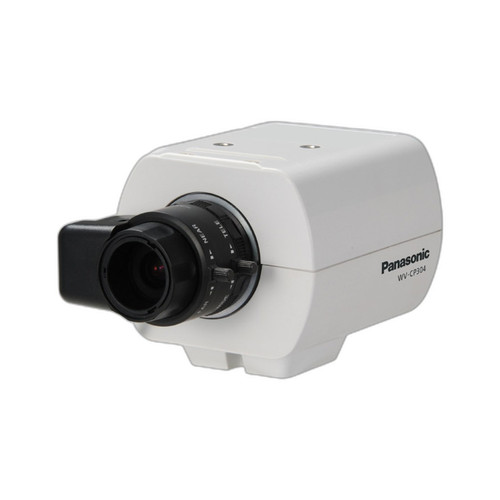
The WVCP304 is rated at 650 TVL—50 TVL lower than the CP630—with minimum illumination of 0.08 lux (color) and 0.05 lux (B/W) at F1.4. Its B/W floor is therefore notably lower than the CP630's 0.008 lux B/W figure, meaning the CP630 reaches deeper into low-light conditions without IR assistance. However, the WVCP304 compensates with electronic sensitivity enhancement up to 32× (auto) or 512× (fixed), which can extend usable sensitivity in extreme low-light scenes without requiring IR hardware. Lens type is specified as optional varifocal. No WDR technology is listed in the WVCP304 spec.
What about installation and environment?
The WV-CP630 runs on 120V AC, which limits deployment to locations with standard mains outlets or dedicated transformer circuits; it is not compatible with conventional 24VAC or 12VDC analog camera power distribution. Its operating temperature is documented as –10 °C to +50 °C (14 °F to 122 °F). Physical dimensions are 75 mm (W) × 65 mm (H) × 132.5 mm (D), with Wall and Ceiling mount types listed. No IP or IK rating is specified for either unit, which is consistent with their indoor-only designation. Output is BNC composite, integrating directly into legacy DVRs and coaxial matrix switchers.
The WVCP304 runs on 24VAC (with 12VDC also noted in card copy), the most common voltage standard on existing analog CCTV infrastructure, making it a drop-in replacement on legacy wiring runs without a separate mains transformer. A PoE connectivity attribute is listed in its spec, though this is atypical for a traditional analog camera and may reflect a data-entry artifact rather than a confirmed IEEE 802.3 PoE port; buyers should verify with the manufacturer before relying on PoE powering. No operating temperature range is provided in the supplied specs. Mount types are Wall and Ceiling, consistent with the CP630.
Which fits your VMS and analytics better?
Both cameras output analog CVBS over BNC and are compatible with DVR and hybrid NVR/analog systems. Neither spec lists ONVIF compliance, IP streaming, edge storage, or onboard audio—consistent with their analog box-camera class. Video Motion Detection (VMD) is the sole analytics capability listed for both models. The WVCP304 spec explicitly notes compatibility with analog CVBS, DVR, and hybrid NVR/analog systems. No VMS compatibility details beyond generic analog infrastructure are provided for the CP630. Neither unit lists audio input/output or a microSD/edge-storage slot.
Which should you choose: the CP630 or the WVCP304?
Our take: The WV-CP630 is the stronger choice when image quality in mixed-light or very dark indoor environments is the primary requirement. Its 700 TVL resolution edges the WVCP304's 650 TVL, and its B/W minimum illumination of 0.008 lux is substantially lower than the WVCP304's 0.05 lux—a 6× sensitivity advantage before any electronic gain is applied. The CP630's Super Dynamic 6 with ABS also provides documented WDR processing absent from the WVCP304's spec sheet, making it the better fit for lobbies or corridors with high-contrast lighting. Conversely, the WVCP304's 24VAC power input is a decisive installation advantage on any site with existing analog camera wiring, eliminating the need for a mains outlet or step-down transformer required by the CP630's 120VAC supply. Choose the CP630 for maximum image performance in new or mains-powered enclosures; choose the WVCP304 for like-for-like replacement on 24VAC infrastructure.
Side-by-Side Comparison
Spec-for-spec, from manufacturer data.
| Specification | i-PRO CP630 | i-PRO WVCP304 |
|---|---|---|
| Type | Analog Indoor Box Camera | Day/Night Fixed Analog Box Camera |
| Resolution | 700 TVL | 650 TVL |
| Image Sensor | 1/3" interline transfer CCD | 1/3" interline transfer CCD |
| Min Illumination (Color) | 0.08 lux @ F1.4 | 0.08 lux @ F1.4 |
| Min Illumination (B/W) | 0.008 lux @ F1.4 | 0.05 lux @ F1.4 |
| WDR | Super Dynamic 6 with ABS | — |
| Electronic Sensitivity Enhancement | — | Auto up to 32× / Fixed up to 512× |
| Day/Night | IR; Day/Night | Electrical Day/Night |
| Lens | Optional (Panasonic or compatible third-party) | Optional varifocal |
| Video Output | BNC composite | BNC composite (CVBS) |
| Power Input | 120V AC | 24VAC |
| PoE | — | Listed in spec (verify with manufacturer) |
| Operating Temperature | –10 °C to +50 °C (14 °F to 122 °F) | — |
| Dimensions | 75 mm (W) × 65 mm (H) × 132.5 mm (D) | — |
| Analytics | VMD | VMD |
| VMS Compatibility | DVR; coaxial matrix switchers | Analog CVBS; DVR; hybrid NVR/analog |
Frequently Asked Questions
Which should you choose: the CP630 or the WVCP304?
The WV-CP630 is the stronger choice when image quality in mixed-light or very dark indoor environments is the primary requirement. Its 700 TVL resolution edges the WVCP304's 650 TVL, and its B/W minimum illumination of 0.008 lux is substantially lower than the WVCP304's 0.05 lux—a 6× sensitivity advantage before any electronic gain is applied. The CP630's Super Dynamic 6 with ABS also provides documented WDR processing absent from the WVCP304's spec sheet, making it the better fit for lobbies or corridors with high-contrast lighting. Conversely, the WVCP304's 24VAC power input is a decisive installation advantage on any site with existing analog camera wiring, eliminating the need for a mains outlet or step-down transformer required by the CP630's 120VAC supply. Choose the CP630 for maximum image performance in new or mains-powered enclosures; choose the WVCP304 for like-for-like replacement on 24VAC infrastructure.
Is the CP630 or WVCP304 better for low light?
The WV-CP630 reaches 0.008 lux in B/W mode at F1.4, versus 0.05 lux for the WVCP304 at the same aperture—making the CP630 roughly 6× more sensitive before electronic gain is applied. The WVCP304 offsets this with electronic sensitivity enhancement up to 512× (fixed), which can help in extreme conditions, but the CP630's native sensitivity advantage and its Super Dynamic 6 WDR processing make it the spec-documented leader for low-light imaging.
Can I power the WVCP304 from an existing analog camera power supply?
Yes. The WVCP304 is rated for 24VAC, which is the standard voltage used on most legacy coaxial analog CCTV wiring runs, enabling direct replacement without additional transformers. The WV-CP630, by contrast, requires 120V AC mains power, so it needs either a dedicated outlet or an external step-down transformer on a typical analog installation.
Do either of these cameras support IP streaming or ONVIF?
Neither camera lists IP streaming, ONVIF compliance, or network connectivity in the provided specifications. Both output analog CVBS over BNC and are designed for connection to DVRs or hybrid NVR/analog systems. Neither includes edge storage or audio I/O per the supplied specs.
Get a Second Opinion on Your Camera Choice
Share your site layout, coverage goals, and budget. Our team will validate the camera selection, flag anything we would change, and recommend products that match the use case.