
Hanwha SMT-2721PVW vs Speco Technologies PVM27: Specification Comparison
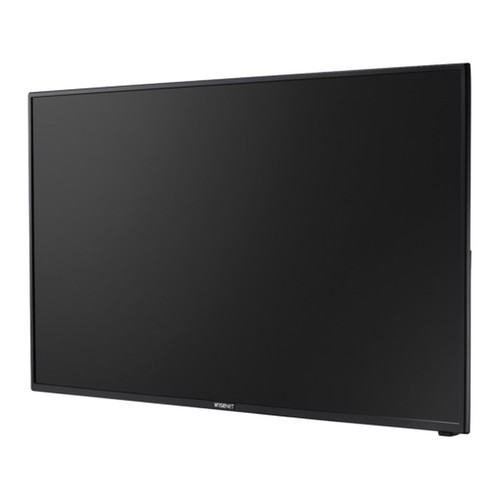
Both the Hanwha SMT-2721PVW and the Speco Technologies PVM27 are 27-inch public view monitors (PVMs) designed for retail, lobby, and light-commercial surveillance deployments where a visible screen deters theft and reassures occupants. Each unit integrates a display with onboard video processing and local microSD storage, eliminating the need for a separate DVR at the install point. The comparison turns on power architecture, integrated camera capability, storage capacity, analytics depth, and VMS/platform compatibility—the dimensions that most directly shape installation cost and system design.
In This Guide
- How do the power architecture and network connectivity differ between the SMT-2721PVW and PVM27?
- Which unit offers stronger onboard imaging and analytics capabilities?
- How do local storage capacity and platform integration compare?
- Which should you choose: the SMT-2721PVW or the PVM27?
- Side-by-Side Specs
- FAQ
How do the power architecture and network connectivity differ between the SMT-2721PVW and PVM27?
The SMT-2721PVW is powered exclusively via HPoE (PoE++, 802.3bt), drawing power and data over a single Ethernet cable. This simplifies conduit runs and eliminates a separate power supply at the mount point, but it requires an 802.3bt-capable PoE++ switch or injector in the infrastructure. Connectivity is wired Ethernet only; no Wi-Fi is specified.
The PVM27 runs on DC 12V with AC/DC compatibility and adds both Ethernet and Wi-Fi connectivity. The dual-mode power input gives installers flexibility when a PoE++ switch is unavailable, and the Wi-Fi option can reduce cabling in retrofit or temporary deployments. However, DC power requires a separate power run or local outlet, which can increase conduit and labor costs versus the single-cable PoE++ approach of the SMT-2721PVW.
Which unit offers stronger onboard imaging and analytics capabilities?
The SMT-2721PVW is specified as AI-enabled, supporting real-time analytics via its SUNAPI (HTTP API) and ONVIF Profile S/G/T/M implementation. Compression support includes H.265, H.264, and MJPEG. Camera specifications (sensor size, resolution, day/night mode) are not listed in the provided spec sheet for the SMT-2721PVW.
The PVM27 integrates dual cameras—a 5MP IP camera and a 2MP TVI camera—with a 1/3-inch CMOS sensor, automatic Day/Night switching, True WDR, and H.265/H.264 compression. This eliminates the need for a separate capture device at the install point. Analytics capabilities beyond Day/Night and WDR are not specified for the PVM27. ONVIF compliance is limited to Profile S, compared to the SMT-2721PVW's broader Profile S/G/T/M support.
In summary: the PVM27 provides richer, spec-confirmed camera hardware (dual 5MP+2MP, WDR, Day/Night); the SMT-2721PVW claims AI-level analytics but does not publish camera sensor specs in the provided data.
How do local storage capacity and platform integration compare?
Both units include a microSD card slot for local storage. The PVM27 specifies a maximum microSD capacity of 1TB, enabling extended on-device retention without a back-end NVR. The SMT-2721PVW lists 'microSD card slot' without specifying a maximum supported capacity in the provided specs.
On integration, the SMT-2721PVW supports ONVIF Profiles S, G, T, and M in addition to Hanwha's proprietary SUNAPI (HTTP API), making it compatible with Hanwha Wave, Wisenet SSM, and third-party VMS platforms that support those ONVIF profiles. The PVM27 is certified for ONVIF Profile S only, which covers basic video streaming interoperability but excludes PTZ control (Profile T), recording search (Profile G), and metadata/analytics (Profile M).
Warranty differs as well: the SMT-2721PVW carries a 5-year warranty versus the PVM27's 3-year warranty, a relevant factor for total cost of ownership in long-term deployments.
Which should you choose: the SMT-2721PVW or the PVM27?
Our take: The SMT-2721PVW is the stronger choice when the installation infrastructure already supports PoE++ (802.3bt) switches and the deployment requires deep VMS integration, AI analytics, or compatibility with Hanwha's Wisenet ecosystem—its ONVIF Profile S/G/T/M plus SUNAPI support and 5-year warranty justify the infrastructure investment. The PVM27 is the better fit when the site lacks PoE++ switching or needs Wi-Fi flexibility, and when confirmed dual-camera hardware (5MP IP + 2MP TVI, True WDR, Day/Night auto-switching) with up to 1TB microSD retention is a priority—its integrated imaging specs are more fully documented. Key spec deltas: storage ceiling is confirmed at 1TB for the PVM27 versus unspecified for the SMT-2721PVW; ONVIF coverage is Profile S/G/T/M on the SMT-2721PVW versus Profile S only on the PVM27; and warranty is 5 years versus 3 years in Hanwha's favor. Camera sensor specs are absent for the SMT-2721PVW, which may require verification before specifying it in camera-critical designs.
Side-by-Side Comparison
Spec-for-spec, from manufacturer data.
| Specification | Hanwha SMT-2721PVW | Speco Technologies PVM27 |
|---|---|---|
| Display Size | 27 in | 27 in |
| Power Input | HPoE / PoE++ (802.3bt) | DC 12V (AC/DC compatible) |
| Network Connectivity | Ethernet (wired only) | Ethernet + Wi-Fi |
| Integrated Camera | Not specified in provided specs | 5MP IP + 2MP TVI |
| Sensor Type | — | 1/3" CMOS |
| Day/Night Mode | — | Yes, automatic |
| Wide Dynamic Range | — | True WDR |
| Video Compression | H.265; H.264; MJPEG | H.265; H.264 |
| ONVIF Compliance | Profile S, G, T, M | Profile S |
| Proprietary API | SUNAPI (HTTP API) | — |
| AI / Analytics | AI-enabled (specified) | Not specified |
| Local Storage | microSD (max capacity not specified) | microSD up to 1TB |
| Operating Temperature | Not specified in provided specs | 0°C to 50°C |
| Weight | 8.5 kg (18.7 lb) | 28.2 lb (12.8 kg) |
| Housing Color | White | White |
| Warranty | 5 years | 3 years |
Frequently Asked Questions
Which should you choose: the SMT-2721PVW or the PVM27?
The SMT-2721PVW is the stronger choice when the installation infrastructure already supports PoE++ (802.3bt) switches and the deployment requires deep VMS integration, AI analytics, or compatibility with Hanwha's Wisenet ecosystem—its ONVIF Profile S/G/T/M plus SUNAPI support and 5-year warranty justify the infrastructure investment. The PVM27 is the better fit when the site lacks PoE++ switching or needs Wi-Fi flexibility, and when confirmed dual-camera hardware (5MP IP + 2MP TVI, True WDR, Day/Night auto-switching) with up to 1TB microSD retention is a priority—its integrated imaging specs are more fully documented. Key spec deltas: storage ceiling is confirmed at 1TB for the PVM27 versus unspecified for the SMT-2721PVW; ONVIF coverage is Profile S/G/T/M on the SMT-2721PVW versus Profile S only on the PVM27; and warranty is 5 years versus 3 years in Hanwha's favor. Camera sensor specs are absent for the SMT-2721PVW, which may require verification before specifying it in camera-critical designs.
Can I power both the SMT-2721PVW and PVM27 from a standard PoE switch?
No. The SMT-2721PVW requires PoE++ (802.3bt), which delivers up to 90W—standard PoE (802.3af, 15.4W) and PoE+ (802.3at, 30W) switches are insufficient. The PVM27 runs on DC 12V and does not use PoE at all; it connects to the network via Ethernet or Wi-Fi but requires a separate power supply or outlet.
Which monitor works better in mixed-brand VMS environments?
The SMT-2721PVW is the more integration-flexible option, supporting ONVIF Profiles S, G, T, and M as well as Hanwha's SUNAPI HTTP API. The PVM27 is certified for ONVIF Profile S only, which covers live video streaming but not recording search, PTZ control, or metadata/analytics channels. If your VMS relies on Profile G or Profile M features, only the SMT-2721PVW is specified to support them.
Which unit offers more onboard video retention without a back-end NVR?
The PVM27 specifies a maximum microSD capacity of 1TB, providing a defined upper bound for on-device retention. The SMT-2721PVW lists a microSD card slot but does not specify a maximum supported card size in the provided specifications, so the retention ceiling for that unit should be confirmed with Hanwha before specifying it in designs where stand-alone local storage is critical.
Get a Second Opinion on Your Camera Choice
Share your site layout, coverage goals, and budget. Our team will validate the camera selection, flag anything we would change, and recommend products that match the use case.