
ACTi B911 vs ACTi B915-K1: Specification Comparison
Both the ACTi B911 and ACTi B915-K1 are 3MP outdoor PTZ speed domes from the same manufacturer, sharing a 1/2.8" sensor, 145dB WDR, and ONVIF Profile S/G/T/M compliance. The comparison is meaningful for installers choosing between a compact 10x-zoom PTZ for mid-range coverage and a long-range 36x-zoom speed dome for wide-area perimeter surveillance. Key differentiators include zoom ratio, pan range, power architecture, IR distance, ingress protection level, and edge analytics depth.
In This Guide
How do the imaging specs compare?
Both cameras deliver 3MP resolution at 30 fps and share the same 1/2.8" sensor format and 145dB WDR rating. The B911 uses a 4.7–47mm (10x optical zoom) lens with a minimum illumination of 0.05 lux color and 0.002 lux B/W at F1.6, supported by 940nm invisible IR with a DORI-rated detection range extending to 940m. The B915-K1 uses a 4.6–165.6mm (36x optical zoom) lens, offering 3.6 times greater reach in optical magnification, and reaches a minimum illumination of 0.003 lux color and 0 lux B/W (with IR on), with a stated IR range of 150m.
On paper the B915-K1 achieves a lower color lux floor (0.003 vs 0.05) and true 0-lux B/W operation when IR is active, making it the more capable low-light performer at the sensor level. However, its IR range is specified at 150m, whereas the B911's DORI envelope extends the detection arc out to 940m — a figure representing radar-style detection sensitivity, not IR illumination distance. Buyers should note these are different measurement standards and not directly equivalent. The B915-K1's 36x zoom provides far greater subject magnification at distance, while the B911's 10x zoom is better suited to tighter coverage zones.
What about installation and environment?
The B911 carries an IP67 rating (dust-tight, immersion to 1m) alongside IK10 and NEMA 4X, and operates across -40°C to 60°C. It draws power via PoE+ (802.3at Class 3), accepting DC 12V or PoE, and weighs 1,501g. Supported mounting options include wall, pole, pendant, corner, and rack. The B911's IP67 rating provides a higher ingress protection level than the B915-K1's IP66 (dust-tight, water jets but not immersion).
The B915-K1 is rated IP66/IK10/NEMA 4X with UL certification for the bundled power adapter, and operates from -40°C to 55°C — a 5°C narrower upper thermal limit. Its power requirement is substantially higher at 75W (High PoE), versus the B911's 802.3at Class 3 draw. The B915-K1 requires either AC 24V or a High PoE injector/switch capable of 75W per port, which rules out standard PoE+ switches. The manufacturer specifies chassis corrosion resistance at the seashore of approximately 10 years for the B915-K1; no equivalent figure is provided in the B911 spec. Mounting options for the B915-K1 are wall, pole, pendant, and corner — rack mount is not listed. Dimensions of the B915-K1 are 170mm x 260mm (Ø x H); B911 dimensions are not provided in the supplied spec.
Which fits your VMS and analytics better?
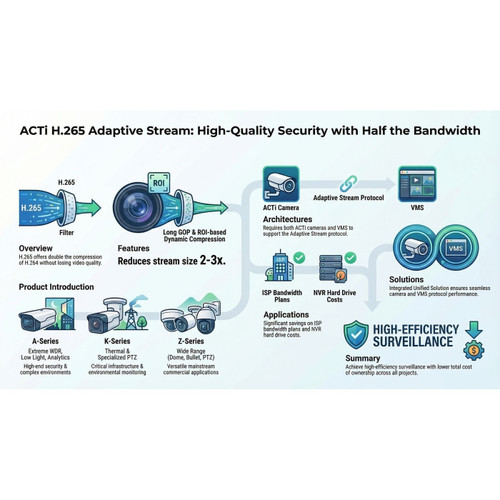
Both cameras support ONVIF Profile S, G, T, and M, plus VISCA, Pelco-D, and Pelco-P serial PTZ protocols and ACTi URL command — the integration footprint is identical on these axes. Both compress via H.265 Adaptive Stream, H.264 (Baseline/Main/High), and MJPEG. The B911 specifies two-way audio with mic-in, line-in, and line-out connections. The B915-K1 specifies two-way audio with line-in and line-out only; a mic-in port is not listed in the provided spec.
On edge analytics, the B911 lists Video Motion Detection, People Counting, and Smoke Detection. The B915-K1 lists VMD and People Counting only — Smoke Detection is absent from its spec. The B915-K1 includes a 3-year warranty (1 year under continuous motion), with a reference to an extended warranty program; no warranty term is provided in the B911 spec as supplied. On-board storage capability is not specified for either model in the provided data. PTZ range differs significantly: the B911 pans -175° to +175° (350° total), while the B915-K1 offers 360° endless pan and -20° to +200° tilt, making it more suitable for perimeter sweep applications.
Which should you choose: the B911 or the B915-K1?
Our take: The B911 is the stronger choice when a site needs PoE+ simplicity, wider pan arc flexibility within standard switch infrastructure, and three-channel analytics including Smoke Detection, while the B915-K1 is the stronger choice when the application demands long-range optical reach and continuous perimeter sweep. The B915-K1's 36x zoom versus the B911's 10x represents a 3.6× increase in optical magnification — critical for subject identification at distance. The B915-K1 also achieves 0 lux B/W minimum illumination (IR on) versus the B911's 0.002 lux, and its 360° endless pan versus the B911's 350° mechanical limit suits continuous sector scanning. However, the B915-K1 demands 75W High PoE — requiring a dedicated injector or switch port — compared to the B911's standard 802.3at Class 3, raising infrastructure cost. Specify the B911 for mid-range outdoor PTZ on standard PoE+ switches; specify the B915-K1 for long-range perimeter or critical-infrastructure sites where power infrastructure can support 75W per port.
Side-by-Side Comparison
Spec-for-spec, from manufacturer data.
| Specification | ACTi B911 | ACTi B915-K1 |
|---|---|---|
| Resolution | 3MP (2048×1536) | 3MP (2065×1553) |
| Image Sensor | 1/2.8" | 1/2.8" |
| Lens / Focal Length | 4.7–47mm (10x optical zoom) | 4.6–165.6mm (36x optical zoom) |
| Min Illumination (Color) | 0.05 lux @ F1.6 | 0.003 lux @ F1.55 |
| Min Illumination (B/W) | 0.002 lux @ F1.6 | 0 lux (IR on) |
| IR Range | DORI detection to 940m (940nm invisible IR) | 150m |
| WDR | 145dB | 145dB |
| Max Frame Rate | 30 fps @ 2048×1536 | 30 fps @ 3MP / 1920×1080 |
| Video Compression | H.265; H.264 (B/M/H); MJPEG | H.265; H.264 (B/M/H); MJPEG |
| IP Rating | IP67 | IP66 |
| IK / Impact Rating | IK10 | IK10 |
| Operating Temperature | -40°C to 60°C | -40°C to 55°C |
| Power Input | DC 12V or PoE+ (802.3at Class 3) | AC 24V or High PoE 75W |
| PTZ Pan Range | -175° to +175° (350° total) | 360° endless |
| Audio | Two-way; mic-in; line-in; line-out | Two-way; line-in; line-out (mic-in not specified) |
| Edge Analytics | VMD; People Counting; Smoke Detection | VMD; People Counting |
| Certifications | CE Class B; FCC Class B; EAC; IP67; NEMA 4X; IK10 | CE; FCC; IP66; NEMA 4X; IK10; UL (power adapter) |
| Warranty | — | 3 years (1 year continuous motion) |
Frequently Asked Questions
Which should you choose: the B911 or the B915-K1?
The B911 is the stronger choice when a site needs PoE+ simplicity, wider pan arc flexibility within standard switch infrastructure, and three-channel analytics including Smoke Detection, while the B915-K1 is the stronger choice when the application demands long-range optical reach and continuous perimeter sweep. The B915-K1's 36x zoom versus the B911's 10x represents a 3.6× increase in optical magnification — critical for subject identification at distance. The B915-K1 also achieves 0 lux B/W minimum illumination (IR on) versus the B911's 0.002 lux, and its 360° endless pan versus the B911's 350° mechanical limit suits continuous sector scanning. However, the B915-K1 demands 75W High PoE — requiring a dedicated injector or switch port — compared to the B911's standard 802.3at Class 3, raising infrastructure cost. Specify the B911 for mid-range outdoor PTZ on standard PoE+ switches; specify the B915-K1 for long-range perimeter or critical-infrastructure sites where power infrastructure can support 75W per port.
Is the B911 or B915-K1 better for low-light performance?
The B915-K1 reaches a lower minimum illumination floor: 0.003 lux color and 0 lux B/W (with IR active) versus the B911's 0.05 lux color and 0.002 lux B/W. If true darkness capability is required, the B915-K1 has the edge on sensor sensitivity. That said, the B911's 940nm invisible IR extends across a DORI detection envelope up to 940m, while the B915-K1's IR illuminator is rated to 150m — so illuminator range and covertness favor the B911 for discreet long-range IR coverage.
Can the B915-K1 run on a standard PoE+ switch port?
No. The B915-K1 requires either AC 24V or High PoE at 75W per port. Standard 802.3at PoE+ switches deliver a maximum of 30W per port, which is insufficient. A High PoE-capable switch or a dedicated 75W injector is required. The B911, by contrast, operates on standard PoE+ (802.3at Class 3), compatible with the majority of managed enterprise PoE switches already deployed in the field.
Which camera supports more edge analytics — the B911 or B915-K1?
The B911 lists three on-board analytics: Video Motion Detection, People Counting, and Smoke Detection. The B915-K1 lists two: VMD and People Counting. Smoke Detection is not specified for the B915-K1 in the provided data. If Smoke Detection is a site requirement — for example, in open-air industrial or storage yard applications — the B911 meets that spec; the B915-K1 does not, based on available specifications.
Get a Second Opinion on Your Camera Choice
Share your site layout, coverage goals, and budget. Our team will validate the camera selection, flag anything we would change, and recommend products that match the use case.