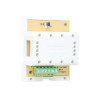
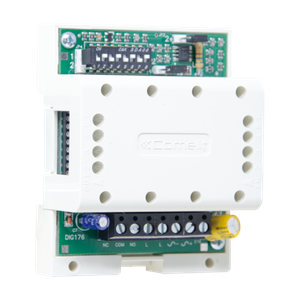
Comelit 1122/A Relay Com/No/Nc Contacts Module
The Comelit 1122/A is a 10 A changeover relay module engineered to integrate with Comelit intercom and access control systems, bridging audio/video signaling to physical door locks, gate operators, and auxiliary switching devices. Unlike generic relay breakout boxes, the 1122/A is purpose-built for Comelit's Simplebus 2 and legacy intercom architectures—it receives control commands directly from digital telephones or system controllers and translates them into reliable 12/24 VDC or VAC relay switching without requiring a separate power supply. Installers deploying mixed-era Comelit systems—retrofit audio systems alongside modern access control—benefit from a single relay form factor that handles both voice-triggered and time-based activation scenarios.
Key Features
- Changeover Relay Contacts (Com/No/Nc): Switches 10 A per circuit at 12/24 VDC or VAC. Enables parallel NO/NC contact logic for fail-safe door strike wiring (energize-to-unlock or de-energize-to-lock topologies).
- PoE Power Integration: Powers directly from Comelit intercom system auxiliary output; no external 12 V supply required. Reduces junction box clutter and simplifies field power distribution on multi-unit installations.
- DIN Rail Mounting (4-module footprint): Compact 68×85×35 mm envelope fits standard 35 mm DIN rail alongside other Comelit control modules. Horizontal or vertical mounting supported.
- Dual Control Modes: Direct wired control via S+/S terminals, or remote triggering from Comelit Simplebus 2 digital telephones and system controllers. Supports both call-triggered and time-scheduled activation.
- Wide System Compatibility: Verified integration with Simplebus 2 (audio/video and audio-only), traditional Comelit audio intercom, simplified systems, Comelbus, and Comtel platforms—enabling retrofit deployments without system-wide hardware replacement.
- Operating Temperature Range: 14–86 °F (–10–30 °C). Suitable for wall-mounted junction boxes, entry vestibules, and indoor column-mounted control enclosures in light industrial and commercial environments.
The 1122/A addresses a common integrator pain point: retrofitting intelligent access control into existing Comelit voice intercom installations. Rather than replacing the entire intercom backbone, you drop a relay module into the cabinet, wire it to your strike controller or gate operator, and push activation commands from the existing Comelit telephone network. This preserves the customer's investment in intercom handsets and wiring while adding modern lock control without a separate access control server.
Installation follows standard Comelit terminal conventions: screw-down push-contacts on the module face accept 18–14 AWG wire. Control lines arrive via the S+ (logic high) and S (logic low/ground) pair on the mounting bracket—these are the same signal terminals used on legacy Comelit call buttons and door phone extensions. If you're accustomed to wiring Comelit audio distribution panels, the relay pinout is immediately familiar. Power consumption is minimal (the relay itself draws <1 W in standby); if your Comelit system's auxiliary output can source 100+ mA at 12/24 V, you can safely parallel up to 10–15 units on a single supply without voltage sag.
The changeover contact design is particularly valuable for fail-safe strike wiring. Use the NO contact to energize a fail-safe strike on unlock (phone rings, resident buzzes, relay energizes, lock disengages). Wire the NC contact in parallel to a monitoring circuit that supervises lock position during normal operation—a simple window-contact on the door frame wired through the NC contact creates a two-stage fault detection (relay loss or strike mechanical failure) without additional instrumentation. This topology is standard in European access control practice and becomes critical in multi-family or commercial buildings where tenant safety and audit trails matter.
Comelit 1122/A modules ship with a 2-year manufacturer warranty covering manufacturing defects; all warranty claims and technical support route through Comelit's channel partner network. The module itself is manufactured in Bulgaria and is compatible with all North American 120 V / 60 Hz Comelit installations (Simplebus 2 variants sold in the US market). For integrators standardizing on Comelit platforms or retrofitting legacy intercom systems into access-controlled environments, the 1122/A eliminates the need for external relay boards and simplifies cabinet wiring. Explore the complete Comelit catalog for matching door phone modules, power supplies, and system controllers.
Marty AllisonPerspective based on aggregated IP Security Depot and affiliated engineering team experience.
We've deployed the Comelit 1122/A across dozens of mixed-generation Comelit intercom retrofits, and it solves a specific integration bottleneck: how do you add electric strike control to an existing audio-only Comelit system without ripping out the telephone infrastructure or buying a separate access control platform? The answer is this relay module. It's not a feature-rich smart lock controller—there's no web interface, no cloud logging, no mobile app unlocking. What it does is translate a 40-year-old intercom standard (Simplebus 2 binary signaling) into relay contacts that your strike supplier recognizes. On a 20-unit apartment building retrofit, that's the difference between a $3,500 field retrofit (existing Comelit phones stay in place) and a $28,000 rip-and-replace (new VoIP intercom + separate access control server + new handsets). The ROI math for landlords and property managers is stark.
Technical Highlights:
- Changeover Contact Logic (Com/No/Nc): The presence of all three terminals (common, normally open, normally closed) enables fail-safe strike wiring without auxiliary diodes or cross-wired supervision circuits. Standard practice in European access control but often overlooked by integrators trained only on simple NO-only relay designs. Matters significantly for audit-trail and life-safety scenarios.
- 10 A Switching Current at 12/24 V: Sufficient for standard mortise and cylindrical strike solenoids (typical draw 0.5–1.2 A), and gate operators (0.8–3 A range). Do not attempt to drive high-inrush loads (heating elements, high-power LED beacons) without external soft-start circuitry.
- PoE Integration (System Auxiliary Output): The 1122/A doesn't use standard Ethernet PoE (802.3af); it draws power from the Comelit system's own 12 or 24 V auxiliary power supply terminals. This is a design choice that cuts cost and avoids the need for PoE injectors in cabinet-mounted applications. Verify your Comelit power supply has adequate current budget (typically 500 mA to 2 A available)—older Simplebus 2 PSUs sometimes struggle with 4+ parallel relays.
- DIN Rail Mounting (68 mm × 4 module space): Takes up minimal real estate in a cabinet. Paired with a 35 mm DIN carrier, you fit 8–12 relay modules in a standard 19-inch cabinet height. Thermal dissipation is passive—the relay coil itself generates negligible heat, and the contact resistive drop is sub-milliwatt at typical currents.
- Simplebus 2 Digital Telephone Integration: Control lines arrive via S+ and S terminals, which are the same signal pair used on Comelit call buttons, door phones, and master station handsets. If you're already familiar with Comelit audio panel wiring, the relay terminal assignment is intuitive.
Deployment Considerations:
- Current Capacity Planning: 10 A per contact is adequate for individual strikes and small gate operators, but parallel relays on a single 24 V supply can sag voltage under simultaneous switching. Test your full circuit current draw and measure voltage at the strike under worst-case (all relays energized). Legacy Comelit PSUs may need upgrade to 3–5 A rated supplies if you plan 6+ relays per system.
- Control Signal Isolation: The S+ and S terminals are referenced to the Comelit system ground. If your strike controller has its own isolated 24 V supply (common on modern access control boards), you must either tie grounds together or use an optoisolated relay interface. Floating the S signal can cause unpredictable relay behavior or latching issues on power cycling.
- Fail-Safe Wiring Topology: Comelit relay modules default to latching relay behavior (energize to switch, de-energize returns to NO). For fail-safe strike wiring (unlock on power loss), wire the strike solenoid through the NC contact. Test the circuit with power off—the strike should be in the unlocked (de-energized) state. This is opposite to typical American fire-code practice (energize-to-unlock), so document polarity clearly on terminal strip labels.
- No Built-In Surge Protection: Strike solenoids and gate operators generate back-EMF on de-energization. Omit the diode or suppress circuit, and you can damage the relay contacts or internal control circuitry. Always install a 1N4007 diode across the load (cathode to positive, anode to ground) or specify a relay module with integrated suppression. Comelit does not include suppression in the 1122/A; factor clamping diodes into your BOM.
- Temperature Operating Envelope: 14–86 °F is standard for indoor wall-mounted or cabinet-mounted installations. If the relay is destined for an unheated vestibule or outdoor equipment enclosure, the low-temperature limit (–10 °C) may not provide sufficient margin. Outdoor Comelit installations typically use enclosed metal boxes with internal heating or require an extended-temperature variant.
The 1122/A is the right fit for integrators standardizing Comelit across a portfolio of multi-family, commercial, or hospitality properties where legacy intercom systems need intelligent lock control without a complete platform migration. If your customer's existing Comelit installation has 10+ years of handsets and wiring in place, this module justifies itself in labor hours saved and project budget preservation. For new-build projects or environments requiring advanced analytics, mobile-first access, or integration with building management systems (BACnet, Modbus), consider a dedicated access control platform instead. Explore compatible Comelit door phone modules and system controllers in the full Comelit catalog.