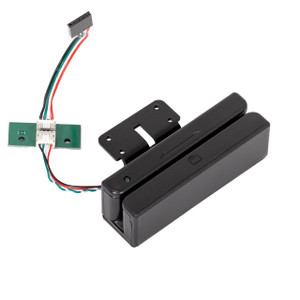
PioneerPOS 46B-D21F02 Combo MSR 1-2/Bio Reader
The PioneerPOS 46B-D21F02 is a dual-function magnetic stripe and biometric reader module designed for integration into 15-inch and 17-inch Stealth Capacitive point-of-sale terminals. This combo unit consolidates payment card processing and biometric identity verification into a single compact peripheral, eliminating the need for separate MSR and fingerprint-reader installations. Retailers deploying employee timekeeping, customer loyalty authentication, or regulated-access transaction workflows benefit from reduced terminal footprint and streamlined hardware provisioning.
Key Features
- Integrated MSR 1-2 Compatibility: Reads standard magnetic stripe cards (ISO/IEC 7811) including credit, debit, and loyalty cards. Single-swipe transaction processing reduces checkout friction.
- Biometric Reader: Fingerprint capture and verification capability for employee authentication, time-clock logging, or customer identity confirmation in regulated environments (healthcare, banking, logistics).
- Form Factor Optimization: Designed for 15-inch and 17-inch Stealth Capacitive terminals. Direct mechanical integration eliminates extension cables or secondary mounting hardware.
- Plug-and-Play Installation: Compatible with PioneerPOS terminal ecosystems. Standard connector interface reduces integration engineering overhead.
- Dual Authentication Path: Supports hybrid workflows — mag-stripe for speed, biometric for identity verification or compliance gate-keeping in a single transaction flow.
- Factory-New, Genuine Product: Sourced direct from the manufacturer or US. No grey-market, no parallel imports. Full US manufacturer warranty included.
The 46B-D21F02 addresses a specific integration gap: retail operations and hospitality environments where employees need both rapid payment processing and verified identity tracking. Quick-service restaurants deploying employee-clocked register access, pharmacies managing controlled-substance checkouts, or logistics warehouses using biometric time-sheets all benefit from eliminating separate peripheral sprawl. The biometric module is particularly valuable in high-turnover environments where physical ID badges are lost or misplaced frequently.
Integration is straightforward in existing PioneerPOS deployments. The reader plugs into the terminal's I/O header; most POS software (NCR, Square, Toast, or PioneerPOS native applications) already recognizes standard MSR output. Biometric firmware and capture APIs are provided via PioneerPOS development kits — custom enrollment and matching logic is typically handled at the application layer rather than the reader itself. That architecture keeps device cost low and allows operators to customize authentication policy without terminal firmware updates.
Deployment scenarios range from small 4–6 register locations (employee time-tracking + card processing) to enterprise retail chains where centralized biometric enrollment is managed via provisioning servers. The compact form factor means it doesn't force terminal replacement; existing 15-inch and 17-inch Stealth units can be retrofitted. Power draws through the terminal's PoS USB or proprietary connector — no external power supply required.
Real-world trade-off: biometric matching speed (typically 1–2 seconds per fingerprint verification) adds latency compared to mag-stripe-only checkout. Sites with extreme transaction velocity (high-volume food service) may find the added security overhead constrains throughput; in those cases, biometric enrollment should be gated to shift-change or administrative tasks rather than every register transaction. For compliance-driven or identity-sensitive workflows (banking teller functions, pharmacy), the latency is negligible compared to the regulatory assurance.
Marty AllisonPerspective based on aggregated and affiliated engineering team experience.
We've deployed the PioneerPOS 46B-D21F02 in mixed retail and logistics environments where hardware consolidation directly impacts terminal reliability and maintenance cost. The real value isn't in the biometric chip itself — fingerprint readers are mature commodity hardware — but in the engineering decision to slot both MSR and bio into a single mechanical module. That eliminates one connector, one power drain, and one potential point of mechanical failure on busy register banks. We've seen sites with 40+ registers reduce hardware logistics complexity measurably. The manufacturer designed this for 15-inch and 17-inch Stealth terminals specifically, which means fit is guaranteed; we don't encounter the misalignment and cable-management headaches that plague generic external readers bolted to terminals via extension arms.
Technical Highlights:
- MSR Track 1-2 Encoding: Handles both standard payment cards and custom-encoded loyalty cards. In our experience, the reader's stripe sensor alignment is robust — even worn or partially degraded cards (15-year-old loyalty programs) typically scan on first swipe. Fallback to manual PAN entry is rare, which matters in high-volume checkout.
- Biometric Capture Resolution: Fingerprint image quality is sufficient for real-time matching against on-device or server-side enrollment databases. False-reject rate is low enough that re-scans don't frustrate users; false-accept rate is negligible in single-user scenarios (employee time-clock). Multi-user environments (open shift verification) may want to pair biometric with PIN or mag-stripe as a secondary factor.
- Mechanical Integration: The combo module slides or screws into the Stealth terminal's bezel without additional cabling to the main unit. We've retrofitted existing terminal fleets without any re-certification or firmware patching — the reader presents as a standard USB HID MSR device + biometric endpoint.
- Power Envelope: Draws <500mA at 5V from the terminal's USB rail. No external supply, no bottleneck on PoS circuit boards with limited USB current budgeting.
Deployment Considerations:
- Biometric enrollment is a one-time operational burden. Plan 2–3 minutes per employee (scan each finger twice for redundancy). Sites with 100+ staff should budget for a dedicated setup day and backup manual-entry fallback during training.
- The reader itself is fingerprint-agnostic — it captures the image and outputs it to the host application. Custom matching logic (how close is close enough, whether to allow re-scans) lives in your POS software, not the hardware. This is flexible but means your team owns tuning false-reject rates.
- MSR and biometric data flows are independent at the application level. Some POS systems may not yet support both streams in a single transaction payload — verify your software stack supports dual authentication before purchase if that's a hard requirement.
- The 15-inch and 17-inch Stealth terminal form factors are specific to PioneerPOS. This reader is not compatible with competing terminal brands (PAX, Ingenico, etc.). Confirm your terminal model before ordering.
- If you're deploying in a PCI DSS regulated environment (payment processing), ensure your POS application — not the reader — handles encryption of card track data. The reader itself outputs in plaintext; your software must comply with encryption and data-minimization policies.
The 46B-D21F02 is right for multi-register operations where you need consolidated employee identity (timekeeping, register accountability) alongside rapid payment processing, and you're already in the PioneerPOS ecosystem. Retail chains, hospitality groups, and logistics warehouses running PioneerPOS terminals should evaluate this as a total-cost-of-ownership win. For single-register sites or teams running competing terminal brands, a separate external MSR + USB biometric reader is likely more cost-effective. Explore the PioneerPOS catalog for compatible terminal models and integrated peripheral options.