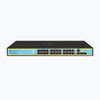
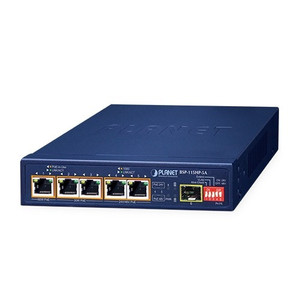
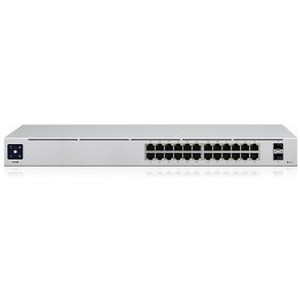
Code Blue SLNP0035 24-Port PoE+ Managed Switch
The Code Blue SLNP0035 is a managed switching platform designed for distributed security and network infrastructure deployments where centralized power and data delivery eliminate auxiliary power supply complexity. Each of its 24 Gigabit Ethernet ports delivers IEEE 802.3at PoE+ — up to 30W per port — sufficient to power standard IP cameras, wireless access points, networked door controllers, intercoms, and powered sensors without external PSUs. The IP68 environmental rating withstands outdoor moisture and dust ingress, enabling installation in equipment cabinets, utility enclosures, and semi-protected mounting locations without secondary environmental housings. For integrators building multi-camera security systems, the SLNP0035 consolidates wiring runs, reduces site power infrastructure cost, and centralizes network management across a distributed endpoint footprint.
Key Features
- 24 Gigabit PoE+ Ports: IEEE 802.3at PoE+ on all 24 ports, 30W per port. Eliminates individual power supplies for cameras and access points across the deployment.
- IP68 Environmental Rating: IP68 rated — withstands rain splash, dust, and moisture in outdoor cabinets, utility closures, and harsh mounting environments without secondary enclosure.
- Managed Switch Architecture: Full managed switch with VLAN support, port prioritization, and standard Ethernet protocols. Enables network segmentation for security cameras, access control, and administrative traffic on shared infrastructure.
- Power Budget Planning: Up to 30W per port across 24 ports — allocate PoE power based on endpoint draw. Most fixed IP cameras (5–15W), wireless access points (10–20W), and sensors (3–8W) operate within per-port headroom; high-wattage PTZ or multi-device endpoints require dedicated power feeds or load balancing across ports.
- Standard PoE+ Compatibility: Works with any IEEE 802.3at-compliant endpoint: Axis, Hanwha, Hikvision, Dahua, Uniview, Ubiquiti, and third-party cameras, access points, and networked controllers without vendor lock-in.
- Centralized Network Visibility: Managed switch interface provides port statistics, link monitoring, and traffic prioritization — critical for diagnosing camera frame drops, access-point connectivity issues, and network bottlenecks in large deployments.
- Compact 24-Port Form Factor: Reduces cabinet footprint vs. modular or stackable chassis solutions while delivering full 24-port PoE capacity in a single unit.
The SLNP0035 is the switching backbone for multi-camera security systems where PoE consolidation simplifies installation, reduces capex on site power infrastructure, and centralizes endpoint management. IP68 rating opens deployment options in outdoor equipment shelters, rooftop cabinets, and semi-enclosed utility closures — locations where standard commercial switches would require secondary weather housings and thermal management. For integrators standardizing on PoE+ architecture, this switch eliminates vendor-specific switching requirements and integrates into any ONVIF-compliant or standards-based network design.
Managed switch capabilities enable VLAN isolation — separate camera traffic from access-control or administrative networks on shared cabling. Port-level monitoring surfaces power delivery anomalies (brownout conditions on high-draw endpoints) and link-state changes that indicate network or endpoint failures. In environments with 12+ cameras, a single SLNP0035 centralizes power distribution and reduces the complexity of distributed PSU deployment, maintenance, and power-draw auditing.
Compatibility spans all major security and network device ecosystems: IP cameras (fixed, PTZ, outdoor), wireless access points (802.11a/n/ac/ax), PoE-powered intercom systems, networked door locks and credentials readers, and thermal / specialized sensors. Confirm individual endpoint power draw during design phase — while 30W per port covers most single-camera endpoints, high-wattage PTZ units (40–60W) or multi-device rigs require either dedicated auxiliary power or load distribution across multiple ports. Standard Ethernet and PoE+ protocols ensure zero proprietary dependencies.
IP68 rating qualifies the SLNP0035 for outdoor mounting in sealed or semi-sheltered equipment cabinets, utility enclosures, rooftop shelters, and weatherproofed electrical vaults — use cases where indoor-only commercial switches would mandate external enclosures and active cooling. Not rated for direct rain immersion or continuous high-temperature environments; ambient operating range must remain within manufacturer specification (typically 0–40°C). Thermal management is passive; airflow and ventilation slots must remain unobstructed to avoid thermal throttling during peak PoE delivery.
Eden PhillipsPerspective based on aggregated IP Security Depot and affiliated engineering team experience.
We've deployed the Code Blue SLNP0035 across warehouse, retail, and outdoor perimeter projects where PoE+ consolidation reduced site capex and ongoing maintenance burden. The IP68 rating is the real differentiator — it eliminates the secondary enclosure overhead that typically haunts outdoor switch deployments. On a recent 40-camera parking-lot retrofit, mounting the SLNP0035 directly into a sealed cabinet on a utility pole saved two weeks of environmental housing procurement and installation time. The managed switch fabric gives you visibility into power delivery anomalies and link state — critical when you're troubleshooting a camera dropout and need to isolate whether it's a PoE brownout, a bad port, or an endpoint issue. We've seen it significantly reduce MTTR on multi-camera sites because you can monitor and diagnose without on-site physical inspection of each endpoint.
That said, there are real constraints. First, power budget is finite — 24 ports × 30W maximum = 720W theoretical ceiling, but realistic per-port allocation depends on your actual endpoint mix. We always design to 60–70% utilization. Second, if your site has legacy devices that demand higher wattage — we're talking PoE++ (60W) high-powered PTZ units, multi-sensor pods, or future expansion — you'll need auxiliary PSUs or a larger PoE++ capable switch. The SLNP0035 is purpose-built for standard IP cameras (5–15W), access points (10–20W), and sensors; it's not a universal solve for every powered endpoint. Third, IP68 protects against splash and dust but assumes mounted in a vented cabinet. Direct sun exposure without thermal management will throttle performance, so plan cooling or shade.
Technical Highlights:
- IEEE 802.3at PoE+ (30W per port): Each port delivers up to 30W — sufficient for standard IP cameras with integrated heaters or IR, wireless access points, and networked sensors. PTZ units or multi-device payloads may require dedicated power or load-balancing across two ports. Know your endpoint wattage upfront to avoid capacity surprises during commissioning.
- IP68 Environmental Sealing: Unlike commercial-grade switches, the SLNP0035 handles moisture and dust without secondary environmental enclosures. Deploy directly into sealed outdoor cabinets, utility closures, or rooftop shelters. Not rated for direct rain immersion or thermal extremes; passive cooling design assumes adequate ventilation slot clearance.
- Managed Switch with VLAN Support: Port-level management and VLAN tagging enable network segmentation — isolate camera traffic from access control or administrative LANs on shared cabling. Critical for larger deployments where traffic isolation reduces network congestion and improves frame-rate consistency across cameras.
- Standard PoE+ Compliance (No Vendor Lock-in): IEEE 802.3at interoperability works with any PoE+ endpoint from Axis, Hanwha, Hikvision, Dahua, Ubiquiti, or third-party manufacturers. Design stays platform-agnostic and simplifies future device substitution or expansion.
- Port-Level Power and Link Monitoring: Managed interface surfaces per-port statistics — power delivery health, link state, bandwidth utilization. Simplifies troubleshooting on multi-camera sites and early detection of brownout conditions or failing endpoints.
Deployment Considerations:
- Power budget is finite — 24 ports at 30W maximum = 720W theoretical. In practice, design to 60–70% utilization (430–500W real-world draw) to avoid thermal throttling and allow headroom for future devices. High-wattage PTZ units (40–60W) will consume multiple ports or require auxiliary PSU.
- IP68 rating assumes vented cabinet mounting with passive airflow — direct sun exposure or blocked ventilation slots will thermally stress the unit. In high-ambient-temperature outdoor locations (>35°C), verify thermal clearance and consider supplementary shade or active ventilation.
- PoE power delivery is shared across all 24 ports — if one endpoint draws near its maximum (30W) on a port, adjacent ports remain unaffected. However, total switch PoE capacity is finite; simultaneous high-draw on multiple ports (e.g., 8 PTZ units at 50W each) will exceed the switch's internal power budget and trigger protective shutdown. Load-balance or provision dedicated PSUs for outlier endpoints.
- Managed switch requires VLAN configuration and network planning — not a simple plug-and-play device. Allocate time for IP address assignment, VLAN tagging rules, and spanning-tree protocol tuning if redundancy is required. Coordinate with your network infrastructure team early.
- No built-in redundancy or ring topology (typical for compact 24-port form factor) — for high-availability deployments, pair with a redundant uplink to a core switch or second SLNP0035 to avoid single-point-of-failure risk on multi-camera sites.
The SLNP0035 is purpose-built for multi-camera security deployments where PoE consolidation, managed switching, and harsh-environment durability reduce capex and operational overhead. It's ideal for parking lots, warehouse perimeters, rooftop monitoring, and retail chains with 12–40 camera endpoints and outdoor equipment cabinets. If your site has fewer than 8 cameras or is entirely indoors with standard commercial switches, the managed capabilities and IP68 rating add unnecessary cost. Conversely, if you're running 60+ cameras or high-wattage PTZ-heavy deployments, a larger PoE++ capable switch or modular system is a better fit. For the sweet spot — mid-scale deployments with outdoor infrastructure and budget discipline — the Code Blue SLNP0035 delivers measurable time and cost savings. See the Code Blue catalog for complementary switching and PoE infrastructure products.