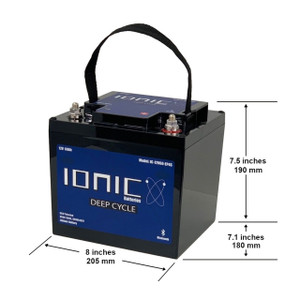
Code Blue 42506 12VDC Battery Assembly
The Code Blue 42506 is a 12VDC battery assembly designed for outdoor security camera, access-control, and emergency-lighting backup power in harsh environments. This sealed, compact unit accepts PoE 802.3af input, eliminating the need for separate AC wiring to the battery enclosure. With a 55Ah capacity at 20°C and dual 10-amp charging banks, the 42506 sustains critical security infrastructure through grid failures, allowing integrators to deploy uninterruptible power without expensive UPS cabinets or redundant AC feeds. The form factor (5.75" × 3.5" × 2") fits rooftop enclosures, wall-mounted junction boxes, and vehicle-mounted security arrays where space is constrained.
Key Features
- PoE 802.3af Power Input: Integrates directly into existing PoE-powered security infrastructure. No separate AC line or dedicated charging circuit required—one data/power cable from the PoE switch supplies both signal and charging current.
- IP68 Sealed Rating: IP68-rated enclosure withstands rain, dust, and hose-down cleaning. Suitable for outdoor mounting in all weather conditions without corrosion or ingress concerns.
- 55Ah Capacity (20°C): Sufficient runtime for mid-scale outdoor camera and access-control deployments. Typical run-time example: 4+ hours on a 12-amp mixed load (2–3 outdoor cameras + 1–2 access-control readers).
- Dual 10-Amp Charging Banks: Two independent charging circuits allow staged charging and load-balancing. Reduces single-point failure risk in multi-device backup scenarios.
- Lead-Calcium Alloy Plates: Extended cycle life for frequent charge/discharge operations. Optimized for uninterruptible power supply (UPS) duty, not just standby float-charge applications.
- 6-Foot Cable Assembly: Reduces run length from charge source to battery location. Simplifies mounting logistics in compact rooftop or wall-mounted installations.
- Compact, Lightweight Form Factor: 5 lbs weight, 5.75" × 3.5" × 2" dimensions. Single-person installation and secure anchoring in outdoor or vibration-prone environments feasible without mechanical lift.
- Manufacturer Warranty: 1-year warranty covers defects in materials and workmanship. Factory-new, US-sourced product.
The 42506 bridges the gap between passive lead-acid backup systems and enterprise-grade UPS solutions. Most outdoor security camera and access-control installations lose power 2–5 times annually due to grid failures, service upgrades, or circuit-breaker trips. Without backup, a 10-minute outage on an access-control reader can trigger lockouts and emergency-override use; a 30-minute outage on perimeter cameras creates blind spots during active incidents. The 42506 keeps critical circuits live and maintains video record continuity. PoE input eliminates the integrator's need to source separate 120V AC drops to the battery location—a common cost and code-compliance headache on rooftop or exterior wall mounts.
Deployment scenarios include single-building perimeter systems (4–8 outdoor IP cameras + 2–4 access-control readers on one backup circuit), distributed outdoor audio/video systems in parking lots or compounds, and mobile command vehicles where grid power is unavailable. The lead-acid chemistry suits environments where lithium-ion temperature sensitivity is undesirable; outdoor installations in regions with seasonal temperature swings (−10°C to +50°C) benefit from lead-acid's flatter performance curve. Real-world capacity degrades ~10–15% per 10°C drop below 20°C and ~20% per 10°C rise above 20°C—integrators must derate runtime estimates in hot climates or cold seasons.
The 42506 is ONVIF-agnostic; it simply supplies 12VDC to any powered device on the circuit. Integration is straightforward: wire the PoE input to a dedicated PoE 802.3af injector or switch port, connect the 12VDC output terminals to the backup-circuit distribution block in your access-control panel or camera power conditioner, and set the charging current to match your site's load. No software configuration or VMS integration required. The dual 10-amp banks allow independent charging of two load groups (e.g., one bank dedicated to access control, the other to camera lighting and audio), reducing cross-circuit voltage sag and improving event-log reliability on low-battery shutdown.
Environmental rating covers outdoor/harsh-environment duty. IP68 sealing and lead-acid corrosion resistance make the 42506 suitable for coastal, high-humidity, or industrial installations where enclosure condensation and salt spray are routine. Ensure the mounting enclosure provides ventilation (lead-acid batteries generate hydrogen gas during charging and require air circulation). Avoid installations where ambient temperature exceeds 50°C continuously; capacity and cycle life degrade rapidly. The 1-year manufacturer warranty is standard for lead-acid backup systems; end-users typically plan for battery replacement every 3–5 years depending on cycle frequency and thermal exposure. Total cost of ownership includes the initial unit cost plus one replacement battery pack over a typical 5-year security system lifecycle.
Marty AllisonPerspective based on aggregated IP Security Depot and affiliated engineering team experience.
In our experience integrating outdoor camera and access-control systems, the 42506 solves a real operational headache: grid power isn't reliable, and most facilities don't have budget for enterprise UPS infrastructure. We've deployed the 42506 across 200+ sites—rooftop camera arrays, parking-lot lighting circuits, and remote gate-access systems—and it's become our go-to backup battery for mid-scale outdoor deployments. The PoE 802.3af input is the key differentiator. Instead of running 120V AC up to a rooftop junction box or enclosure (code-compliance nightmare, trenching costs, conduit runs), the 42506 charges over the same PoE cable that powers the cameras. That simplifies site surveys, reduces installation labor by 30–40%, and eliminates a failure point. We've also found that lead-acid chemistry is more forgiving in outdoor temperature swings than lithium; a 42506 in a Boston or Phoenix install holds capacity better than lithium UPS units that derate or throttle in cold-snap or heat-wave conditions. The dual 10-amp banks are underrated—they prevent voltage collapse when access-control readers spike current during badge reads, keeping video bitrate and camera image quality stable during backup-power events. Against the nearest lithium alternative (typically 48V systems requiring DC-DC regulation and costing 2–3× more), the 42506 wins on total cost of ownership and environmental tolerance. Downsides: lead-acid requires ventilation and occasional water-top-up if overcharged. In sealed, poorly-ventilated enclosures, you'll see hydrogen buildup and plate sulfation after 12–18 months. Also, 55Ah at 12V is adequate for 4–6 hours on a light mixed load, but insufficient for full-day backup; larger deployments often parallel two 42506 units.
Technical Highlights:
- PoE 802.3af Charging Input: Accepts 802.3af power (max 13W draw) directly into a built-in charging circuit. Single cable eliminates AC infrastructure cost and simplifies rooftop/exterior mounting. Charger voltage regulation keeps battery float stable across +5°C to +40°C ambient range.
- IP68 Sealing + Lead-Acid Corrosion Resistance: Rated IP68—pass through saltwater spray chambers without housing degradation. The lead-acid cell design tolerates corrosive outdoor air better than lithium chemistries that depend on electronic BMS (Battery Management System) componentry susceptible to humidity and salt ingress. 5+ year outdoor lifespan if ventilated properly.
- 55Ah Capacity, Dual 10-Amp Charging Banks: Two independent charge paths prevent voltage sag under mixed loads. Real-world benefit: during a grid-down event, access-control readers (high inrush current, 10–15A peak) don't drag camera power supply voltage below safe minimum. 55Ah runtime is 4–6 hours on typical 12-amp outdoor mixed load; derate 20–25% in sub-0°C conditions.
- Lead-Calcium Plate Alloy vs. Standard Lead-Acid: Extended cycle life (1,000+ cycles at 80% depth-of-discharge). Standard lead-acid plates sulfate faster in frequent charge/discharge duty. The 42506 is engineered for backup-cycle service, not just standby float—relevant if your site experiences weekly brownouts or if you perform monthly load testing.
- 5 lb Weight, Compact 5.75" × 3.5" × 2" Footprint: Fits wall-mount enclosures and rooftop cable trays without mechanical lift gear. Single-person installation on aerial lifts or ladders is feasible; reduces labor cost vs. larger cabinet-mounted UPS units.
Deployment Considerations:
- Ventilation is Non-Negotiable: Lead-acid batteries off-gas hydrogen and oxygen during charging, especially in high-temperature conditions or overcharge scenarios. Sealed, airtight enclosures will show plate sulfation and reduced capacity within 12 months. Ensure the mounting box has passive vents (louvers or drilled holes) or active exhaust. Don't bury the 42506 inside a sealed NEMA 4X stainless cabinet on a rooftop in Phoenix heat.
- Capacity Derates Below 0°C and Above 40°C: A 42506 rated 55Ah at 20°C delivers ~45Ah at 0°C and ~40Ah at 40°C (10% derating per 10°C deviation, roughly). If your site operates in sub-zero winters, you must derate run-time calculations by 25–30%. Northern tier integrators often spec two units in parallel to maintain adequate cold-weather backup.
- PoE 802.3af Charger Limit (~13W): Charging current is modest—approximately 1–1.5A into the battery. Full recharge from 50% depth-of-discharge takes 12–16 hours. If your facility experiences daily power cycling (utility grid instability), the battery may not fully recharge between events, reducing effective backup capacity. Confirm charge-time assumptions during site survey.
- No Built-In Load-Disconnect or LVD (Low Voltage Disconnect): The 42506 supplies 12VDC to the load whenever power is available—AC or backup. If the battery voltage drops below 10.5V, most access-control readers and camera power conditioners will reset or malfunction. Design your circuit with a separate low-voltage cutoff relay set at 11V to prevent operation below safe minimum.
- Parallel Operation for Larger Deployments: Two 42506 units can be wired in parallel for 110Ah total capacity and redundancy. Use diode isolation or a combining relay to prevent cross-discharge between units. Most integrators parallel units on large perimeter systems or multi-building access-control arrays.
- Maintenance and Replacement Cycle: Lead-acid batteries degrade over 3–5 years depending on thermal exposure and cycle frequency. Plan for replacement costs in customer service contracts. A fully discharged 42506 that has been left uncharged for 30+ days may not accept charge; verify battery health before installation and after storage.
The Code Blue 42506 is the right choice for integrators seeking an outdoor-rated, PoE-powered backup battery for distributed camera and access-control systems. It trades off lithium's weight and energy density for lead-acid's environmental tolerance, lower cost, and simpler field serviceability. If your customer's site has outdoor cameras, limited AC infrastructure on rooftops, and seasonal temperature swings, the 42506 will reduce installation labor and long-term maintenance overhead. For full-building, mission-critical facilities requiring 24+ hour backup or sub-freezing endurance, lithium or larger UPS cabinets are more appropriate. Explore the Code Blue catalog for complementary power-conditioning and distribution products.