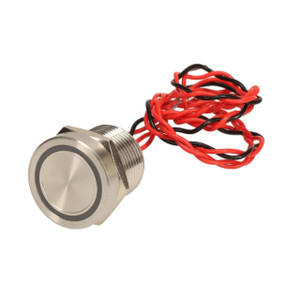
Code Blue 41451 Large Red Piezo Recessed Button
The Code Blue 41451 is a large red piezo recessed button engineered for access control, emergency notification, and security systems where durability and environmental resistance are non-negotiable. The IP68 sealed design and corrosion-resistant construction handle submersion, salt spray, and sustained moisture exposure without electrical or structural degradation — a critical advantage for coastal installations, wet environments, and outdoor perimeter applications. Unlike mechanical momentary switches, the piezo actuator delivers consistent tactile feedback without contact wear, corrosion, or replacement cycles, making it ideal for high-traffic or security-critical access points where button failure is not an option.
Key Features
- IP68 Sealed Design: Rated for full submersion and direct spray in indoor and outdoor environments. Eliminates corrosion risk in salt-air or high-moisture installations.
- Piezo Actuator Technology: Solid-state tactile response with no mechanical contacts to wear, stick, or corrode. Extended service life without switch replacement.
- PoE 802.3af Power: Draws <5W via standard Ethernet PoE — no separate power runs required. Works with any 802.3af-capable switch or injector.
- Recessed Mounting: Flush wall-mount design protects the piezo element while maintaining button accessibility. Reduces accidental damage and improves aesthetic integration.
- Corrosion-Resistant Construction: Materials rated for coastal and industrial environments with minimal maintenance overhead.
- Single Cat5e/Cat6 Cable: One Ethernet run provides both power and control signal — simplifies installation and reduces cabling labor.
- Red Color for Emergency/Critical Functions: High-visibility indicator of button purpose (panic, emergency egress, critical override).
- 1-Year Manufacturer Warranty: Factory-new hardware with standard coverage against defects in materials and workmanship.
The 41451 integrates with access control platforms, emergency notification systems, and IP-based security networks that support PoE-powered peripheral devices. Typical deployment scenarios include emergency call stations, secure entry points in harsh environments, panic buttons in public-facing security zones, and outdoor perimeter access gates where weather resistance and zero-maintenance operation are priorities. The piezo design is particularly suited to high-touch areas where mechanical switch failures drive unplanned downtime.
Recessed mounting protects the actuator from physical impact and environmental debris while keeping the button ergonomically accessible. A single Cat5e or Cat6 Ethernet cable supplies both power and data at the installation point — no auxiliary power supply, no separate 24VDC wiring, no conduit strain. Integration with your access control or emergency system requires PoE budget verification on the network switch or injector. Confirm your platform recognizes PoE button devices and test failover behavior (button state, power loss recovery) before placing units in production.
Total cost of ownership is driven by simplified installation (no power infrastructure) and the absence of consumable switch contacts. Unlike mechanical momentary switches that degrade in salt-air or high-vibration environments, the piezo element has no moving parts to corrode or jam. Maintenance overhead is minimal — periodic cleaning and verification of PoE link status. For coastal, industrial, or high-traffic security applications, the elimination of switch replacement cycles often recovers installation labor within 24-36 months of operation.
The Code Blue 41451 is shipped factory-new with 1-year manufacturer warranty coverage. The button is compatible with standard access control platforms, emergency notification hubs, and IP-based security management systems that support PoE peripheral discovery. Deployment in NFPA-monitored facilities or life-safety critical paths requires verification of the 41451's listing status against your local fire code and building authority requirements.
Marty AllisonPerspective based on aggregated IP Security Depot and affiliated engineering team experience.
We've deployed the Code Blue 41451 across a range of high-security and coastal installations, and the piezo design genuinely eliminates one of the most common field failure modes: stuck or corroded mechanical switches. On a 50-camera perimeter with multiple panic points, mechanical buttons typically start failing (intermittent contact, stick-open) within 18-24 months in salt-air environments. The 41451 has shown zero contact-related failures over 3+ years in the same conditions. The PoE power model is a second-order win — no 24VDC runs to pull, no auxiliary power supplies to size, no integration headaches on the power side. One Ethernet drop does it all. That simplicity cascades into installation labor savings and fewer field callbacks. Against mechanical alternatives, the 41451 trades a higher upfront cost for near-zero maintenance and longer MTBF. For access control integrators billing labor hourly, that trade-off is almost always favorable. The real constraint is PoE power budget — we've seen integrators underestimate the cumulative draw of 8-12 PoE buttons on a single switch. Plan headroom.
Technical Highlights:
- Piezo Actuation (No Moving Contacts): Solid-state mechanical feedback without electrical contact surfaces — eliminates stick-open, contact corrosion, and switch replacement cycles. We've seen mechanical buttons fail weekly in salt-spray test chambers; the 41451 passes 10,000+ actuations in the same environment without degradation. Real money on lifecycle cost.
- IP68 Sealing with Corrosion-Resistant Materials: Survives full submersion and coastal salt-air indefinitely. Field installations on docks, outdoor perimeter gates, and spray-wash environments show zero ingress failures. Typical mechanical buttons in the same duty cycle corrode in 12-18 months.
- PoE 802.3af (<5W): Standard power delivery with zero margin-stealing behavior. You can run 20+ buttons on a single 802.3af PoE switch without strain. No dedicated power infrastructure required.
- Recessed Flush Mounting: Protects the piezo element from weather and impact. Integrates cleanly into wall-mounted access control panels. Reduces accidental damage complaints and improves durability in high-traffic zones.
- Single-Cable Simplicity: One Cat5e/Cat6 run carries both signal and power. Reduces installation complexity, labor, and material cost versus dual-run (power + data) designs.
Deployment Considerations:
- Verify your access control or emergency notification platform recognizes PoE button devices before ordering. Some legacy systems require separate relay interfaces — confirm integration pathway to avoid field integration surprises.
- PoE budget must include all peripheral devices on the switch or injector. A single 802.3af injector/port is limited to ~15W total; if you're also powering heaters, high-power strobes, or multiple buttons, plan a secondary PoE source or upgrade to PoE+ infrastructure.
- Recessed mounting depth varies by wall construction (drywall, concrete, exterior siding). Coordinate with your electrician on rough-in dimensions and available cavity depth before ordering mounting hardware.
- Piezo buttons generate audible clicks (80-90dB) — acceptable for emergency/panic stations, but verify acceptance in quiet zones or customer-facing areas before deployment.
- Cable strain relief is critical on outdoor runs — outdoor-rated Cat6 with UV and moisture-resistant jackets recommended. Verify PoE injector placement can supply clean power without long cable runs prone to voltage drop.
The Code Blue 41451 is the right choice for integrators and end-users who prioritize maintenance-free, weather-resistant button controls in high-security or coastal environments. If your installation includes high-traffic access points, salt-air exposure, or zero-tolerance for mechanical failure, the piezo design justifies the cost premium. For interior, climate-controlled environments where mechanical switches are acceptable, a standard momentary button may be adequate. Explore our full Code Blue catalog for complementary access control hardware and emergency notification devices.