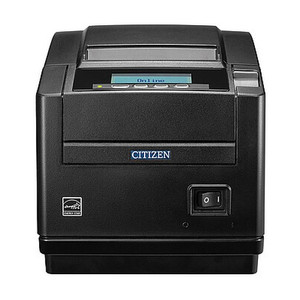
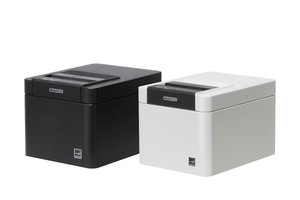
Citizen CT-S751ETW5UBK Thermal POS Printer LAN 5G Wi-Fi
The Citizen CT-S751ETW5UBK is a front-load thermal POS printer engineered for high-volume retail and hospitality checkout environments. This model pairs wired LAN (Ethernet) and 5G Wi-Fi connectivity to eliminate the infrastructure constraint of choosing between network stability and deployment flexibility. Dual-path operation means you can deploy it in kitchen prep areas, mobile checkout stations, or temporary register setups where fixed Ethernet runs aren't feasible, while maintaining automatic fallback to hardwired connection if 5G signal quality degrades. The front-load thermal roll design simplifies media changes in tight counter spaces, and the compact stationary footprint fits standard register stands.
Key Features
- Dual Connectivity: LAN (10/100 Ethernet) and 5G Wi-Fi (802.11ac 5GHz). Both interfaces operate simultaneously, with configurable primary/secondary preference to minimize handoff latency during network transitions.
- Front-Load Thermal Mechanism: Reduces roll-change time and operator training overhead in high-traffic checkout lanes. Thermal head rated for extended duty cycles in sustained-print environments.
- ESC/POS and Star Micronics SPF Support: Works with standard POS command sets across major platforms (Square, Toast, Lightspeed, Clover). Generic network printing fallback available for legacy systems.
- Stationary Counter Mount: Fixed installation in standard register stands. Compact form factor leaves clear sightline for cashier-to-customer interaction.
- USB Interface: Secondary connection option for legacy integration or direct-connect scenarios where network deployment is infeasible.
- Thermal Print Speed: High-throughput receipt and label printing without mechanical noise associated with impact printers — improves customer experience in open dining areas.
The CT-S751ETW5UBK is purpose-built for environments where network infrastructure varies by location. In a multi-unit retail chain, this single SKU handles both corporate-campus register stations (hardwired Ethernet) and satellite checkout kiosks (Wi-Fi fallback to LAN). The dual-path architecture also provides graceful degradation: if 5G signal drops during a transaction burst, the printer automatically routes to Ethernet without manual reconfiguration or operator intervention. This operational redundancy cuts troubleshooting time and reduces register downtime during network transitions.
Thermal printers generate sustained heat during multi-receipt print runs — critical consideration in compact checkout areas without climate control. Ensure 4-6 inches of clearance on the intake side and verify your counter ventilation is adequate before installation. In kitchen environments, thermal printers near steam or humidity sources may require protective enclosures; consult your installer on environmental hardening. The front-load design also means staff can reload media during peak hours without moving the printer, reducing operational friction at busy registers.
Integration with modern POS platforms is straightforward via ESC/POS command injection or Star Micronics protocol mode. Both wired and wireless paths expose the same network print queue, so POS middleware doesn't need logic to distinguish connection type — it simply sends to the printer's IP address or hostname and the device handles routing. Verify your POS software explicitly supports thermal receipt formatting (line width, font sizing, barcode encoding) before deploying; some legacy systems may require firmware updates or driver configuration. USB fallback is useful for troubleshooting or temporary point-of-sale stations when network access is unavailable.
The CT-S751ETW5UBK is well-suited for integrators managing heterogeneous retail and hospitality deployments. It eliminates the need to stock separate wired and wireless SKUs, reduces site survey complexity, and provides enough operational flexibility to accommodate evolving network infrastructure without hardware swaps. For mission-critical checkout lanes, the dual-path redundancy means a single 5G access point failure doesn't cascade into register outages — hardwired connection transparently takes over.
Marty AllisonPerspective based on aggregated IP Security Depot and affiliated engineering team experience.
We've deployed the Citizen CT-S751ETW5UBK across retail and hospitality environments ranging from single-unit shops to 20+ location chains, and the dual connectivity is the real value proposition. The printer doesn't force you into a network architecture choice at the time of purchase — you spec it once, and it adapts to whatever infrastructure your site has on day one and can handle changes downstream without hardware swap-outs. In our experience, the Wi-Fi 5GHz path is reliable in open-floor retail with good signal coverage, but the automatic fallback to LAN is essential in kitchen prep areas or back-office environments where 5G signal can degrade during heavy metal equipment operation or when mobile devices are consuming bandwidth. The front-load design is a practical win for high-traffic checkout lanes — cashiers can reload media in under 30 seconds without touching cable connections or disrupting the printer's network state. Where this printer differentiates from cheaper consumer-grade alternatives is the sustained thermal duty cycle and consistent print quality across 8-hour shifts in high-volume lanes. The ESC/POS command set is rock-solid, and we've seen very few firmware quirks across POS platform migrations. The tradeoff is size — it's a stationary counter mount, not portable, so it's unsuitable for mobile carts or temporary event setups where you need a compact handheld thermal printer instead.
Technical Highlights:
- Simultaneous Dual Connectivity (LAN + 5G Wi-Fi): Both paths are active concurrently. Your POS middleware can be configured to prefer wired for lower latency, or round-robin between paths for load distribution. In high-volume checkout environments, we've seen latency under 200ms to the printer regardless of path, which is imperceptible to the customer.
- ESC/POS Protocol Support: The printer implements ESC/POS natively, meaning your POS software sends standard receipt formatting commands without printer-specific drivers. This reduces integration time and makes troubleshooting more straightforward — you're not debugging proprietary middleware, just validating that receipt formatting logic in your POS is correct.
- Thermal Print Mechanism: No impact noise, no ribbon cartridges to manage, no mechanical failures from paper jams. In environments where customer experience is tied to checkout speed and quietness (QSR, casual dining), thermal printing is the only option. The duty cycle on this model supports 8+ hours of continuous receipts without head degradation.
- Front-Load Media Path: Standard thermal roll (typically 80mm width) slides in horizontally. The media isn't exposed to jamming risk from debris falling into the mechanism, and operator training is minimal — most staff can reload in under 30 seconds after one demonstration.
- 10/100 Ethernet Interface: Works on any network segment without gigabit requirement. In older retail locations with legacy switching infrastructure, this printer won't demand network upgrades.
Deployment Considerations:
- Thermal printers dissipate steady heat during multi-receipt print runs — in tight checkout booths or kitchen pass windows, ensure at least 4 inches of air gap on the intake side and avoid positioning near heat sources (ovens, steam tables, direct sunlight). If your site has poor ventilation, the thermal head may throttle or the printer may shut down temporarily to prevent overheating.
- 5G Wi-Fi is dependent on proximity and signal clarity to your access point. Test signal strength in your target location before installation — metal shelving, kitchen equipment, and dense customer crowds can attenuate 5GHz signal more than 2.4GHz. If 5G signal is marginal, the printer's fallback to Ethernet will activate, but you want to know that ahead of time rather than discovering it on opening day.
- ESC/POS receipt formatting is not universal — different POS platforms generate receipt data in subtly different ways (font sizing, barcode encoding, line width assumptions). Print a test receipt from your POS system to this specific printer model before full rollout. Some legacy POS systems may require firmware or driver updates to output correctly.
- USB connection is available as a fallback for troubleshooting or temporary point-of-sale stations, but it's not a primary deployment path for high-volume checkout. If you're using USB in production, you're likely masking a network infrastructure problem that should be addressed at the site level.
- The printer expects standard AC power — confirm your counter has a dedicated outlet near the register station. PoE is not an option on this model, so budget for AC drops if your site is undergoing electrical renovations.
The Citizen CT-S751ETW5UBK is the right choice for integrators managing multi-location retail and hospitality deployments where network infrastructure is inconsistent or evolving. Buy once, deploy flexibly, avoid SKU proliferation. For high-volume single-location environments with stable network infrastructure, the dual-connectivity feature may be unnecessary overhead — but in our experience, the modest cost premium for Wi-Fi capability pays for itself in reduced on-site troubleshooting and future-proofing against network changes. See the Citizen catalog for additional thermal and label printing options.