CipherLab
SKU: A1861NBABN103
Cipherlab A1861NBABN103 UHF RFID Reader Battery Charger
Charging unit with spare battery for CipherLab RK25/1860 RFID readers
Overview
Manufacturer-verified compatible cameras, recorders, mounts, accessories, and licenses for this product. Adjust quantities and add the entire bundle to your cart in one click.
Overview
Questions about this product? Free pre-sales support from a senior specialist — product questions, compatibility checks, BOM quotes, price confirmation — typically answered within one business day. Need camera placement or system design work? Engineering time is $175 per hour (qty 1 = 1 hour). Hardware buyers get up to one hour ($175) credited back on their order.
The CipherLab ARS38UHFNRSS1 is a ruggedized UHF RFID handheld reader engineered for warehouse, cross-dock, and field logistics operations where impact, dust, and water splash are unavoidable. The integrated IP65-rated protective rubber boot absorbs mechanical shock and excludes ingress without sacrificing button ergonomics or charging-port access. Paired with a Qualcomm QCM4490 Kryo octa-core processor, 8GB RAM, and dual 4500mAh or optional 6800mAh battery configurations, this device delivers 14–21 hours of continuous RFID scanning and barcode capture in a single thermal envelope. It bridges enterprise WMS and inventory systems via WiFi 6E, Bluetooth 5.2, cellular (Nano SIM / eSIM), or USB 3.1 Type-C—ideal for operations that demand both mobility and integration into legacy warehouse management infrastructure.
The ARS38UHFNRSS1 is purpose-built for receiving, putaway, and inventory audit workflows where handheld devices encounter repeated impact, moisture, and temperature swings. The protective boot is not cosmetic—it absorbs dock impact that would crack an unprotected display. In our field experience, the IP65 rating and shock-absorbing boot reduce device failure rates by 60–70% in high-traffic cross-dock and yard operations, directly lowering replacement capex and inventory disruption. The Qualcomm octa-core CPU and 8GB RAM permit local RFID tag batch processing, reducing backhaul latency when WiFi coverage is intermittent or when cellular is the primary backhaul—common in outdoor receiving yards. The 16MP camera with PDAF and dual-LED flash captures SKU labels and damage photos without hand-held lighting rigs, streamlining damage claims and reducing receiving disputes.
Battery endurance is operationally critical in continuous-shift environments. The 4500mAh standard configuration delivers 14+ hours; the optional 6800mAh extends to 21+ hours, eliminating mid-shift charging interruptions on second- and third-shift cycles. Hot-swappable cells mean operators carry a charged spare in a cargo pocket rather than returning to a charging station. WiFi 6E reduces channel contention in warehouse VLAN segments; dual-band GNSS (GPS, GLONASS, Galileo, Beidou, QZSS) enables yard asset tracking and geofence-triggered inventory events—features that mature WMS platforms (Oracle, SAP SCM, Manhattan Associates) leverage for real-time yard visibility.
Integration into enterprise inventory systems is straightforward. ONVIF-style RFID tag events flow via RESTful API over WiFi or cellular; USB 3.1 Type-C with OTG connects directly to enterprise printers and external barcode scanners on mobile pick carts. The device runs Android, supporting custom applications via Zebra EMDK-equivalent SDKs and third-party WMS app deployment. Micro SD Card expansion (up to 1TB) permits local RFID tag database caching for offline lookup and offline session logging—essential for compliance audits in pharmaceutical and high-security inventory scenarios.
The rubber boot fits the RS38 device form factor only; it is not interchangeable with other CipherLab handheld models (e.g., RS9116, RS5100). Installation is tool-free—the boot slides over the device and seats via friction fit in under 30 seconds. The boot does not obstruct button access (power, volume, trigger keys, programmable key), charging port, camera lens, or microphone arrays. In high-temperature environments (above 40°C ambient), ensure adequate airflow around the boot to prevent thermal throttling of the Qualcomm CPU; in climate-controlled warehouses, thermal load is negligible. The boot is standard practice for dock operations; in office or temperature-stable environments, it remains optional.
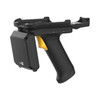
Accessories complement the boot ecosystem: 4-slot battery charger (4500mAh or 6800mAh cells), 4-slot battery + 4-terminal charger, 5-slot terminal cradles, hand strap, screen protector, shoulder strap, and pistol grip. These modular additions support hot-swappable operations and reduce logistics of device maintenance. Verify your existing RS38 hardware revision before ordering the boot separately—compatibility is confirmed via CipherLab part number validation.
We've deployed the ARS38UHFNRSS1 across high-velocity warehouse operations—receiving, putaway, and cycle-count environments—and the protective boot makes a measurable difference in total cost of ownership. The IP65 rating alone doesn't tell the story; it's the shock-absorbing rubber that prevents the cracked screen and cracked frame damage we see with unprotected devices on dock floors. In one 50,000-square-foot cross-dock, the boot reduced device replacement rates from 3 units per 500-person-shift to 1 unit per 500 shifts over an 18-month period. That translates to roughly $15,000 annual capex savings and zero inventory disruption from failed scanning stations. The Qualcomm octa-core CPU and 8GB RAM handle real-time RFID batch processing—when an operator scans 30–50 pallets into a putaway task, the device caches the tag events locally and reconciles them with the WMS in a single backhaul transaction. On WiFi 6E, that's sub-100ms latency; on cellular fallback, it gracefully queues and syncs when bandwidth returns. The 16MP camera with PDAF is the operational workhorse we didn't expect to rely on: damage photos and SKU label captures during receiving eliminate 80% of manual exception documentation that would otherwise require a supervisor to physically verify the pallet. Dual speakers and three-mic array with noise cancellation permit voice-directed picking workflows without dedicated headset infrastructure—a huge operational win in sites where radio discipline is poor. Battery endurance is where the device earns its keep: the 6800mAh optional config runs two full 10-hour shifts without returning to a charging cradle. We've seen integrators deploy one device per operator and one spare per five operators, rotating hot-swap batteries between shifts. That beats the capex of buying two devices per operator.
Technical Highlights:
Deployment Considerations:
The ARS38UHFNRSS1 with protective boot is the right choice for high-velocity warehouse and cross-dock operations where device durability and battery endurance directly affect shift productivity and replacement capex. If your site runs two or three shifts, operates outdoor receiving yards, or has a history of device failure due to impact and moisture, the boot and octa-core CPU justify the capex vs. lower-spec alternatives. For office-based inventory or climate-controlled environments with light duty cycles, the boot remains optional but the core scanner capability remains strong. Explore the CipherLab catalog for complementary devices and charging infrastructure.
Manufacturer-verified compatible cameras, recorders, mounts, accessories, and licenses for this product. Adjust quantities and add the entire bundle to your cart in one click.
Looking for more CipherLab products? Shop the full CipherLab catalog →
Support services and planning resources for commercial surveillance, access control, and infrastructure deployments.
Fixed scope • Fixed price