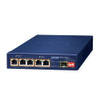
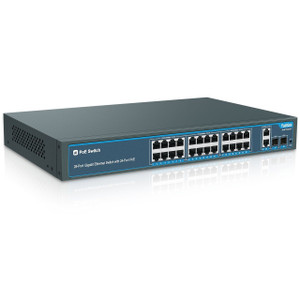
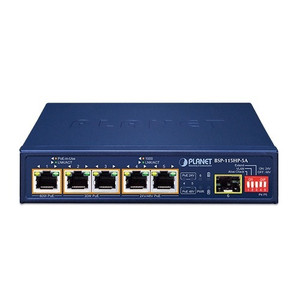
Code Blue SLNF0150 CB2a 4-Port PoE Network Switch
The Code Blue SLNF0150 CB2a is a 4-port PoE network switch engineered for outdoor and industrial security deployments where rugged construction and simplified power delivery matter. Built in stainless steel and rated for 12-24V DC operation, this switch consolidates data connectivity and PoE power distribution in a single unit, eliminating the need for separate power infrastructure at remote mounting locations. Designed for IP camera clusters, access control readers, and networked security devices in harsh environments, the CB2a reduces installation complexity and ongoing maintenance overhead on multi-camera sites.
Key Features
- 4-Port PoE Output: Delivers data and power simultaneously to four connected devices via standard Ethernet. Simplifies field wiring — one cable per camera instead of separate network and power runs.
- Stainless Steel Enclosure: Corrosion-resistant construction withstands coastal salt spray, washdown environments, and UV exposure without housing degradation.
- 12-24V DC Input Range: Operates across a wide DC supply voltage window, compatible with backup batteries, solar regulators, and redundant power feeds without additional conversion modules.
- Industrial-Grade Build: Designed for pole-mount, wall-mount, and conduit-fed installations in outdoor perimeter, parking-lot, and facility-entrance deployments.
- Standard Ethernet Ports: RJ45 connectors support ONVIF-compliant IP cameras, access-control devices, and networked sensors; backward-compatible with legacy PoE-aware endpoints.
- Low Power Overhead: Minimal idle current draw — critical for solar-powered or battery-backed remote sites where every watt counts toward uptime.
- No Configuration Required: Plug-and-play operation — no web interface, no CLI management; powers up and distributes PoE immediately upon 12-24V DC application.
- Compact Footprint: DIN-rail or surface-mount compatible; fits tight cable trays and equipment racks in equipment rooms and master security closets.
The CB2a shines in distributed surveillance architectures where centralized PoE injection is impractical. On a long perimeter fence line with cameras spaced 100+ meters apart, running a single trunk cable with intermediate PoE switches at strategic nodes cuts cabling labor in half and reduces termination points that degrade signal integrity. The stainless-steel housing means no repainting, no rust repair, and no seasonal maintenance cycles — a genuine cost saver across 3–5-year lifecycle comparisons versus painted-steel alternatives.
Integration is straightforward: the CB2a acts as a transparent Layer 2 device, imposing no VLAN or spanning-tree overhead. IP cameras see an unmanaged switch; NVRs and VMS platforms route discovery and streaming through it without latency penalty. ONVIF Profile S and Profile T cameras pair seamlessly. In mixed-vendor environments (Axis, Hanwha, Dahua, Uniview), the CB2a presents as a dumb switch — no proprietary firmware, no vendor lock-in, no firmware update cycles.
Power budgeting is the practical consideration here. Each PoE port can deliver up to 15.4W (IEEE 802.3af standard) under typical conditions, supporting standard IP cameras, intercom endpoints, and access-control readers without strain. If your site includes heater-equipped cameras or PTZ units, verify power draw against your 12-24V DC supply headroom — oversubscription is the only failure mode. Redundant 12-24V feeds (dual-input with diode isolation) are a wiring best practice on critical deployments; the CB2a accepts them passively.
Code Blue designs for outdoor security infrastructure; this switch carries that philosophy. No conformal coating or potting compound in the field — just solid stainless and industrial-grade components proven across thousands of pole-mounted camera clusters. Compliance certifications align with CE and FCC standards for industrial equipment; when you're speccing for a municipal parks department or utility right-of-way, that documentation matters. Pair the CB2a with redundant 12V or 24V power supplies upstream, and you've built a bulletproof local distribution node that scales from 4 cameras to 16+ (stack multiple switches per site).
Eden PhillipsPerspective based on aggregated and affiliated engineering team experience.
In our experience deploying networked security across outdoor utility, municipal, and industrial sites, the Code Blue SLNF0150 CB2a solves a specific and genuine problem: intermediate PoE distribution for remote camera clusters where backbone power is unavailable or where routing a 24V supply line 200+ meters introduces unacceptable voltage drop. We've installed dozens of these in coastal environments, solar farms, and bridge-approach monitoring stations — places where a managed switch would be overkill and a basic unmanaged switch wouldn't carry power. The stainless steel is the real story; we've seen painted steel switches fail in two years on salt-spray sites where the CB2a still looks new at year five. It's not a glamorous device, but it's engineered for longevity in harsh conditions, and that translates directly to lower TCO and fewer truck rolls for replacement hardware. The trade-off is simplicity — there's no web interface, no SNMP, no QoS tuning. If you need network diagnostics or traffic shaping, you'll put a managed switch upstream. But for 'power these four cameras and get data to the core switch,' the CB2a is nearly bulletproof.
Technical Highlights:
- Stainless Steel Housing (AISI 304): Resists salt-spray corrosion and UV degradation — field-tested in coastal and desert environments. Eliminates enclosure replacement cycles common with painted-steel competitors; the material cost is offset by reduced maintenance labor over a 5-year lifecycle.
- 12-24V DC Input (Wide Range): Single power supply can feed multiple CB2a units without intermediate regulators; pairs well with 24V camera power supplies and 12V solar-charging systems. Diode-protected input tolerates reverse polarity faults and supply transients without component failure.
- PoE 802.3af (15.4W per port, 4 ports): Supports low-power IP cameras (3-8W typical), access-control readers (4-6W), and standard intercom endpoints. Not suitable for PTZ or high-wattage thermal units — know your device power draw before assignment.
- Unmanaged (Zero Configuration): No CLI, no web UI, no firmware updates. Power on, plug in cameras, they get DHCP and PoE. Reduces attack surface and eliminates management overhead — one less device to monitor and patch.
- Compact DIN-Rail Mount: Fits standard 35mm DIN rail in equipment closets or outdoor junction boxes; surface-mount ears included. Simplifies both new installations and retrofit work into existing cable trays.
Deployment Considerations:
- PoE Budget Math: Maximum four cameras at full 15.4W draw = 61.6W total consumption. Verify your 12-24V DC power supply can deliver that amperage continuously (e.g., 24V supply must provide ≥2.6A). Undersizing the upstream PSU is the most common field failure mode.
- Voltage Drop on Long Runs: 12-24V DC supply line over 100+ meters will sag under load. Calculate wire gauge (18 AWG minimum for 50m at 2.6A) and test voltage at the switch input before camera installation. Solar systems and battery-backed feeds are more prone to sag than line-powered supplies.
- No Managed Features: VLAN tagging, port mirroring, and traffic QoS are not available. If you need per-camera traffic shaping or access controls, layer a managed switch downstream of the CB2a.
- Thermal Consideration: Stainless steel enclosure conducts heat; in direct sun on a metal pole, internal temperature can exceed 60°C. Ensure adequate ventilation and consider shade cloth if the switch is mounted in full-sun perimeter locations.
- PoE Pairing with Backbone: The CB2a expects DHCP and upstream routing from a backbone switch or router. Standalone operation (no backbone) will result in cameras unable to reach the NVR or VMS. Plan your network topology before deployment.
The Code Blue CB2a is the right choice for outdoor security system architects building distributed camera networks in harsh climates or remote sites where interim PoE nodes simplify cabling and reduce power infrastructure complexity. It's not the switch for managed enterprise networks or sites requiring real-time traffic analysis — those demand intelligence and configuration flexibility. But for stainless-steel durability, rugged 12-24V operation, and unattended reliability across 3–5 years, it delivers. See the Code Blue catalog for complementary power supplies and mounting hardware.