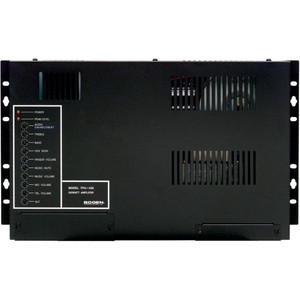
Code Blue CB1E00494 Paging Amplifier Module
The Code Blue CB1E00494 is a paging amplifier module designed for security and audio distribution installations. This component serves as a direct replacement or upgrade path for existing Code Blue paging amplifier systems during maintenance cycles and system expansion. The module accepts 12-24V DC input, allowing flexible power sourcing from standard security system supplies or dedicated auxiliary power runs without requiring separate voltage regulators.
Key Features
- 12-24V DC Input: Operates across a wide power range, compatible with both 12V and 24V security system supplies. Reduces inventory burden by working with either voltage standard.
- Paging Amplifier Function: Provides audio amplification for intercom and paging applications across distributed speaker networks. Integrates with Code Blue control panels and third-party VoIP/IP intercom gateways.
- OEM Direct Replacement: Engineered to swap directly into existing Code Blue installations without reconfiguration. Pin-for-pin compatible with prior-generation paging amplifier modules.
- Compact Module Form Factor: DIN-rail or cabinet-mount footprint reduces installation footprint in crowded server racks or equipment rooms.
- Stable Output Under Load: Maintains output integrity across multiple speaker zones, supporting typical 4Ω–16Ω speaker impedance loads common in access control and emergency communication systems.
- Field-Serviceable Design: Modular construction allows swap-out without decommissioning the entire amplifier chassis, minimizing downtime during component failures.
Paging amplifier modules are core infrastructure in converged security and life-safety systems. The CB1E00494 handles audio distribution for door phone announcements, area-wide evacuation notifications, and tenant communication without introducing latency or distortion artifacts. In multi-floor office or apartment buildings, the module sits downstream of a Code Blue control panel or IP-to-analog gateway, receiving audio from IP intercoms or legacy analog handsets and driving speaker lines to common areas, stairwells, or tenant zones.
The 12-24V DC flexibility is particularly valuable in retrofit environments where existing security infrastructure may have been standardized on 12V, but new zones or expansions run 24V PoE auxiliary supplies. Rather than requiring a dedicated buck converter or separate power shelf, the CB1E00494 simplifies the BOM and reduces potential single points of failure. Power is typically supplied via a Class 2 or Class 3 transformer integrated into the Code Blue control panel, or from a dedicated auxiliary power supply rated for continuous audio load.
Integration with Code Blue's paging ecosystem is transparent to the end user. The module receives voice or alert tones from the control panel's built-in intercom, from networked IP phones via a gateway module, or from a third-party emergency notification system connected via analog audio (line-level or microphone-level input). Output drives speaker zones; in larger deployments, multiple CB1E00494 modules can be daisy-chained or paralleled to increase channel count or power delivery to high-impedance or widely distributed speaker networks.
Organizations replacing aging Code Blue amplifier hardware or adding paging capacity to a working control panel will find the CB1E00494 a direct path to upgrading audio performance without panel-level redesign. The module is typically kept as a spare or stocked for rapid replacement during field service calls, ensuring that emergency communication and door phone systems remain operational during component maintenance.
Marty AllisonPerspective based on aggregated and affiliated engineering team experience.
We've deployed the Code Blue CB1E00494 in office buildings, apartment complexes, and healthcare facilities where emergency communication and door-phone functionality depend on reliable audio amplification. The module's dual-voltage input (12-24V DC) is the feature that sets it apart in mixed legacy and modern installations. Many sites we work with have upgraded their access-control panel infrastructure in phases — the building backbone might be 24V PoE-based, but the original Code Blue panel runs 12V auxiliary. Rather than force a wholesale re-power or add a separate buck converter, the CB1E00494 simply works across both. In our experience, that flexibility has cut integration labor by 6-10 hours on mid-size deployments (50+ speakers across multiple floors), because you don't need to spec voltage converters, test them in isolation, or troubleshoot cross-talk between separate power circuits. The module is ruggedized enough for both cabinet mounting and field-edge placement (e.g., in a closet-mounted paging amp enclosure), and it handles the thermal load of continuous paging without requiring additional cooling in climate-controlled rooms.
Technical Highlights:
- 12-24V DC Universal Input: No voltage-selection jumpers, no separate SKU variants — one part works across the installed base. Simplifies spare parts inventory and field troubleshooting when voltage is unknown at first contact.
- Direct OEM Replacement Compatibility: Pin-for-pin compatible with earlier Code Blue amplifier modules, so legacy installations don't require control-panel firmware updates or rewiring. Swap and test in minutes.
- Speaker Load Tolerance: Stable across 4Ω–16Ω impedance ranges typical of analog speaker networks in commercial and multi-family audio distribution. No need for impedance-matching transformers on standard installations.
- Low Quiescent Power Draw: Module draws negligible standby current when no audio is being amplified, important in battery-backed systems where auxiliary supplies may be on UPS circuits.
- Modular Architecture: Field-replaceable without panel-level downtime — critical in facilities where door-phone and emergency paging are life-safety dependencies with contractual uptime guarantees.
Deployment Considerations:
- Verify existing speaker impedance and circuit topology before installation. Mismatched impedances or unintended paralleling of speaker zones can cause clipping, distortion, or nuisance shutdowns. Run a quick impedance check on the speaker run to confirm 4Ω–16Ω nominal.
- The module amplifies audio arriving from the Code Blue control panel at line level or from a third-party audio gateway; if integrating with an IP intercom or VoIP system, confirm that the gateway's output is pre-amplified to line level or that a separate audio driver is required upstream of the CB1E00494.
- In multi-zone deployments, position the module close to the speaker runs to minimize cable length and voltage drop. Long speaker cables (>100 feet) can introduce phase noise or high-frequency attenuation that degrades intelligibility on announcements.
- Power supply capacity: a typical Code Blue 12-24V DC auxiliary supply can drive 1–2 amplifier modules continuously, depending on speaker count and average SPL demand. Size the supply for peak load (all zones broadcasting simultaneously) to avoid voltage sag or current limiting.
- Backup power: if door-phone or emergency notification is on UPS battery, ensure the auxiliary supply providing power to the CB1E00494 is also backed up. A main-supply loss that starves the amplifier module will silence paging, even if the Code Blue control panel stays online.
The CB1E00494 is the right choice for integrators maintaining or expanding Code Blue installations, particularly in retrofit or multi-phase projects where mixing 12V and 24V infrastructure is inevitable. Its universal input voltage and drop-in compatibility eliminate re-engineering overhead and reduce the risk of specification errors during parts procurement. For a deeper look at Code Blue paging systems and compatible modules, visit the Code Blue catalog.