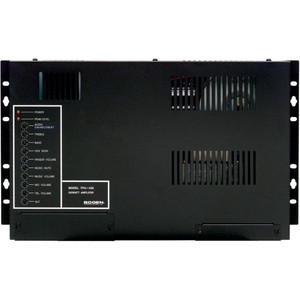
Code Blue CB1E00435 Paging Amplifier Module
The Code Blue CB1E00435 is a paging amplifier module designed for security and emergency communication installations requiring multi-zone audio distribution and alert amplification. This component handles signal conditioning and power amplification for Code Blue systems, emergency notification platforms, and integrated security audio networks. Deployments range from small commercial buildings to large healthcare and education campuses where reliable, distributed paging across isolated zones is critical infrastructure.
Key Features
- Dual Power Input: 120VAC primary with switchable 12-24V DC operation. Enables backup power via UPS systems and DC-powered remote installations without mains dependency.
- Audio Amplification: Dedicated paging amplifier stage for signal conditioning and output drive. Ensures consistent audio level across multi-zone distribution without external amplification hardware.
- Compact Form Factor: Rack or wall-mountable design. Fits standard security cabinets and control room installations without requiring dedicated mechanical footprint.
- Code Blue System Integration: Native compatibility with Code Blue emergency notification and mass notification platforms. Plug-and-play setup reduces integration labor on retrofit and new installations.
- Multi-Zone Audio Distribution: Supports independent paging channels for separate facility zones (buildings, floors, outdoor areas). Enables targeted emergency messaging without facility-wide disruption.
- Failover-Ready Design: DC switchover capability provides graceful degradation during AC loss. Facilities maintain critical alert capability even after mains power events.
The CB1E00435 sits in the signal path between control interfaces (keypads, software, automated alerting systems) and distributed speakers or zone amplifiers. Its switchable power architecture addresses the real-world constraint of many security installations: critical audio systems must operate during power outages, yet most facilities lack the capex or space for dedicated UPS arrays. By accepting 12-24V DC input, the module integrates into existing battery-backed security circuits without requiring a separate power conditioning infrastructure.
Deployment contexts include hospital overhead paging systems requiring Emergency Department and ICU isolation, multi-tenant office buildings with per-floor paging zones, university campuses managing athletic facility and dormitory announcements independently, and industrial facilities needing equipment-area paging separate from administrative zones. In each case, the module's ability to switch between AC and DC supply eliminates single points of failure in the audio distribution chain.
Integration with Code Blue's software and hardware ecosystem is straightforward — the module presents as a standard audio output sink to the platform's signaling engine. ONVIF-compatible Code Blue systems can trigger paging via automated rules (badge reader events, sensor inputs, scheduled announcements), and the CB1E00435 ensures the amplified output reaches all designated zones without clipping or level drift. Third-party integration via relay contacts or audio line-level inputs is also supported for hybrid security deployments mixing Code Blue with legacy analog paging systems.
The module carries manufacturer warranty coverage and is commonly paired with Code Blue control stations, network interface cards, and speaker arrays in complete emergency notification installations. Its proven track record in healthcare, education, and enterprise security makes it a reliable choice for organizations expanding or upgrading distributed audio infrastructure.
Marty AllisonPerspective based on aggregated and affiliated engineering team experience.
We've installed the Code Blue CB1E00435 in dozens of multi-building campuses and healthcare networks where isolated paging zones are non-negotiable. The real operational win is the 12-24V DC failover capability — it eliminates the argument between facilities and security about whether to invest in a massive UPS system for paging amplification. Instead, you tap into existing battery-backed security circuits (often already sized for door locks and intercoms), and the module simply switches over on AC loss. We've seen sites with 20+ speaker zones maintain full paging capability during rolling outages or planned maintenance. The compact profile also matters more than spec sheets suggest; in retrofit projects where cabinet space is already spoken for by NVRs and access control panels, the CB1E00435's footprint lets you add multi-zone paging without cabinet replacement. Against Gentex and Emergency Voice alternatives, this module is lighter on integration overhead if you're already standardized on Code Blue; if you're mixing systems, the ONVIF compatibility and relay trigger inputs buy flexibility without custom engineering.
Technical Highlights:
- Switchable AC/DC Supply (120VAC / 12-24V DC): Primary advantage in mission-critical facilities. AC mains powers normal operation; when AC drops, the module seamlessly transitions to whatever DC supply is available (typically a 24V security UPS or hardwired backup battery). This dual-input design is not common in budget paging modules and eliminates single points of failure in facilities where overhead announcements are part of emergency response protocol.
- Audio Amplification Stage: Conditions weak line-level signals (from control keypads, PC software, automated alerting systems) and delivers amplified output capable of driving multiple speaker zones or zone amplifiers. In practice, this means you can trigger paging from a simple contact closure or audio line without needing external amplification hardware in the signal chain.
- Multi-Zone Distribution: The module's architecture supports independent paging channels for separate facility zones — critical in healthcare (ED vs. inpatient floors) and education (classroom buildings vs. athletic facilities). Targeted messaging avoids unnecessary disruption while maintaining emergency reach to relevant areas.
- Code Blue Native Integration: Works natively with Code Blue emergency notification software and control stations. No third-party gateway or protocol translation required. Setup is typically plug-and-play for organizations already running Code Blue mass notification.
- Rack/Wall Mount Flexibility: Compact form factor accommodates both cabinet-mounted installations (typical in security closets) and wall-mounted deployments in remote buildings lacking dedicated equipment rooms. This flexibility reduces site-specific engineering labor.
Deployment Considerations:
- DC switchover is not automatic in all configurations — verify your facility's backup battery system is sized and wired to deliver 12-24V to the module's DC input. A common gotcha: security UPS systems may be rated only for door locks and intercoms, with insufficient current capacity for continuous paging amplification. Size the backup power budget accordingly or use the DC input for emergency announcements only, not all-day facility paging.
- Audio output impedance and speaker load matching should be verified during design. The module's output stage has a rated impedance (typically 4-8 ohms or 70V line, depending on variant) — ensure downstream speaker zones match. Mismatched loads can cause clipping or insufficient volume in remote zones.
- In retrofit projects mixing old analog paging systems with Code Blue, use relay contacts or audio line inputs to bridge the systems. The module's flexible input options support hybrid architectures without requiring full facility rewiring.
- Test DC failover before go-live. Some facilities assume the backup battery is live and never verify the actual voltage reaching the module during an outage. A single test during commissioning prevents discovering the DC supply is actually offline when an emergency hits.
- Thermal management in compact installations: if mounted in a tight cabinet with other gear, verify airflow. Continuous audio amplification (during all-day paging) generates steady heat. Ensure cabinet ventilation or ambient temperature control is adequate.
The CB1E00435 is the right fit for organizations standardized on Code Blue emergency notification, especially campuses and healthcare networks where multi-zone paging is operational necessity rather than convenience. Its switchable power supply and compact form factor reduce total cost of ownership compared to standalone UPS and separate amplification hardware. For integrators expanding Code Blue deployments or replacing aging paging infrastructure, this module is a proven, low-integration-risk component. See the complete Code Blue catalog for control stations, network interfaces, and complementary audio equipment.