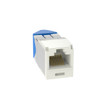
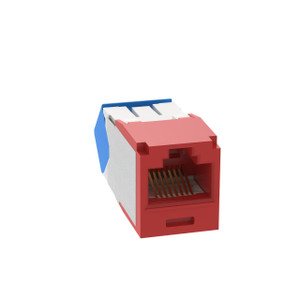
Panduit CJLR6X88TGIW Mini-Com Cat 6A Left/Right Angled Jack Module
The Panduit CJLR6X88TGIW addresses a persistent challenge in high-density network deployments: maintaining proper bend radius and cable dress when terminating jacks in tight enclosures or back-to-back patch panel configurations. This Mini-Com Cat 6A UTP jack module features a 45° left/right angled termination block that routes cable horizontally away from the connector face, eliminating the sharp 90° bends that stress conductors and degrade signal integrity. The tool-less TG (twist and go) termination mechanism eliminates punchdown tools and speeds deployments, while factory testing and individual serialization ensure every module meets Category 6A channel performance requirements out of the box.
Key Features
- 45° left/right angled termination block routes cable horizontally, solving tight-space cable management in high-density racks and shallow wall boxes
- Tool-less TG termination for 22-26 AWG twisted pair cable — no punchdown tool required, reducing install time and eliminating termination errors
- Exceeds ANSI/TIA-568.2-D and ISO/IEC 11801 Category 6A component and channel requirements — verified 500 MHz bandwidth with margin for 10GBASE-T
- Supports IEEE 802.3bt Type 3 (60W) and Type 4 (90W) PoE delivery over all four pairs, future-proofing infrastructure for high-power devices
- 2,500 connection cycle rating with PoE under load — engineered for datacenter and enterprise patch field applications with frequent MAC layer changes
- 100% factory tested and individually serialized for full traceability and warranty documentation
- RJ45 8P8C jack compatible with all standard Cat 6A patch cords; off-white housing integrates with commercial wall plates and panels
- UL 1863 and UL 2043 plenum rated, RoHS compliant for code-compliant installations in air-handling spaces
The 45° angled termination block is the defining feature of the CJLR6X88TGIW, and it solves a geometry problem that integrators face daily: horizontal cable entry into vertical patch panels or faceplates mounted in shallow boxes. In a standard straight jack, cable exits the rear at 180° from the plug face, forcing a hard 90° bend to route horizontally along a panel or down into a wall box. That bend consumes 2–3 inches of clearance and violates the 4× cable diameter minimum bend radius spec when space is tight. The angled termination block rotates the IDC contacts 45° off-axis, so cable enters from the side and routes naturally parallel to the mounting plane. This cuts the effective depth requirement by half and maintains compliant bend radius even in 1.5-inch deep low-voltage boxes or back-to-back patch panels with zero rear clearance. The left/right designation means the installer chooses cable entry direction during termination, accommodating both left-hand and right-hand cable approach without stocking separate SKUs.
TG termination replaces the traditional 110-style punchdown block with a captive twist-lock IDC mechanism. The installer strips the cable jacket, untwists pairs to the color-coded wire guides, seats all eight conductors into the terminal slots, then rotates the orange cap 90° clockwise until it clicks. The rotation drives the conductors into the IDC contacts, trims the excess wire, and locks the cap in place — a single one-handed motion that takes under 20 seconds per jack. Because the insertion force is distributed over the entire rotation rather than concentrated in a punchdown impact, the termination is gentler on the conductors and less susceptible to user error. The color-coded wire guides are molded into the jack body and sized for 22-26 AWG solid or stranded cable, the full range of Cat 6A premise wire. Panduit factory-tests every jack to 500 MHz and beyond, verifying insertion loss, return loss, NEXT, FEXT, and alien crosstalk parameters across the full channel. Each jack body carries a laser-etched serial number that ties to the factory test report, providing documentary evidence for warranty claims and post-install troubleshooting. The test margin engineered into these modules means they will pass TIA-5e field test even after multiple re-terminations or cable stress during installation.
Category 6A performance is required for 10GBASE-T Ethernet over copper to 100 meters, and the CJLR6X88TGIW delivers 500 MHz bandwidth with the headroom needed to support that data rate plus simultaneous PoE power delivery. The jack is explicitly rated for IEEE 802.3bt Type 3 (UPOE, 60W) and Type 4 (UPOE+, 90W) applications, the highest power classes defined in the PoE standard. Type 3 and Type 4 use all four pairs for power delivery, doubling the conductor current compared to 802.3at, and that current generates I²R heating in the cable bundle. The CJLR6X88TGIW's contact design maintains low resistance across the connection interface even under thermal stress, and the 2,500-cycle mechanical rating accounts for insertion/extraction under powered conditions. In a datacenter or enterprise patch field where devices are moved, added, or changed weekly, 2,500 cycles translates to roughly five years of active service before contact wear becomes a field concern. The jack meets IEC 60603-7 mechanical and environmental specs, including the temperature cycling, vibration, and humidity exposure tests that simulate years of in-service aging.
The Mini-Com form factor is Panduit's modular jack system, compatible with a broad installed base of Panduit faceplates, patch panels, surface mount boxes, and furniture outlets. Each jack snaps into a Mini-Com port cutout with a positive latch, and the faceplate legend can be labeled with Panduit's adhesive or printable label cartridges for MAC layer documentation. In new construction, the angled jack is typically used in high-density applications where panel depth is constrained: network closets with wall-mount racks that have limited rear clearance, modular furniture installations where cable routes horizontally behind the work surface before dropping to floor boxes, or retrofit projects where new Cat 6A jacks are added to existing shallow boxes originally designed for Cat 5e. The off-white color matches standard electrical trim and integrates with most commercial interiors without calling attention to the infrastructure. For datacenter and AV integrators, this jack delivers the performance and durability required for 10G IP camera backhaul, high-bandwidth AV-over-IP endpoints, and PoE-powered access points, with the installation speed and cable management advantages that reduce labor cost and improve long-term reliability in space-constrained enclosures.