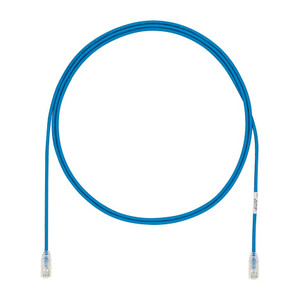
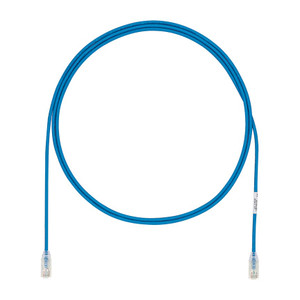
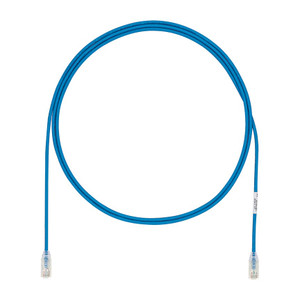
Panduit UTP28X35 Cat6A 28 AWG UTP Patch Cord
High-density 10GBASE-T deployments create cable-management nightmares — bundle diameters that choke airflow, pathway congestion that blocks future adds, and patch-panel spaghetti that turns every MAC into a 20-minute ordeal. The Panduit UTP28X35 solves this with a 28 AWG slim-profile design that delivers full Cat 6A performance in a 0.185-inch diameter — 40% thinner than standard 23 AWG Cat6A patch cords. At 35 feet, this off-white U/UTP cable bridges cross-rack connections in data centers, aggregation switches in server farms, and backbone links in high-speed computing clusters while maintaining the bend radius and pathway capacity you need for future expansion. RapidID barcoding and a tangle-free latch turn asset tracking and connector servicing from pain points into one-handed operations.
Key Features
- 28 AWG Slim Profile (0.185" Diameter) — 40% reduction vs. standard Cat6A enables tighter bundles, improved airflow in cabinets, and higher pathway fill without exceeding NEC conduit limits
- 10GBASE-T Performance to 500 MHz — Exceeds ANSI/TIA-568.2-D and ISO 11801 Class EA requirements; supports IEEE 802.3an 10 Gigabit Ethernet over the full 100-meter channel
- PoE++ Compliant (802.3bt Type 3 & 4) — Supports up to 100W PoE delivery in 24-cable bundles (Type 4) and 60W in 48-cable bundles without thermal derating concerns
- Centered De-Embedded Plug Design — Integral pair manager inside the plug body maintains pair geometry through termination, eliminating the alien crosstalk that plagues cheap Cat6A patch cords in dense bundles
- Patented Tangle-Free Latch — Low-profile boot prevents snags on adjacent cables during extraction; single-finger release reduces MAC time and prevents accidental disconnects
- RapidID Pre-Installed Barcodes — Laser-etched asset tags on both connectors integrate with Panduit's RapidID software for automated port mapping, circuit tracing, and inventory audits
- CM/LSZH Dual Rating — Meets both NEC CM (UL 1685) and IEC 60332-3 LSZH requirements in a single cable; simplifies spec compliance for projects with mixed US/international standards
- Solid Copper Conductors — 28 AWG solid construction (not stranded) provides superior high-frequency performance and lower insertion loss compared to stranded alternatives marketed for "flexibility"
- 100% Factory Tested — Every cord verified for wire map, NEXT, and return loss before shipping; eliminates the field-termination errors that plague bulk-cable installations
Why 28 AWG Matters in 10G Deployments: Standard 23 AWG Cat6A patch cords measure 0.28–0.32 inches in diameter, which means a 48-port patch panel fully populated with 3-foot cords consumes roughly 15 inches of horizontal cable-management depth — before you account for service loops or bend-radius protection. Scale that to a 42U cabinet with six switches, and you're fighting 90+ inches of cable mass that blocks airflow, prevents door closure, and makes adds nearly impossible without de-cabling entire rows. The UTP28X35's 0.185-inch diameter cuts bundle cross-section by 58%, reclaiming vertical space for additional switches or improving hot-aisle/cold-aisle separation in thermally constrained data centers. This isn't a flexibility trade-off — solid 28 AWG copper maintains the 10GBASE-T frequency response through 500 MHz and outperforms stranded 28 AWG alternatives (which suffer from skin-effect losses) in return-loss and insertion-loss testing. The centered de-embedded plug design keeps pair twist intact through the termination point, a critical detail when alien crosstalk from adjacent cables can push NEXT margins below the 3 dB headroom required for 10GBASE-T link negotiation. Panduit's integral pair manager inside the plug body clamps the four pairs in their factory geometry, preventing the untwisting that turns a Cat6A-rated cable into a Cat5e performer under real-world bundle conditions.
Data Center & Virtualization Deployment Context: The 35-foot length targets three primary use cases: (1) cross-rack server-to-TOR (top-of-rack) connections in standard 42U cabinets with 6–8 feet of vertical rise plus horizontal pathway routing, (2) aggregation-switch uplinks spanning adjacent cabinets in a pod architecture, and (3) storage-network connections in hyper-converged infrastructure where NVMe-oF or iSCSI traffic demands lossless 10G transport. In VMware vSphere or Microsoft Hyper-V environments running distributed virtual switches, the UTP28X35 handles the east-west traffic between hypervisors — workloads like vMotion, Storage vMotion, and Fault Tolerance that saturate 1G links and require jumbo-frame support across the full 10G bandwidth. The PoE++ (802.3bt) compliance matters even in data centers: edge-compute cabinets increasingly host PoE-powered devices like access points, IP cameras for physical security, and environmental sensors for DCIM monitoring. A 24-cable bundle of UTP28X35 cords supports Type 4 PoE (100W per port) without exceeding the 10°C temperature rise that triggers alien-crosstalk derating in TIA-568.2-D Clause 8.4. The CM/LSZH dual rating simplifies multinational deployments — the same SKU works in US facilities (where NEC Article 800 requires CM in plenum alternatives or conduit) and European data centers (where IEC 60332-3 LSZH is mandatory for occupied spaces). This eliminates the SKU sprawl and inventory-management headaches that come from stocking separate plenum and LSZH variants for identical electrical performance.
RapidID Asset Management & Service Efficiency: Every UTP28X35 ships with laser-etched barcodes on both modular plugs, encoded with a unique serial number that integrates with Panduit's RapidID port-mapping software. During initial installation, a barcode scanner or smartphone app captures the plug ID and links it to switch port, patch-panel position, and end-device MAC address in a centralized asset database. This turns circuit tracing from a tone-and-probe exercise into a database query — when a server NIC fails or a VLAN migration requires re-patching, the software displays the exact cabinet, U-position, and port number in under five seconds. The tangle-free latch design complements this: the low-profile boot (0.95 inches long vs. 1.3+ inches for standard boots) prevents snags when extracting a single cord from a dense bundle, and the single-finger release reduces the two-handed fumbling that leads to accidental disconnects of adjacent links. In MAC-heavy environments — think blade-server expansions, quarterly hardware refreshes, or rapid VM provisioning — this combination cuts per-port service time from 8–12 minutes (locate, trace, extract, verify, re-patch) to under 2 minutes, compounding across hundreds of connections per quarter.
Compliance & Standards Validation: The UTP28X35 isn't just "Cat6A-rated" — it exceeds ANSI/TIA-568.2-D Category 6A and ISO/IEC 11801 Class EA electrical performance requirements across the full 1–500 MHz spectrum, verified through swept-frequency testing per TIA TSB-184-A (balanced twisted-pair transmission performance). This includes worst-case insertion loss (≤ 37.4 dB at 500 MHz for a 35-foot cord), near-end crosstalk (≥ 62.3 dB NEXT at 500 MHz), and return loss (≥ 20.1 dB at 500 MHz) — margins that matter when you're daisy-chaining these cords with keystone jacks, consolidation points, or MPTL (multi-port telecommunications outlet) configurations that add connector pairs to the channel budget. The modular plugs meet IEC 60603-7-5 (8-position RJ45 interface) and are cULus Listed under UL 1863 (communications cables) and CSA C22.2, ensuring compatibility with any 8P8C jack that complies with the same standards. PoE compliance covers IEEE 802.3af (15.4W), 802.3at (30W), and 802.3bt Type 3 (60W) and Type 4 (100W), with bundle derating tested per Siemon/Panduit joint thermal studies — 48 cables at 15W/port or 24 cables at 100W/port remain within the 10°C rise limit that keeps alien crosstalk below TIA-568.2-D Annex E thresholds. RoHS compliance (EU Directive 2011/65/EU) eliminates lead, mercury, and hexavalent chromium, a requirement for European tenders and an increasingly common spec in US federal contracts via FAR Clause 52.223-17. This isn't checkbox compliance — it's the warranty underwriting and insurance validation you need when a link failure costs six-figure SLA penalties or triggers a data-center audit.