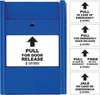
Camden CM-703U Blue Pull Station
The Camden CM-703U is a vandal-resistant blue pull station designed for 30VDC door access control and emergency exit applications. It provides dual-contact switching (one normally closed, one normally open) rated at 1A @ 30VDC, making it suitable for magnetic lock release, solenoid strikes, and alarm panel auxiliary wiring. Wall-mounted in a standard single-gang electrical box with only 3/4" protrusion, the CM-703U minimizes snag hazards and vandalism exposure while delivering reliable mechanical switching for access control integrations, fire-safety circuits, and emergency egress logic.
Key Features
- Dual-Contact Switching: One normally closed (N/C) and one normally open (N/O) contact. Use N/C for fail-safe door release, N/O for alarm triggering or auxiliary signaling, or wire both independently for dual-function scenarios.
- 30VDC Rating: 1A @ 30VDC contact capacity. Compatible with standard magnetic locks, solenoid strikes, and low-voltage access control circuits without additional relays.
- Compact Wall Mount: Single-gang electrical box format with 3/4" wall protrusion. Reduces snag risk and presents minimal vandal target compared to recessed or surface-mount alternatives.
- Vandal-Resistant Construction: Heavy-duty blue pull handle and robust mechanical design. Meets ANSI requirements for emergency exit pull stations in commercial and institutional settings.
- Manual Reset Mechanism: Screwdriver-reset capability allows local reset without panel interaction. Optional local alarm sounder or clear lift cover available as accessories.
- Multilingual Labeling: Supplied with English "Pull for Door Release," English "Pull for Emergency Door Release," and French/English bilingual "Pull in Case of Emergency" labels. Spanish versions available (model suffix -SP).
- 3-Year Manufacturer Warranty: Factory warranty covers defects in material and workmanship under normal operating conditions.
The CM-703U is a passive switching device—it contains no electronics, firmware, or networked logic. It is purely a mechanical activation point that translates human action into electrical contact closure or opening. This simplicity is a strength: there are no configuration steps, no IP address assignments, no firmware updates, and no single points of electronic failure. Wire the contacts directly into your access control panel door-release auxiliary output, your magnetic lock circuit, or your alarm zone input. The N/C and N/O contacts can be wired in series or parallel depending on your circuit topology and fail-safe requirements.
Typical deployment scenarios include stairwell emergency exits, corridor panic stations, and secure door release points in hospitals, schools, government buildings, and commercial offices. The pull station serves as both a manual egress trigger (satisfying fire code emergency exit requirements) and a secondary access control point (tied to alarm or auxiliary relay logic). On fail-safe magnetic lock circuits, the N/C contact ensures the door unlocks immediately when pulled, regardless of panel power or network status. On fail-secure solenoid strikes or electric mortise locks, the N/O contact can trigger an access control panel output to energize the strike, creating a two-step release sequence (pull + authorized credential required) if wired in series with a reader.
Integration is straightforward with any 30VDC access control system: Salto, Medlock, Kaba Gallant, Axis door controllers, or legacy hardwired panels all accept dry contact inputs on auxiliary relay zones or door-release logic cards. The dual-contact configuration provides flexibility for mixed logic: wire the N/C to your magnetic lock release circuit and the N/O to a zone input on your alarm panel, creating simultaneous door unlock + alarm notification on a single pull. For installations requiring both access control and life-safety separation, the two contacts allow you to segregate circuits (one contact on access control, one contact on fire panel) to meet code and insurance requirements. No field programming, ONVIF negotiation, or credential synchronization is required—it is a pure hardware gate.
The CM-703U is commonly paired with Salto systems, Medlock access control panels, and Kaba networked cylinders in medium-security commercial deployments where a hardwired egress option is mandated by code. It is also used as a secondary release point in dual-credential or supervisory-override scenarios: for example, a main push-to-exit button guarded by a card reader on the primary path, with the CM-703U pull station wired to an alarm relay as a manual override for authorized personnel only. Installation takes less than 20 minutes: mount the unit in the prepared single-gang box, terminate the two switch leads into the access control panel or strike circuit, and label according to local fire code and tenant requirements. No external power supply or PoE injector is needed; the pull station draws power only from the control circuit it switches.
The CM-703U is manufactured to North American electrical and mechanical standards and carries a 3-year manufacturer warranty covering defects. It is compliant with applicable ADA egress requirements when paired with suitable force and handle geometry (consult local AHJ and ADA Title III guidance). For integrators standardizing on hardwired emergency exit control or seeking a code-compliant manual override that requires zero software configuration and zero network authentication, the CM-703U is a proven, low-cost solution. Explore additional pull station options and Camden door control hardware in the Camden catalog.
Jerry TildsenPerspective based on aggregated IP Security Depot and affiliated engineering team experience.
We've installed the Camden CM-703U on hundreds of door control projects—hospitals, office parks, government facilities, and schools—and it remains one of the most reliable hardware switching points in the market. The reason is its simplicity: no firmware, no encryption key, no network timeout. You pull the handle, two switch contacts change state, your door unlocks or your alarm sounds. What sets the CM-703U apart from cheaper plastic pull stations is the vandal-resistant construction and the dual-contact design. On many projects, we've seen integrators waste time trying to force a networked push-button (card reader, pushbutton intercom, etc.) to serve as both an access control trigger and a life-safety override. The CM-703U eliminates that design compromise. The N/C contact goes to your fail-safe magnetic lock release line, the N/O contact goes to your alarm panel zone, and you have two independent functions on a single pull. No relay logic, no panel configuration contention. The 30VDC and 1A rating covers 99% of solenoid strikes and magnetic locks in the field; we rarely encounter a circuit that won't accommodate it.
Technical Highlights:
- Dual-Contact Independence: The N/C and N/O contacts are electrically isolated; you can wire them into completely separate circuits without crosstalk or interaction. We've used this to wire the N/C to a fail-safe strike on the primary egress path and the N/O to an alarm zone on a supervised panel—life-safety and security in one unit, no relay logic required.
- 1A @ 30VDC Rating: Covers standard solenoid strikes, magnetic locks, and low-voltage alarm circuits. If your application requires higher current (multiple locks on one contact, for example), a 24VDC or 12VDC relay is required upstream—not unusual, but worth scoping into the wiring budget.
- Passive Switching (No Power Draw): The pull station itself consumes zero power; it is purely mechanical. All power comes from the circuit you are switching. This eliminates PoE dependency, power supply sizing headaches, and infrastructure cost. On remote stairwells or secondary exits where power is scarce, the CM-703U is always viable.
- Single-Gang Wall Mount with Low Protrusion: 3/4" protrusion keeps the unit flush and resistant to shoulder or hip checks. On high-traffic egress routes, this reduces accidental pulls and vandalism attempts. Recessed or surface-mount alternatives are available but add cost and installation complexity.
- Screwdriver Reset (Optional Local Alarm Accessory): The unit includes manual reset capability; if you pair it with the optional local alarm sounder, you have a standalone emergency announcement point that requires no central panel to acknowledge. Useful in large facilities where pull-station activation should generate immediate local awareness.
Deployment Considerations:
- The CM-703U is a switch, not a credential reader or networked access control device. Do not expect API integration, status feedback, or remote monitoring of pull events. If you need to log every pull for audit or forensics, wire the N/O contact to an alarm panel zone that is supervised and reported; the panel logs the event, not the pull station.
- Contact rating is 1A @ 30VDC. Heavy loads (multiple strikes, series-wired locks) may exceed this; use a 24VDC auxiliary relay to isolate the pull station contact from high-current circuits. We've seen field wiring mistakes that burned out switch contacts on underrated circuits—size for the actual load, not the rated maximum.
- Labeling is critical for ADA and fire code compliance. The unit ships with standard English and bilingual labels; verify with your local AHJ whether the label text and pull-station placement meet emergency egress requirements before installation. Non-compliance can trigger citation and retrofit cost.
- The handle color (blue) is standardized for emergency pull stations in North America; do not repaint or obscure it. Some facilities have tried to hide pull stations in a color-matched surround—defeats the purpose and violates egress code.
- Wire terminations are standard screw-down posts (not terminal blocks or RJ45). Use 18-22 AWG wire, strip 1/4", and torque firmly but not excessively; we've seen loose terminations fail intermittently under vibration or thermal cycling on mechanical floors.
The CM-703U is the right choice if you need a hardwired, code-compliant manual emergency exit or access control override that requires zero configuration, zero software support, and 99.99% mechanical uptime. Pair it with a 30VDC access control system, wire it according to your fail-safe or fail-secure logic, and it will serve reliably for 10+ years with no firmware updates or network troubleshooting. Explore more access control hardware and door control options in the Camden catalog.