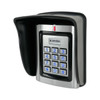
Camden CV-550SPK Standalone Proximity Reader & Keypad
The CV-550SPK is a combined proximity card reader and PIN keypad designed for single-door or distributed access control deployments where eliminating a centralized control panel simplifies wiring and installation. It reads HID 125kHz proximity credentials, supports one relay output for electric strike or door lock control, and stores up to 20,000 user credentials locally. This form factor cuts installation labor at the door — you get both card and keypad authentication without a second mounted device.
Key Features
- Dual authentication (card + PIN): One physical device handles proximity cards and keyboard entry, reducing the number of components you mount and wire at the door frame.
- 20,000 credential capacity: Standalone operation means the reader stores credentials on-board. Suitable for small-to-medium single facilities or individual access points in larger distributed networks.
- One relay output: Controls a door strike or magnetic lock via a single dry-contact relay. Verify relay current and voltage ratings against your lock's requirements — over-specification here is a common installation error.
- OSDP and Wiegand support: OSDP (Open Supervised Device Protocol) is the modern standard for reader communication with access control panels; Wiegand is the legacy fallback. If you're integrating with an existing Wiegand-based system, the CV-550SPK will function; OSDP panels will give you richer command/status feedback and encrypted communication.
- 16VDC operating voltage: Requires a regulated 16VDC power supply on-site. Unlike PoE readers, this means running a dedicated power line to the reader — account for conduit and wire gauge in your install estimate.
- Combination reader/keypad housing: Single enclosure reduces penetrations through the door frame and simplifies weatherproofing on outdoor installations (though you must verify IP rating for your environment — not all proximity readers are rated for rain or dust).
Integration & Compatibility
Deploy the CV-550SPK in retrofit projects where running new control panel wiring is expensive or impossible. It pairs with any access control system that accepts OSDP or Wiegand reader input — that covers most modern panels and distributed reader architectures. In a networked setup, the CV-550SPK can act as a standalone node, reducing dependency on a single control point. Confirm your panel or access control software explicitly supports OSDP or Wiegand input from this reader model before purchasing; don't assume compatibility based on protocol name alone.
For warehouse automation or perimeter gates where a single door or checkpoint needs quick credential-based access without full building integration, the CV-550SPK eliminates unnecessary infrastructure. It is not suitable for high-security multi-door facilities requiring real-time server-side audit trails or immediate credential revocation across multiple readers — in those cases, a networked reader system with centralized management is required.
The CV-550SPK (often searched as CV 550SPK) is a compact, field-proven solution for integrators managing legacy or cost-constrained deployments. Its strength is simplicity; its limitation is that all 20,000 credentials live on the device, so bulk updates or revocation requires physical access to the reader.
Frequently Asked Questions
Q: Does the CV-550SPK require a separate access control panel?
A: No. It is a standalone reader with local credential storage and one relay output. You can wire it directly to a door lock or strike. However, for multi-door sites or systems requiring centralized audit logging, you would typically integrate it with an access control panel via OSDP or Wiegand.
Q: What is the maximum door lock current the relay can switch?
A: The datasheet specifies one relay output, but exact current and voltage ratings must be verified in the full technical documentation. Do not assume the relay can directly drive high-current strikes without checking the spec sheet against your lock's draw.
Q: Can I add more readers to the CV-550SPK for a multi-door installation?
A: The CV-550SPK is designed for single-door use. For multiple doors, deploy additional CV-550SPK units or select a centralized access control panel with multiple reader inputs.
Q: Is the CV-550SPK suitable for outdoor use?
A: It is a standalone reader, but its IP (ingress protection) and IK (impact) ratings must be confirmed against your climate and vandalism risk. Verify the datasheet for environmental specifications before specifying it for an outdoor gate or perimeter access point.
Q: What credential format does it support?
A: The CV-550SPK reads HID 125kHz proximity cards. It does not support higher-frequency (13.56MHz) contactless or mobile credentials — if you need those, confirm with the manufacturer whether a different model in the Camden line offers that capability.
Q: How do I update or revoke credentials?
A: Credentials are stored on the reader itself. Updates or revocation typically requires physical access to the device or a dedicated programming interface — not remote management from a central server. Plan accordingly for high-turnover facilities.
Ted PerryPerspective based on aggregated IP Security Depot and affiliated engineering team experience.
The CV-550SPK is a practical fit for single-door retrofits and distributed access points where you want to avoid the wiring and power overhead of a centralized panel. The combination card reader and keypad in one housing is a genuine labor saver on installation day, and the OSDP/Wiegand dual-protocol support gives you flexibility with both legacy and modern panels.
Technical Highlights:
- 20,000 stored credentials: Adequate for small facilities or individual checkpoints, but understand this is local storage — no cloud sync or remote revocation without physical reader access.
- 16VDC requirement: Plan for a dedicated 24/7 regulated power supply at the reader location. Unlike PoE readers, you cannot pull power from a network switch, so budget for conduit and wire sizing.
- One relay output: Sufficient for a single strike or lock, but verify the relay's current rating against your lock's inrush and holding current. A 12A relay is common, but confirm before spec'ing the unit.
Deployment Considerations:
- This is a single-door device. If your site has three doors, you need three units — make sure your integration plan accommodates parallel reader deployment and doesn't assume a single unit can be multiplexed.
- Credential updates are local to the reader. In a high-turnover environment (retail, warehouse), plan for a manual or semi-manual provisioning workflow — not a centralized revocation broadcast.
Choose the CV-550SPK when you're adding a secure access point to an existing facility without running new control wiring, or when a single-door retrofit site needs both card and PIN authentication in the smallest physical footprint. It's not the right choice if you require real-time credential management across multiple readers or immediate lockdown capability from a central console.