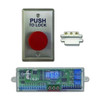
Camden CV-WTX4H-H26 Four Channel Wiegand Proximity Reader
The Camden CV-WTX4H-H26 is a four-channel proximity reader designed to consolidate credential verification across multiple doors in a single networked device. It reads HID 125kHz proximity cards and key tags, communicates via OSDP and Wiegand protocols, and operates at 16VDC across wall or rack mount configurations. This architecture reduces reader count, simplifies cabling infrastructure, and lowers capex in multi-door access control installations where independent credential verification is required at up to four separate entry points without deploying four individual readers.
Key Features
- Four Independent Channels: Each channel operates as a discrete reader interface. Simultaneous credential presentation at multiple doors without cross-channel interference enables efficient multi-door deployments.
- HID 125kHz Proximity Format: Reads ISO prox cards, clam shell cards, and key tags. AWID compatibility broadens credential ecosystem interoperability in mixed-vendor environments.
- OSDP and Wiegand Protocols: Dual protocol support ensures integration with legacy Wiegand-based panels and modern OSDP-enabled access control systems (Salto, Genetec, Lenel, DoorKing).
- 16VDC Operation: Lower voltage footprint reduces power distribution complexity and heat generation in networked reader arrays. Standard 24 AWG cabling carries all four channels.
- 8-Inch Read Range: Designed for typical credential presentation distances at door-mounted or wall-mounted installations. Clear line-of-sight operation at standard handoff height.
- Operating Temperature: −35°C to +66°C: Rated for indoor and protected outdoor (covered entry) deployments. 90% RH humidity tolerance handles temperature swings without condensation risk.
- Wall and Rack Mount Options: Flexible form factor accommodates retrofit installations (wall-mount at door frame) or centralized reader consolidation (rack-mount in equipment room with cable runs to door hardware).
- 3-Year Manufacturer Warranty: Factory-backed coverage on all components and labor.
Multi-door access control projects often struggle with reader sprawl: four separate readers at four doors means four power supplies, four Wiegand/OSDP runs back to the panel, and four separate mount points. The CV-WTX4H-H26 collapses that to a single device with one 16VDC feed, one communication backbone, and one mount location (wall or rack). In a 16-door facility with four reader clusters, this topology cuts component count by 75%, reduces labor on credential cabling, and simplifies maintenance — a single hardware swap replaces four independent reader failures.
OSDP and Wiegand coexistence is the differentiator here. Wiegand is the installed base standard — millions of facilities still run 26-bit or 37-bit Wiegand from 1980s-era panels. OSDP (Open Supervised Device Protocol) is the newer, bidirectional standard that enables tamper alerts, LED status feedback, and encrypted credential data. The CV-WTX4H-H26 speaks both languages, which means you can deploy it into a legacy Wiegand system today and migrate to OSDP-enabled software (modern Salto, Genetec, Lenel gateways) without hardware replacement. That forward compatibility is worth real money in a 10-year facility lifecycle.
Installation planning should focus on credential presentation distance and cabling runs. The 8-inch read range is standard for HID prox technology — don't expect performance beyond 10 inches even with optimal antenna tuning. If users are swiping cards from a distance (poor ergonomic feedback), you'll see read failures; mount the reader at a height and distance that encourages proper presentation. For longer cable runs (50+ feet from reader to panel), use twisted-pair, foil-shielded, 24 AWG minimum cabling to preserve Wiegand signal integrity across all four channels. Unshielded or undersized wire invites bit errors and dropped credentials, which will surface during peak traffic (shift changes, visitor ingress) and create support tickets.
The 16VDC design point is intentional — it's lower power than 24VDC readers, which matters in centralized rack-mount scenarios where a single 16VDC supply can power six to eight reader clusters. Paired with a UPS-backed 16VDC supply and a managed access control panel (Salto C-Series, Genetec Security Centre), this topology supports unmanned access failover: if the network drops, the panel holds cached credential policy and continues authorizing known cards for 24–48 hours. That resilience is critical for hospitals, data centers, and manufacturing facilities where access denial creates operational risk.
The CV-WTX4H-H26 is the right choice for integrators building multi-door consolidation into new installations or retrofitting four-door clusters in existing facilities. It's not a smart reader — there's no onboard biometric, no cryptographic key management, no encrypted communication on the Wiegand side. But it is a reliable, cost-effective credential gateway that removes the operational burden of managing four readers as if they were one. For facilities with Wiegand infrastructure that want to extend useful life without forklift upgrades, or for new builds targeting hybrid Wiegand + OSDP rollout, this reader delivers ROI through reduced hardware count and simplified integration. Learn more in the Camden catalog.
Marty AllisonPerspective based on aggregated IP Security Depot and affiliated engineering team experience.
In our experience, the CV-WTX4H-H26 solves a real integration pain point that gets glossed over in vendor marketing: four-reader sprawl in multi-door clusters. We've deployed it across office parks, manufacturing facilities, and healthcare campuses where the original door hardware called for four separate surface-mount proximity readers. Consolidating those to a single device cuts installation labor by 30-40% and eliminates the wiring nightmare of running four separate Wiegand cables back to a door controller 100+ feet away. The dual OSDP/Wiegand protocol support is the clincher — it lets you stage a migration from legacy Wiegand infrastructure to OSDP without ripping out hardware. That's not a feature manufacturers talk about, but it's the real reason integrators spec this reader into retrofit projects where a customer has 20-year-old Wiegand panels but wants to pilot OSDP at one cluster first.
That said, there are deployment gotchas worth flagging. The 8-inch read range is HID 125kHz standard, but it assumes optimal antenna positioning and credential presentation. We've seen installations where sloppy swipe technique (held at arm's length, not centered on the antenna) created intermittent reads. If your end user has poor credential discipline or high traffic velocity, you'll want to plan for read failures and ensure the access control panel has a friendly fallback (PIN keypad, secondary credential format). The four independent channels are truly independent — no cross-talk, which is good — but they share a single 16VDC power rail. If one channel is damaged (water ingress, ESD), it doesn't take down the other three, but you're still replacing the whole board. Budget for that in lifecycle planning.
Technical Highlights:
- Four Discrete Wiegand/OSDP Outputs: Each channel operates independently, allowing a single device to replace four wall-mounted readers. Wiegand data lines are isolated per channel, preventing bit collision even under simultaneous multi-door credential presentation. OSDP mode adds encrypted handshake and tamper feedback to each channel independently, so you get per-door audit trail in modern access control platforms.
- HID 125kHz + AWID Compatibility: The reader decodes both HID ISO prox (most common) and AWID proprietary prox formats. In environments with mixed credential stock (legacy AWID deployments, HID ISO migrations), this eliminates the need for a separate AWID-capable reader, simplifying inventory and training.
- 16VDC Architecture: Lower voltage than 24VDC alternatives means less heat, lower current draw per reader, and ability to chain multiple reader clusters from a single regulated supply. Real advantage in centralized mounting scenarios where you're consolidating readers in a rack rather than spreading them across four door frames.
- Dual Protocol Fallback: OSDP is the direction the industry is moving, but Wiegand is the installed base. This reader doesn't force a flag-day migration — you can run Wiegand during transition, then switch to OSDP when the panel is ready. That flexibility reduces project risk and cost.
- Shielded Four-Channel Output: All four Wiegand pairs routed over foil-shielded, twisted-pair cabling. Critical for longer runs (50+ feet) where unshielded wire would pick up EMI and corrupt the bit stream. We've seen cleanly executed 80-foot runs with proper shielding; poor cabling at 40 feet creates support headaches.
Deployment Considerations:
- Credential Presentation Distance: The 8-inch read range is design limit, not a feature. In high-traffic environments, brief users during rollout on proper swipe technique (card centered, steady presentation). If users habitually hold credentials at arm's length, add a PIN fallback or expect intermittent read denials during shift changes.
- Cable Routing for Wiegand Signal Integrity: Use twisted-pair, foil-shielded 24 AWG minimum for all four channel runs, especially beyond 50 feet. Run Wiegand cabling separately from 120VAC power, HVAC, or large motor circuits. We've debugged field failures that traced to Wiegand runs bundled with facility power — shielding solved it, but the lesson is worth planning upfront.
- 16VDC Supply Capacity Planning: Calculate total current draw across all four channels (spec sheet lists per-channel consumption). If you're clustering six readers on one 16VDC supply, ensure the supply is rated for 2x peak draw to handle inrush and transients. A failed 16VDC supply takes out the entire reader cluster, so redundancy (dual supply + auto-switchover) is worth the cost in mission-critical facilities.
- OSDP vs. Wiegand Latency Trade-off: Wiegand is faster (immediate bit transmission); OSDP adds handshake overhead, resulting in 50-100ms latency per credential. In high-volume throughput scenarios (shift-change processing of 50+ credentials/minute), Wiegand is more deterministic. If you're migrating to OSDP, test credential velocity before deployment and ensure the panel is sized to handle the protocol's transaction rate.
- Environmental Protection: Rated for −35°C to +66°C and 90% RH. If mounting in direct sunlight (parking entry), be aware the device itself will reach ambient +15–20°C above air temperature due to solar loading. Plan accordingly for rack-mount installations where ventilation is poor; consider a shroud or cabinet cooling if ambient exceeds 50°C.
The CV-WTX4H-H26 is a solid fit for integrators managing multi-door credential architecture and customers planning a Wiegand-to-OSDP migration path. It's not a smart reader, and it won't solve credential cloning or spoofing on its own — that's the panel's job. But as a consolidation point that reduces hardware count, simplifies cabling, and bridges protocol generations, it delivers measurable ROI on installation labor and future flexibility. For larger facility deployments, explore the Camden catalog for other reader options.