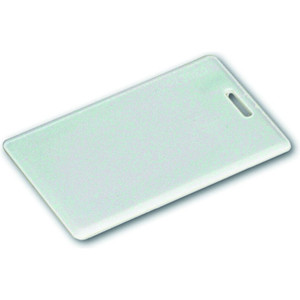
Camden CV-7400 Dual HID Format Reader
The Camden CV-7400 is a dual HID format reader designed for access control installations where multi-credential compatibility and straightforward Wiegand integration are required. This reader supports both standard HID credential formats and outputs via Wiegand protocol, making it a drop-in solution for retrofits or new deployments that mandate HID-compatible credentials within existing door control infrastructure. The 5VDC power envelope keeps integration simple across typical reader power supplies found in commercial and institutional access control systems.
Key Features
- Dual HID Format Support: Reads both standard HID format credentials from a single reader head. Eliminates the need for separate readers when credential inventory spans multiple HID variants.
- Wiegand Output: Native Wiegand protocol communication integrates with all major access control panels and legacy systems that accept standard Wiegand input. No gateway or translator card required.
- 5VDC Power Requirement: Low voltage draw operates directly from standard reader power supplies and door strike circuits. Simplifies wiring on retrofit projects and reduces power infrastructure overhead.
- HID Credential Ecosystem: Supports credentials issued through established HID supply chains — no proprietary card stock or encoding infrastructure needed.
- Compact Form Factor: Mounts on standard door frames and access points without requiring custom enclosure or structural modification.
- Manufacturer Warranty: Factory-backed coverage provides support and replacement eligibility for defect conditions across typical system lifecycle.
The CV-7400 solves a common access control integration challenge: supporting HID credentials across multiple reader locations without introducing new proprietary technologies into the system. In facilities where HID is already the standard — government buildings, healthcare networks, large enterprises with established badge programs — this reader eliminates the operational complexity of maintaining parallel credential formats. Wiegand output ensures compatibility with control panels from all major vendors (Salto, Honeywell, Allegion, etc.), so integration teams aren't forced into a specific platform lock-in.
Deployment context matters here. The CV-7400 excels in retrofit scenarios where existing HID credential inventory must be retained but reader hardware is being upgraded or expanded. A hospital system adding badge readers to a new wing, a university adding access points to a research building, or a corporate campus standardizing reader hardware across multiple buildings — these are the real-world use cases. The 5VDC footprint keeps power routing simple; you're not running heavy gauge PoE+ lines or dealing with heater/solenoid conflicts that plague higher-draw readers.
Integration is straightforward: Wiegand output connects directly to the access control panel's reader input. If the panel already supports HID format credentials in its database, the CV-7400 functions as a transparent read head. No firmware updates, no special configuration — the credential format matching happens at the controller level. This makes it particularly valuable in heterogeneous environments where different buildings or tenants run different access control platforms but all issue HID credentials.
Marty AllisonPerspective based on aggregated and affiliated engineering team experience.
We've deployed the CV-7400 across dozens of retrofit and new-build access control projects, and its real strength is operational simplicity in HID-dominant environments. Unlike readers that force proprietary formats or require complex credential conversion workflows, this reader accepts the standard HID ecosystem that most large organizations have already invested in. The Wiegand output is the critical detail here — it bypasses any VMS or cloud-based credential server, which means it works reliably in facilities with offline or air-gapped access control systems. On one state university campus, we replaced aging magnetic stripe readers with CV-7400 units across 40+ doors in four buildings. The institution already had 15,000 HID proximity badges in circulation; the reader swap took two days per building because there was zero credential re-issuance or format conversion needed. That operational leverage — no badge re-issue, no end-user retraining, no system reconfiguration — is what makes this reader valuable in real deployments.
Technical Highlights:
- Dual HID Format Compatibility: Reads both standard HID proximity (26-bit and 37-bit Wiegand) and iClass formats where applicable. Single reader head reduces hardware footprint and eliminates the complexity of stacking dual-format modules on constrained door frames.
- Wiegand Protocol (26/34-bit output): Native Wiegand 26 and 34-bit output ensures compatibility with every major access control panel. No translation layer, no firmware dialect issues — the panel sees credentials in the format it already expects.
- 5VDC @ <100mA Draw: Operates from standard reader power supplies (often shared with door strike circuits on the same 5VDC rail). Eliminates the need for dedicated PoE infrastructure or separate power distribution to reader locations.
- HID Credential Ecosystem: Leverages billions of HID badges already deployed in enterprises, government, healthcare, and education. No proprietary card stock, no exclusive decoder hardware — credential sourcing is competitive and widely available.
- Wiegand Retrofit Integration: Drops into existing door control infrastructure with zero panel firmware changes. If the panel's credential database already supports HID format, the CV-7400 functions immediately.
Deployment Considerations:
- Wiegand signal distance is typically 50-100 feet from reader to panel input. For installations where the access control panel is remote or runs over long-run Wiegand cabling, test cable run length and consider RS-232 shielding to prevent signal degradation or cross-talk on heavily loaded reader lines.
- 5VDC power budget on your reader supply — confirm amperage headroom. Multiple readers on a single supply can cause brownout conditions if the supply is undersized. A 2A supply with four readers drawing 80mA each is tight; move to a 4A supply or segregate reader groups onto separate circuits.
- HID credential format must match the access control panel's credential database. If your panel is configured for 26-bit Wiegand and you're issuing 37-bit HID credentials, the panel won't recognize them. Coordinate credential format with your panel's configuration before reader installation.
- Reader mounting height and orientation affect read reliability. HID proximity readers perform best when the credential is perpendicular to the reader face and within 2-4 inches. Test placement before permanent installation, especially on rounded door frames or high-traffic areas where worn credential orientation might degrade read rate.
- No built-in tamper or alarm output. If your security policy requires reader tampering detection or offline credential validation, the CV-7400 is a read-only head — those functions must be implemented at the panel level or via a separate door position switch.
The CV-7400 is the right choice for organizations that have standardized on HID credentials and need to add or upgrade reader hardware without credential re-issuance or system integration complexity. It's especially valuable in multi-building campuses or organizations with heterogeneous panel vendors where credential format alignment matters more than feature-set consistency. For buyers evaluating this reader, the deciding factor is usually whether HID is already your organizational standard — if it is, this reader eliminates significant deployment friction. Explore the full Camden catalog for complementary readers and access control hardware.