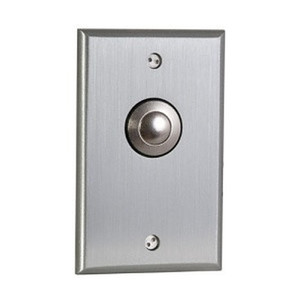
Camden CM-1000/50 Cylinder Lock Ring TCP/IP Access Control
The Camden CM-1000/50 is a surface mount cylinder lock ring designed for networked access control environments requiring TCP/IP integration and 30VDC key-actuated switch control. The unit accepts standard mortise cylinders (1", 1 1/8", 1 1/4" bore) and delivers mechanical key authentication coupled with electronic strike activation—eliminating the need for card readers or biometric hardware in legacy door control architectures. Mounted on walls, poles, or pedestals, the CM-1000/50 bridges mechanical security (keyed entry) with networked management, supporting up to 50 concurrent users across distributed access control platforms.
Key Features
- TCP/IP Network Integration: Connects to networked access control systems for centralized user management and audit logging. Eliminates isolated key-switch silos in multi-site deployments.
- 30VDC Operating Voltage: Low-voltage operation integrates directly with standard door strike modules, electromagnetic locks, and overhead door operators without external relay conditioning.
- 50 Concurrent User Support: Credentials assigned to up to 50 users across distributed authentication architectures—suitable for small to mid-size facility deployments.
- Mortise Cylinder Compatibility: Accepts standard 1", 1 1/8", 1 1/4" mortise cylinders. Key management remains independent of electronic credentials, providing redundant access if networked systems fail.
- Surface Mount Versatility: Mounts flush to walls, pipe columns, or pedestal installations with tamper-proof hardware and no set-screw assembly required.
- Weather-Resistant Housing: 1/4" aluminum die-cast body with heavy-duty rubber gasket sealing. Rated for indoor and outdoor exposure without additional weatherproofing cabinets.
- UL/CSA Certification: Meets code compliance requirements for regulated facilities (healthcare, financial, government). Soldered 18 AWG leads with heat-shrink contact protection ensure reliability in high-humidity and salt-air environments.
- One or Two Switch Configuration: Supports single or dual switch outputs with left and/or right hand operation, allowing flexible relay wiring to match existing strike and door operator circuits.
The CM-1000/50 bridges the gap between analog mechanical security and modern networked access control. In environments where legacy door hardware must remain in service—parking gate operators, warehouse overhead doors, or perimeter pedestrian gates—the TCP/IP integration eliminates manual key management overhead. Facility administrators log access events and revoke credentials centrally rather than physically collecting or rekeying cylinders. The 50-user capacity supports small multi-tenant buildings, retail chains with 5-10 locations, or warehouse networks where a single key profile must be replicated across distributed entry points.
Integration with standard access control platforms (those supporting TCP/IP relay command and user authentication APIs) simplifies commissioning. The electrical interface is straightforward: the switch closure activates a 30VDC output that triggers the door strike or operator. No special drivers or VMS integration required—any system that can command a networked relay can operate the CM-1000/50. In hybrid deployments where some doors use card readers and others retain keyed access for emergency override or offline redundancy, the CM-1000/50 coexists on the same TCP/IP backbone without complexity.
Physical durability is engineered for high-frequency use. The die-cast aluminum housing resists impact and corrosion; the cylinder sits flush against the faceplate with integral locators that prevent lock-picking rotation without cylinders removal. Installation is straightforward: surface mounting requires only anchor holes and four tamper-proof screws; soldered leads connect directly to your existing strike or operator circuit with no terminal block assembly. Gasket sealing handles rain and spray; UL/CSA certification confirms suitability for healthcare, financial, and government facilities requiring third-party validation.
Choose the CM-1000/50 when mechanical key control must integrate with networked access management, legacy door hardware must remain in service, and centralized credential revocation reduces operational friction. It is not a replacement for modern credential readers (card, biometric, PIN); it is a bridge technology for facilities in transition or for emergency override access points that deliberately isolate from network dependencies. Explore the full range of Camden access control hardware to integrate strike modules, electromagnetic locks, and request/exit button assemblies into a cohesive networked installation.
Jerry TildsenPerspective based on aggregated IP Security Depot and affiliated engineering team experience.
We've deployed the CM-1000/50 in retrofit scenarios where existing mechanical key infrastructure must coexist with new TCP/IP access control systems. The real value here is hybrid resilience: a facility with a primary card-based system can assign the keyed cylinder as a secondary access point that remains functional even if the network goes down. We've seen it on emergency exits, rooftop mechanical rooms, and loading dock override stations—places where a single keyed entry point eliminates the cost of a separate UPS-backed electronic strike or the friction of manual key exchange. The TCP/IP integration is straightforward but not invisible; it requires an access control platform that supports networked relay commands and user authentication APIs. If you're using a legacy DVR-based access system without API support, this product becomes a stand-alone keyed switch with no network logging—which is fine for some deployments, but defeats the centralized management benefit. The 50-user capacity works well for small multi-site rollouts (5-10 locations) or departmental access in larger facilities, but scales poorly beyond that without duplicate key management overhead.
Technical Highlights:
- TCP/IP Network Command + Mechanical Redundancy: Centralized credential revocation over TCP/IP, but key-based access survives network outages. We've seen this eliminate the need for expensive dual-strike UPS systems in cost-sensitive deployments. The trade-off: key distribution and revocation still require physical action (changing cylinders or rekeying) if a keyholder leaves the organization.
- 30VDC Low-Voltage Output: Direct integration with standard door operators, electromagnetic locks, and electric strikes—no external relay or voltage step-down required. Most overhead door operators and mag-lock systems run 12VDC or 24VDC natively, so you may still need a power supply unless your strike rail is already 30VDC. Verify your existing strike voltage before ordering to avoid unexpected wiring changes on-site.
- Mortise Cylinder Acceptance: Standard 1", 1 1/8", 1 1/4" bores mean you can source cylinders from any commercial locksmith—no proprietary locks. This is intentional design; it keeps keying costs low and allows end-users to upgrade or replace cylinders independently of the electronic infrastructure.
- Surface Mount Only: Unlike mortise-frame installations that hide wiring in the door frame, surface mounting is visible and exposes 18 AWG leads. In high-security or aesthetically sensitive environments (corporate lobbies, healthcare), surface-mounted switches can look industrial and out of place. Plan cabinet or concealment accordingly.
- 50 User Credential Limit: The platform supports 50 concurrent users, which is adequate for small deployments but becomes a bottleneck if you're rolling out across a 50+ location chain. If you're managing more than 10 sites with 5+ users each, you'll outgrow this product quickly and should evaluate credential-based readers (card or PIN pads) instead.
Deployment Considerations:
- TCP/IP integration requires an access control platform with networked relay support and user authentication APIs. If your current system is standalone or DVR-based, the CM-1000/50 becomes a keyed switch with no network logging—verify platform compatibility before specifying.
- Cylinder sourcing and rekeying are manual processes. Unlike credential-based systems where you deactivate a card in software, removing a user's access to a keyed cylinder requires physical key collection or cylinder replacement. Build this into your operational procedures and budget for locksmith labor in high-turnover environments.
- Weather sealing is good for covered overhangs and light spray, but prolonged salt-air or coastal UV exposure can degrade the aluminum housing over 3-5 years. If installing near salt water, specify stainless steel hardware upgrades and plan for periodic maintenance.
- The switch is rated for left and/or right hand operation. Confirm your installation orientation (key entry from left or right) during design phase to avoid on-site modification or rekeying after installation.
- 30VDC output assumes your strike or motor circuit is already 30VDC. If you're integrating with 12VDC or 24VDC hardware, you'll need a separate power supply or voltage step-down—this adds cost and complexity. Verify voltage compatibility with your existing door hardware before procurement.
The CM-1000/50 is the right choice for facility managers balancing legacy mechanical security with modern networked management—retrofit projects where keyed access must remain available for emergency override, or small multi-site deployments where credential readers aren't justified economically. It's not a modern primary access reader; it's a bridge technology for hybrid resilience. Explore the full Camden catalog for strike modules, electromagnetic locks, and networked hardware to build out a complete installation.