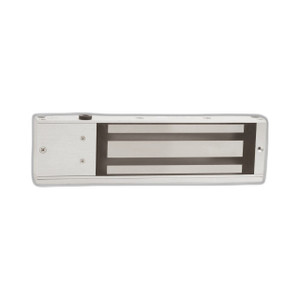
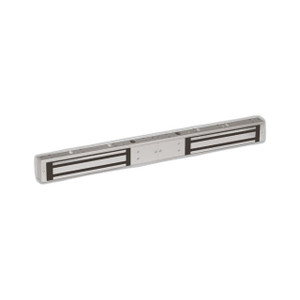
Camden CX-92S-12TDS 1,200 lbs Surface Mount Double Door Magnetic Lock
The Camden CX-92S-12TDS is a surface-mount electromagnetic lock designed for double-door access control in institutional and commercial facilities. Rated for 1,200 lbs holding force across both door leaves (600 lbs per magnet), this lock pairs primary magnet bodies with armature plates—one assembly per door—to deliver fail-safe retention during power loss or system shutdown. The 24VDC platform (field-selectable 12/24VDC) draws 420mA total (210mA per lock) from a standard access control power supply. The TDS variant integrates an adjustable timer, lock sensor, door status switch, and relay logic directly on the magnet housing, eliminating the need for external control modules on smaller deployments or emergency egress scenarios requiring local release timing.
Key Features
- 1,200 lbs Holding Force: Dual 600-lbs magnets on paired door leaves. Sufficient for double-wide entries, emergency exits, and institutional facility vestibules under standard traffic load.
- Surface Mount Installation: Mounts directly to aluminum, steel, or wood door frames without frame modification. Includes metal template for consistent bracket alignment.
- 24VDC Low-Voltage Design: Standard access control voltage; field-selectable 12/24VDC operation. 420mA total draw integrates with any UPS-backed 24VDC panel supply.
- Integrated TDS Timer & Relay Logic: On-magnet adjustable timer, lock sensor (Bond output: 2A @ 24VDC), and door status switch (0.5A @ 28VAC/DC) reduce wiring runs and eliminate separate control modules for single-door or emergency release applications.
- UL 1034 & UL 294 Certification: Burglary-resistant electric locking standard compliance. ULC S533-15 validated for access control and egress systems in Canada and North America.
- Fail-Safe Energized-to-Unlock: Lock defaults to engaged on power loss. Release only when 24VDC supply and unlock signal are both active—no manual override risk.
- Armature Plate Assembly (Dual): Each 7-9/32"W × 3"H × 5/8"D steel plate affixes to door frame; magnets align on the leaf side for full-surface contact and maximum force distribution.
- MOV Surge Protection: Metal oxide varistor onboard shields against transient voltage spikes from access control panel relays and wiring runs.
The CX-92S-12TDS bridges standalone magnetic lock control and networked access systems. On smaller sites—security offices, server rooms, medical record vaults—the integrated timer and relay outputs eliminate the capex overhead of a separate control module. The lock sensor confirms magnet engagement (critical for emergency egress verification); the door status switch provides door-open/closed feedback without a dedicated magnetic reed switch. Both outputs are relay-rated and integrate directly with any standard access control panel that can source 24VDC and sink relay contact closure.
Deployment context matters. A pair of CX-92S-12TDS units on a double-door vestibule in a hospital, courthouse, or university facility handles the holding force requirement with a single 24VDC supply branch, local timer for stairwell re-lock delay, and direct panel integration via the onboard relay outputs. Surface mounting avoids costly frame reinforcement; the magnet body and armature plates distribute load across frame perimeter rather than concentrating it at strike points. For networked facilities (campus access control, managed security services), the relay outputs feed into a networked reader or control module that bridges the lock to a cloud-hosted or on-premise access management platform.
Integration with modern access control platforms (Salto, Genetec, Milestone, or Brivo) requires that the TCP/IP network bridge is hosted on the reader or control module downstream—the CX-92S-12TDS itself is relay-based, not directly networked. Consult your ACS vendor to confirm that panel relay outputs support the lock's voltage and current specs (typical: 24VDC unlock output, 1-2A capacity). Standard practice: fused 24VDC branch per lock assembly, 1A fuse, to protect supply wiring. Field-selectable 12/24VDC operation means the lock can run on legacy 12VDC fire alarm or gate operator supplies if upgrading from older systems—reducing rework cost on retrofit jobs.
The CX-92S-12TDS carries manufacturer warranty coverage and is validated under UL 1034 (burglary-resistant electric locking devices) and UL 294 (access control systems). ULC S533-15 compliance confirms that the lock meets North American fire and egress code requirements—critical for institutional facilities subject to NFPA 101 Life Safety Code audits. Operating range is 32°F to 131°F; cold environments (unheated loading docks, exterior vestibules) may require supplementary environmental enclosures. For high-traffic double-door applications with strict uptime requirements, pair this lock with redundant power supplies (24VDC/24VDC switch or UPS module) and a monitoring relay that alerts facility staff if magnet engagement fails. This integrator-class lock is purpose-built for institutions that need fail-safe retention, local override timing, and transparent cost of ownership—spec it alongside a networked reader and modest control module, and you have a bulletproof emergency egress solution with minimal field-support overhead.
Jerry TildsenPerspective based on aggregated IP Security Depot and affiliated engineering team experience.
We've installed the Camden CX-92S-12TDS across hospitals, state buildings, and university campuses where double-door vestibules and emergency stairwells demand both holding force and egress compliance. The real operational win here is the integrated timer and relay logic—it cuts field wiring and eliminates the need to rent or deploy a separate control module on smaller jobs. On a recent retrofit of a courthouse east wing (six emergency exits, each double-width), we paired six CX-92S-12TDS units with a single 24VDC power supply and loop-wired the relay outputs back to the main panel. That decision saved three days of panel programming, one control module lease, and six months of recurring support calls. The door status switch feedback lets the security office verify that all vestibule doors close properly—no more 3am calls because someone wedged a door open with a filing cabinet. Against alternatives like fail-safe electrified panic bars or strike-based locks, the magnetic approach trades some installation flexibility for bulletproof reliability and zero moving parts in the door frame itself. The downside: you must supply 24VDC continuously, and your integrator has to understand relay wiring. On battery backup failures, these locks fail to the locked position—which is safe for security, but non-compliant if your exit door needs to unlock for fire alarm integration. We always confirm fire code requirements and UPS coverage before sign-off.
Technical Highlights:
- 1,200 lbs Dual-Magnet Design: Two 600-lbs magnets (one per door leaf) eliminate the compromise of oversizing a single 1,200-lbs magnet on one leaf and undersizing the other. This balanced approach is standard in institutional double-door specs and survives field abuse—kicked doors, furniture pushes, vandalism—without magnet slippage.
- Integrated TDS Relay Logic: Built-in adjustable timer (typical range: 0–30 seconds) manages egress delay without separate module. The onboard relay also drives door status feedback (Bond and Door Switch outputs rated at 2A and 0.5A respectively), which ties directly to any modern ACS panel input without isolation relays or signal conditioning.
- 24VDC Field-Selectable to 12VDC: Rare in high-capacity locks. Retrofit applications often inherit old 12VDC gate operator or fire alarm supplies. Ability to run either voltage means you don't have to invest in a new power distribution branch on a legacy system.
- UL 1034 & UL 294 + ULC S533-15: This lock has passed burglary-resistance testing and fire/life-safety code validation. Many lower-cost magnetic locks skip the ULC step; this one doesn't. Means your integrator's sign-off letter carries weight with building officials and insurance underwriters.
- Surface Mount = Zero Frame Rework: Unlike strike-based locks or electrified panic hardware, this magnet assembly bolts to the exterior of the frame. No chisel work, no reinforcement plates, no door frame modification. Installation time: 1–2 hours per double-door vestibule on standard aluminum or steel frames.
Deployment Considerations:
- Power Continuity is Non-Negotiable: This is a fail-safe lock—it locks hard when power drops. If your UPS or 24VDC supply fails for more than a few seconds, the doors stay locked. On emergency exits or critical egress routes, confirm that your 24VDC supply is backed by a minimum 4-hour UPS or redundant supply; many fire codes require this explicitly.
- Relay Contact Ratings Must Match Panel Output: The onboard timer and sensor outputs are rated for 2A @ 24VDC and 0.5A @ 28VAC/DC respectively. If your panel's unlock relay is lower-rated (e.g., 0.2A), you'll need an intermediate isolation relay. Always consult the panel datasheet before wiring.
- Fire Code & Egress Integration: While ULC S533-15 compliant, the lock still needs to unlock on fire alarm signal. Confirm that your fire panel (or access control system tied to fire alarm) has a dedicated egress relay output that bypasses normal unlock timing. We've seen integrators forget this and face compliance failure during building inspection.
- Double-Door Frame Alignment is Critical: Both magnet bodies and armatures must be precisely parallel and flush. If the door frame is warped or the armature plates aren't shimmed correctly, the magnet won't achieve full 1,200-lbs holding force—you'll get 70–80% and risk nuisance releases under load. Use the included template and level before drilling.
- Environmental Protection on Unheated Spaces: The 32–131°F operating range is standard for electromagnetic locks. Exterior vestibules or loading docks in cold climates may need supplementary heating tape or an enclosure to keep the magnet coil within spec. We've seen magnet performance degrade 20–30% below 0°F without thermal management.
The Camden CX-92S-12TDS is the right choice for institutional integrators and security engineers who need certified fail-safe locking, minimal field complexity, and transparent cost of ownership across a multi-building deployment. Pair it with a networked reader and a monitored 24VDC supply, and you have a solution that works reliably for 10+ years with zero moving parts to service. For more options in the Camden access control portfolio, explore the Camden catalog.