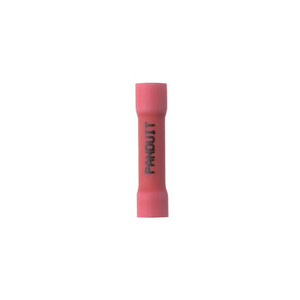
Panduit BSN14-M Nylon-Insulated Butt Splice Connector, 16-14 AWG
Overview
The Panduit BSN14-M is a nylon-insulated butt splice connector engineered for 16-14 AWG (1.5–2.5 mm²) copper conductors. At 1.15 inches overall length and a compact 0.2-inch width, it's sized precisely for dense terminal blocks, control panels, and field wiring runs where space is at a premium. If you're terminating 16 or 14 AWG wire in a security enclosure, building automation panel, or access control installation and need a connector that meets both UL and CSA listing requirements, the BSN14-M (often searched as BSN14 M) is the straightforward answer. Its blue color code instantly identifies 16-14 AWG gauge on the bench or in the field — no second-guessing conductor sizing during inspection or troubleshooting.
Panduit has built the BSN14-M to satisfy demanding commercial and industrial environments: a 600V maximum voltage rating gives you headroom well beyond typical low-voltage control circuits, and the 150°C UL and CSA temperature ratings mean this connector handles elevated operating conditions without degrading — relevant in tight enclosures or near heat-generating equipment. Explore the broader Panduit wiring accessories catalog for compatible ferrules, terminals, and cable management.
Key Features
- 16-14 AWG Conductor Range (1.5–2.5 mm²): Covers the two most common control-wiring gauges in security and building systems — one part number handles both, reducing your stock SKU count and the risk of grabbing the wrong splice in the field.
- 600V Maximum Voltage Rating: Rated well above the 24V–120V circuits typical in access control, alarm panels, and IP camera PoE homerun splices — giving you a substantial safety margin and making this connector broadly applicable across low- and mid-voltage control wiring.
- 150°C Temperature Rating (UL and CSA): Both the UL and CSA listings confirm 150°C rated performance. In enclosed equipment cabinets where heat builds, lower-rated splices soften and fail; at 150°C this connector maintains its mechanical and dielectric integrity where cheaper alternatives won't.
- Nylon Insulation: Nylon outperforms PVC in abrasion resistance and retains flexibility at low temperatures — an advantage when routing wire bundles in outdoor or unheated enclosures. It also resists common solvents and oils encountered in industrial and warehouse environments.
- Tin-Plated Copper Contact: Tin plating on the copper barrel resists oxidation over the connector's service life, maintaining stable contact resistance — important in low-current signal circuits where a corroded joint means a nuisance alarm or intermittent access credential failure.
- 9/32-Inch Strip Length: The specified 9/32 in. strip length removes guesswork from wire prep. Match it exactly and the conductor seats fully in the barrel — under-strip leaves wire outside the crimp zone, over-strip exposes bare copper past the insulation mouth.
- UL 486C and CSA C22.2 No.65 Listed: Both listings are inspector-recognized standards for wire connectors — UL 486C covers splicing wire connectors, CSA C22.2 No.65 covers the Canadian equivalent. Projects requiring code compliance in the US or Canada clear both authority-having-jurisdiction checkpoints with this part.
- Blue Color Code: Industry-standard blue identifies 16-14 AWG range at a glance. During inspection, troubleshooting, or a midnight service call, color coding is the fastest way to confirm you're working on the right conductors.
- Compact 1.15 × 0.2-Inch Footprint: Fits in densely wired enclosures without forcing a larger wire-way. When you're routing 20 homerun conductors through a 4-inch square junction box, every millimeter counts.
Integration and Compatibility
The BSN14-M is compatible with any standard ratchet or non-ratchet crimp tool sized for insulated butt splices in the 16-14 AWG range — Panduit's own crimp tool line or equivalent tools from other manufacturers with the correct die set. The tin-plated copper barrel accepts stranded or solid copper conductors within the 16-14 AWG range; do not use with aluminum conductors unless the connector is specifically rated for aluminum (the BSN14-M is copper-rated). This splice is appropriate for commercial wire management applications including security camera home-run extensions, alarm loop continuations, access control reader wiring, and general control panel wiring. For larger conductor sizes (12-10 AWG or 22-18 AWG), Panduit's butt splice family includes adjacent part numbers — match the color code to the conductor gauge to maintain code compliance and mechanical integrity. Pair with Panduit wire connectors and terminals for a single-source termination solution across your panel build. If your project also requires cable management and labeling solutions, Panduit's broader line integrates cleanly with the same tool ecosystem.
Frequently Asked Questions
Q: What wire gauges does the BSN14-M accept?
A: The BSN14-M is rated for 16-14 AWG conductors, corresponding to 1.5–2.5 mm² in metric sizing. Both gauges are accepted in the same connector.
Q: What certifications does the BSN14-M carry?
A: The BSN14-M meets UL 486C (wire splicing connectors) and CSA C22.2 No.65 standards. Both are recognized by electrical inspection authorities in the US and Canada respectively.
Q: What is the maximum voltage and temperature rating for this connector?
A: The BSN14-M is rated for a maximum of 600V. Both the UL and CSA temperature ratings are 150°C, making it suitable for elevated-temperature enclosure environments.
Q: Can the BSN14-M be used with aluminum conductors?
A: No. The BSN14-M uses a tin-plated copper barrel and is rated for copper conductors only. For aluminum-to-copper or aluminum-to-aluminum splices, a connector specifically listed for aluminum use is required.
Q: How much insulation should I strip before crimping?
A: Panduit specifies a 9/32-inch (approximately 7mm) wire strip length for the BSN14-M. Strip each conductor end to this length before inserting into the barrel to ensure the conductor seats fully within the crimp zone.
Q: What crimp tool is required for the BSN14-M?
A: The BSN14-M requires a crimp tool with a die set appropriate for nylon-insulated butt splices in the 16-14 AWG range. Panduit offers compatible crimp tools in their hand tool line; third-party tools with matching die geometry for insulated splices in this gauge range are also suitable.
The BSN14-M is one of those parts that integrators keep in their bag because it works without drama — a 600V, 150°C-rated nylon butt splice for 16-14 AWG copper that clears both UL 486C and CSA C22.2 No.65. I reach for this part specifically when I need dual-standard listing on a single connector: US and Canadian projects both close without sourcing a separate CSA-only part.
Technical Highlights:
- 150°C Dual Temperature Rating: UL and CSA both confirm 150°C — at that threshold you can route this splice inside a packed enclosure next to a transformer or driver without worrying about insulation creep that causes shorts months after commissioning.
- Tin-Plated Copper Barrel: Tin plating resists oxidation on the contact surface, which matters in low-current signal circuits like alarm loops and reader data lines where a corroded barrel connection reads as a fault rather than a bad device.
- 9/32-Inch Strip Depth: A defined strip length isn't a trivial spec — it's what ensures the conductor bottoms in the barrel crimp zone consistently. Variations of even 1/16 inch in strip depth are the most common cause of a crimp that passes pull test on day one and fails under vibration six months later.
Deployment Considerations:
- Confirm your crimp tool die is sized for nylon-insulated splices in the 16-14 AWG range — a die sized for uninsulated or vinyl splices will either crack the nylon shell or leave an under-crimped barrel. The 9/32-inch strip depth is only useful if the crimp engages the full barrel.
- The BSN14-M is copper-rated only. If you encounter aluminum branch circuit conductors in a retrofit access control or camera installation (common in older commercial buildings), do not use this splice — you need a connector with a listed aluminum or Al/Cu rating to avoid galvanic corrosion at the joint.
For commercial security and building automation installations where inspectors expect both UL and CSA documentation on termination hardware — particularly mixed US/Canada campus projects or tenant buildouts with Canadian AHJ oversight — the BSN14-M eliminates the need to carry two different splice part numbers for the 16-14 AWG range.